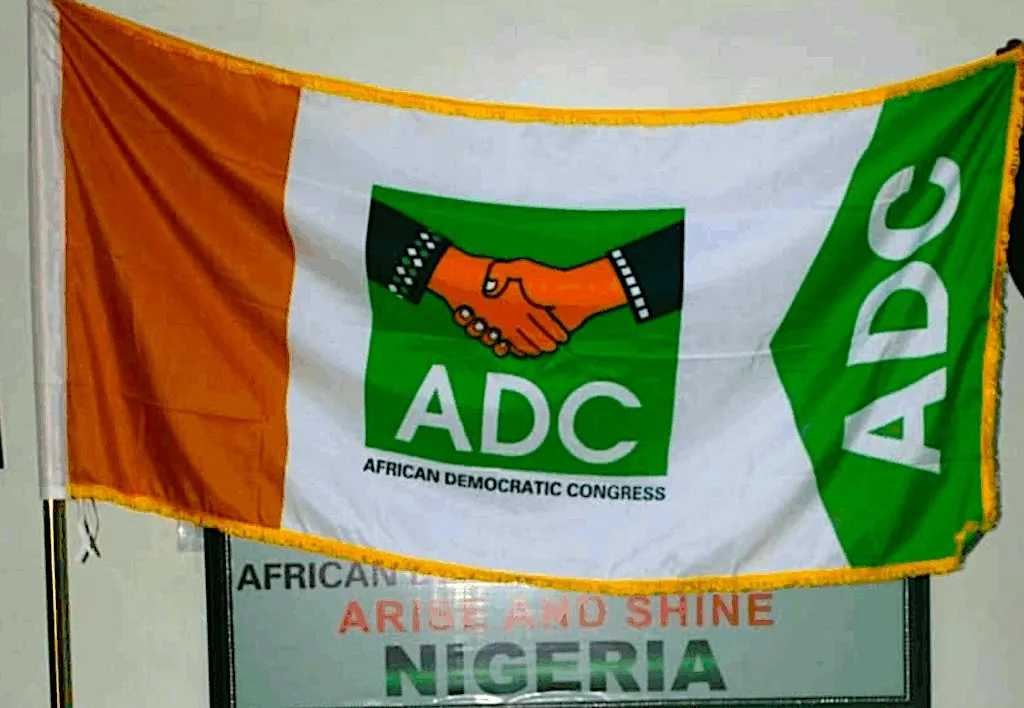
The African Democratic Congress, or ADC, is having a difficult time as political activities in the run-up to the general elections in 2027 progressively pick up steam.
The ADC is facing both internal and external challenges after being hailed by some political analysts as a possible rallying point for disgruntled blocs.
The road to 2027 seems to be becoming steeper from electoral disappointment and arrests.
setbacks in the FCT election
According to reports, structural flaws in the ADC’s political apparatus were made clear during the recent FCT area council elections. The party was unable to convert its prominence into electoral successes in important councils, despite loud campaigns and prominent media involvement.
According to reports, the FCT failure could be an early warning sign for a party looking to center a larger opposition movement.
Despite its efforts to establish itself as a viable rival to the ruling parties, analysts think that the ADC’s grassroots campaigns were unsuccessful.
The ADC has the chance to assess its preparedness for 2027 through the FCT council elections, according to some political observers.
Its organizational depth, voter penetration, and coalition-building ability were questioned in light of the results, nevertheless.
Veteran journalist and former presidential adviser Dr. Reuben Abati made comments regarding the Federal Capital Territory (FCT) elections, stating that the ADC was unable to convert its campaign efforts into electoral success in the FCT area council elections.
During his appearance on Arise Television’s Morning Show on Monday, Abati made the statements.
He noted that political parties need to start reevaluating their tactics in preparation for upcoming elections, saying that the results of the Abuja elections demonstrated that the contests had been mostly determined.
“We simply hope that everyone involved, including the ADC, which held events in Abuja but received nothing, will take note of this and plan accordingly.
“We cannot say what that will imply in the future,” Abati stated.
Additionally, it was reported that Chidi Odinkalu, the former chairman of the National Human Rights Commission, criticized opposition political parties and leaders for how they handled the FCT elections, calling them disorganized and ineffectual.
During a Monday appearance on Channels Television’s Politics Today, Odinkalu claimed that the opposition had not shown leadership at a crucial juncture.
The opposition is “an utter disgrace,” according to Odinkalu, who also said that the current political atmosphere shows that the parties who are supposed to act as checks on the ruling administration are not taking their responsibility seriously.
Speaking on the incompetence of Nigeria’s political opposition is challenging. They’re not being serious.
“And I think anybody who looks at the system has to say that there isn’t any opposition at all right now,” Odinkalu stated.
El-Rufai’s imprisonment by the DSS, EFCC, and ICPC
The arrest and detention of former Kaduna State Governor Nasir El-Rufai by anti-corruption and security agencies, such as the Department of State Services (DSS), the Economic and Financial Crimes Commission (EFCC), and the Independent Corrupt Practices Commission (ICPC), last week heightened the political atmosphere in the nation.
Opposition voices have characterized the action as politically tinged, despite the ruling All Progressives Congress’s insistence that such measures are a part of ongoing investigations and institutional responsibilities.
The timing, according to some advocates, is problematic, particularly if alignments and realignments get more intense before 2027.
El-Rufai is seen by many as one of the important ADC leaders who can put pressure on President Bola Tinubu’s reelection, despite the fact that he is extremely controversial.
The party has now become uneasy over his arrest.According to reports, former vice president Atiku Abubakar issued a warning on Tuesday that Nasir El-Rufai’s family, friends, and acquaintances had serious concerns about his health and well-being.
According to reports, El-Rufai bled through the nose over the weekend, prompting Atiku to issue a warning to the administration.
Atiku, however, stated that Nigerians should receive information from the Federal Government in a statement released through X on Tuesday.
Atiku asserts that “the government has a constitutional duty to guarantee El-Rufai’s safety, dignity, access to medical care, and access to his attorney and family.”
It is quite concerning and unethical in a democracy that he reportedly had a nosebleed while family members were supposedly denied access.
“Granting him release right now is the legal and compassionate course of action if the authorities are unable to ensure his health and fundamental rights. This administration will be held responsible if El-Rufai suffers any losses.
In the meantime, it was noted that the EFCC had also apprehended and arrested Abubakar Malami, a chieftain of the ADC and former Attorney General of the Federation, AGF, a few weeks prior.
Political campaign ads cost the Enugu government N150 million.
The Enugu State Structures for Signage and Advertisement Agency (ENSSAA) on Monday imposed a necessary N150 million permission fee for political campaign advertising ahead of the 2026 and 2027 elections, a move that has sparked intense debate.
The administration of Governor Peter Mbah instituted the policy, which has been justified as a regulatory tool meant to uphold law and order and guarantee adherence to state advertising regulations.
Opposition parties, on the other hand, contend that the charge is excessive and unfairly impacts smaller parties, such as the ADC.
The ADC’s Enugu State chapter reportedly objected to the required payment.
Campaign advertisement permit fees are illegal, unconstitutional, and undemocratic, according to the party.
The ADC claimed that the charge was created by the ruling APC in Enugu State to prevent opposition parties from running in the upcoming elections.
The opposition party said in a press release signed by Paul Anigbogu on behalf of the Enugu ADC Media Team that the state administration was attempting to usurp the federal government’s authority by enforcing the “illegal” advertising permission charge, which is completely against the Nigerian Constitution.
“If the state government does not remove the unlawful and unconstitutional financial barricade put in the way of political parties and candidates running for local government and general elections in Enugu State, we completely reject this fee and will not hesitate to challenge it in court,” the statement said.
A purported attempt on Peter Obi’s life
With news of a purported murder attempt on former presidential candidate Mr. Peter Obi, tensions increased even more on Tuesday.
From Abuja, the Obidient Movement Worldwide’s National Coordinator, Dr. Yunusa Tanko, confirmed the attack in a statement.
According to Tanko, the event happened soon after Olumide Akpata, a distinguished lawyer, formally declared himself an ADC member.
He claimed that armed men followed the group straight from the ADC Secretariat to Chief Odigie-Oyegun’s private home, where they opened fire on the gate and a number of cars that were parked inside.
“In Benin, Edo State, Peter Obi and the ADC leadership are being besieged and attacked.”
In what seems to have been a successful assault on our life, they fired at the gate and wrecked multiple cars. “There is a threat to democracy,” Tanko wrote.
Many of the party’s followers turned to social media shortly after the incident was made public, calling the development alarming and indicative of growing political animosity.
Obi, who is currently in the ADC, was the Labour Party’s 2023 presidential candidate. According to reports, he is still one of the most recognizable faces of the movement opposing the current government because of his impressive election performance and the legal battle that followed.
newly signed Electoral Act of 2026
The recently enacted 2026 Electoral Act, which established both manual and electronic transmission of election results, adds another level of complexity to the unfolding drama.
The provision in the statute allowing for the manual transmission of election results, according to opposition figures, may unintentionally encourage result manipulation and tampering.
Bolaji Abdullahi, the party’s National Publicity Secretary, signed a statement released on Thursday that called the President’s acceptance of the amendment a blow to the nation’s ability to hold legitimate elections.
The opposition party cautioned that the change might erode public trust in upcoming elections because it creates uncertainty and gives considerable discretion in the compilation and dissemination of election results.
The ADC also voiced concern that residents may feel pressured to stay at polling places in order to protect their ballots, which might increase tension during elections if there are no clear guarantees for technological transparency.
“In response to President Bola Tinubu’s actions on Wednesday, February 18, the ADC, as a duly constituted political party in the Federal Republic of Nigeria, affirms in the strongest and clearest terms possible that we are ready, willing, and prepared to defend the sanctity of Nigeria’s democracy using every constitutional and lawful means available to us.
In defense of their constitutional rights, the party declared, “We will mobilize Nigerians toward vigilance, toward lawful participation, and toward unity.”
Analyst: Nigeria doesn’t have a coordinated opposition
According to Nduka Odo, a public affairs analyst and communication specialist at Peaceland University in Enugu, Nigeria does not yet have a cohesive and organized opposition that can take on the ruling APC before the next elections in 2027.
In an interview on Tuesday, Odo made the claim, claiming that the nation’s current political events had confirmed his prior claim that there was no strong opposition.
Since effective opposition involves power, momentum, and coordination, he argues that isolated voices cannot be characterized as political opposition.
He characterized the ADC as a “sketch” of what an opposition party ought to be, citing the party’s results in the most recent Abuja elections as proof that it had not yet proven itself to be a viable substitute.
Odo stated that the results of the polls in Abuja should act as a warning to the ADC to restructure before 2027.
The party’s reaction to the controversial electoral act amendment bill’s passage was also criticized by the analyst, who claimed that the ADC did not take any significant action.
Odo accused the ruling party of trying to rig the 2027 elections, saying that if the APC had been in opposition, it would have raised the issue with international media outlets like CNN and the BBC and organized rallies at the National Assembly.
He went on to say that the ADC’s leaders don’t seem to be united or truly devoted to creating a powerful opposition platform, and that the group appears to be split and lacking in internal coherence.
“What I’ve said somewhere else has been proven by recent activities in the country,” Odo stated. Currently, Nigeria has no opposition.
“Political opposition does not consist of lone voices.” Today, people like Peter Obi are that. An opposition requires coordination, velocity, and power.
“At the moment, ADC is merely a sketch of what an opposition ought to be.” In the most recent elections in Abuja, this was evident. ADC received an early notice to complete its actions before 2027.
When parliamentarians enacted the blatantly contentious election act change, the ADC accomplished nothing of value, which indicates that the party still has a ways to go. The deputy speaker, Benjamin Kalu, ignored the house members who shouted for order, and we all observed what he did.
The lawmakers were curious about the contents of the measure, but he persisted. Had APC been in the opposition, they would have surrounded the House of Representatives.
“They would continue to demonstrate against the electoral act’s passage.” They would be explaining how the ruling party has developed a way to rig the 2027 election on CNN and the BBC.
ADC, however, isn’t accomplishing any of stuff. ADC doesn’t seem to have truly come together as a single entity. They don’t seem to have a consensus yet. There appears to be a lack of trust among the leaders. It appears that they are all in and out of sync.
“And APC recognizes this. I previously said that the PDP will not survive until after the 2027 election. Almost finished. My only surprise is that LP didn’t really make it through the Lamidi Apapa scourge.
It appears that ADC will face a similar plague. And I observed that the ruling party had a hand in LP’s illness. Their fingers are visible in the jaundiced stand of ADC as well.
“Our fledgling democracy is at risk from the ruling party’s ongoing suppression of the opposition, regardless of the method. It is not possible to force all elected officials to join the ruling party.
It is ridiculous and anti-democratic for members of the legislature, the main branch of government tasked with restraining the executive branch’s excesses, to sing the president’s sycophantic anthem on the legislative floor instead of the national anthem.
The objective of oppositionism transcends the pursuit of power. To restore rationality to Nigerian governance, we need organized opposition.