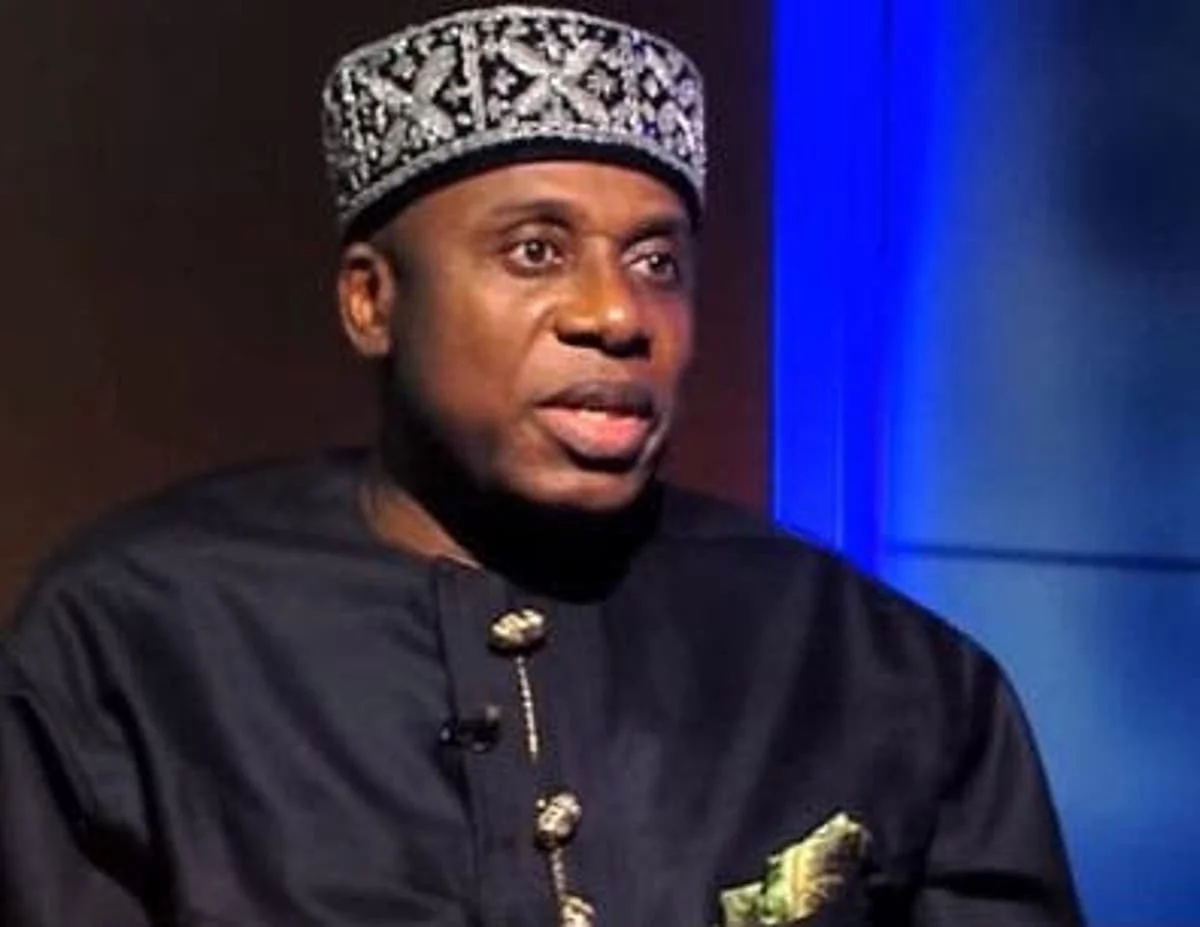
Rotimi Amaechi, a former governor of Rivers State and leader of the African Democratic Congress, an opposition alliance, has called on Nigerians to get ready to cast large ballots in 2027 in order to guarantee President Bola Tinubu’s loss.
Amaechi, who announced in August that he would like to run for president in 2027, said that Tinubu’s defeat in Lagos State in 2023 demonstrated that he is not unbeatable.
Amaechi and Seriake Dickson, a former governor of Bayelsa State, gave speeches at the First Daily newspaper’s fifth anniversary lecture on Monday in Abuja.
The event’s topic was, “2027: How can we make our votes count?”
In his message of goodwill, Amaechi warned that complacency and voter apathy allow electoral malpractice to flourish and urged Nigerians to vote in the upcoming elections to stop President Tinubu from winning a second term.
He declared, “The government is not the first step toward electoral reform.” The fault lies with the people. The more you claim that the outcomes were scripted, the more apathetic voters you are. Apathy among voters will force President Bola Tinubu to return to Villa.
“Tell the people the power is in your hands,” Amaechi said, urging residents to take charge of the proceedings. Come on out. How was Tinubu defeated in Lagos if he is so unbeatable?
It may be repeated, but you have to acknowledge that the man there is not unbeatable. It is the opposition that is a problem.
He continued by saying that it is impossible to expect an elected administration to implement election reform.
The issue with elections in Nigeria is that there isn’t a current administration capable of implementing electoral reform. None. We tried it before and didn’t succeed,” he stated.
Vested interests among the political class, according to Amaechi, frequently thwart reform initiatives.
The former minister of transportation also accused opposition parties of failing to devise workable plans, pointing out that their capacity to oppose the ruling class is undermined by internal strife and a lack of concentration.
“I inform the opposing parties that you are the issue. Nigeria’s salvation is not being discussed by the opposition party. He remarked, “No one is saying, “Oh, things are horrible, how do we replace the candidate?”
Dickson, the event’s chair, had earlier denounced what he called “the worst coup” against democracy, characterizing it as the subversion of the people’s sovereignty through manipulated elections.
“We still have a long way to go in terms of safeguarding the people’s sovereignty as stated in our constitution, as Nigerians only express that sovereignty during elections.
“The worst coup you can plan is rigging elections,” the former governor clarified.
The senator from Bayelsa West went on to denounce the manipulation of election outcomes by public servants and politicians.
“When politicians, governments, security agencies, and the electoral umpire itself collude and then cook election results that have no reference whatsoever to the people, it is the worst form of violation of the people’s sovereignty,” he stated.
To put it another way, people don’t even cast ballots; instead, votes are recorded and attributed to them, and then they are told to go to court right away.
“In my opinion, those who have planned and executed that are the true coup plotters because it is a coup against democracy, the nation, and the people’s sovereignty.”
During his tenure as governor of Bayelsa, the former governor claimed to have seen electoral tampering.
“I witnessed all of this while serving as an opposition governor and fighting numerous battles to keep my state in opposition.” My dear friends and fellow Nigerians, if we are honest, what the average Nigerian politician refers to as election strategy is actually a plot to commit crimes,” he stated.
In order to stop election fraud and uphold the will of the people, he urged the National Assembly to tighten electoral regulations.
In his keynote speech, Dr. Sam Amadi, the director of the Abuja School of Social and Political Thought, criticized the country’s electoral system, denouncing what he called an increasing entanglement between political power and election management.
According to Amadi, “everyone who has something to do with the management of electoral election is connected to the President” as a result of the current political climate.
He bemoaned the effective abandonment of the long-standing custom of selecting impartial and independent election officials.
He said that “our elections are always rigged in one form or another,” citing structural factors including exorbitant campaign expenses, the huge benefits of public service, and a political economy that turns elections into “warfare.”
He claimed that even when people realize that the country’s survival is at risk, this combination increases civic cynicism and lowers turnout.
The director stated that a divided, impoverished society can only transition peacefully through free and fair elections.
The speaker concluded with a useful call to action, encouraging concentrated public pressure on organizations and individuals who have the power to alter results.
He called for reform specifically for INEC.
“INEC must be opened to scrutiny,” he declared, accusing judges, attorneys, and political parties of facilitating rigging.
In his welcome remarks, Daniel Markson, the publisher of First Daily, bemoaned Nigeria’s poor standing abroad, saying, “This country has a leadership problem.” There are leaders here, I know that. I’m not specifically blaming any of you, but let’s face it: we have failed. We’ve not succeeded.
I’m fifty-five years old. As awful as it is, I cannot recall ever working for Nigeria. Yes, I don’t recall ever having Nigeria work for me, and I doubt I’ll live to see that day.
Markson blamed defective elections for the nation’s leadership dilemma.
He declared that the following year, First Daily would launch a national voter education campaign.
Since Nigeria returned to civilian administration in 1999, the country has struggled to hold credible elections on multiple occasions.
Allegations of vote-buying, intimidation, and result manipulation have continued despite a number of improvements, such as the adoption of the Smart Card Reader in 2015 and the Bimodal Voter Accreditation System in 2023.
President Bola Tinubu was elected in the 2023 general elections, which were tainted by logistical issues, technical difficulties, and allegations of prejudice against the Independent National Electoral Commission.
In the run-up to the 2027 elections, the public’s trust has been damaged by these incidents, and many Nigerians now wonder if their votes actually matter.
Political leaders, diplomats, and media executives gathered at the event to discuss Nigeria’s democratic future and the pressing need to restore the country’s electoral system’s integrity.