

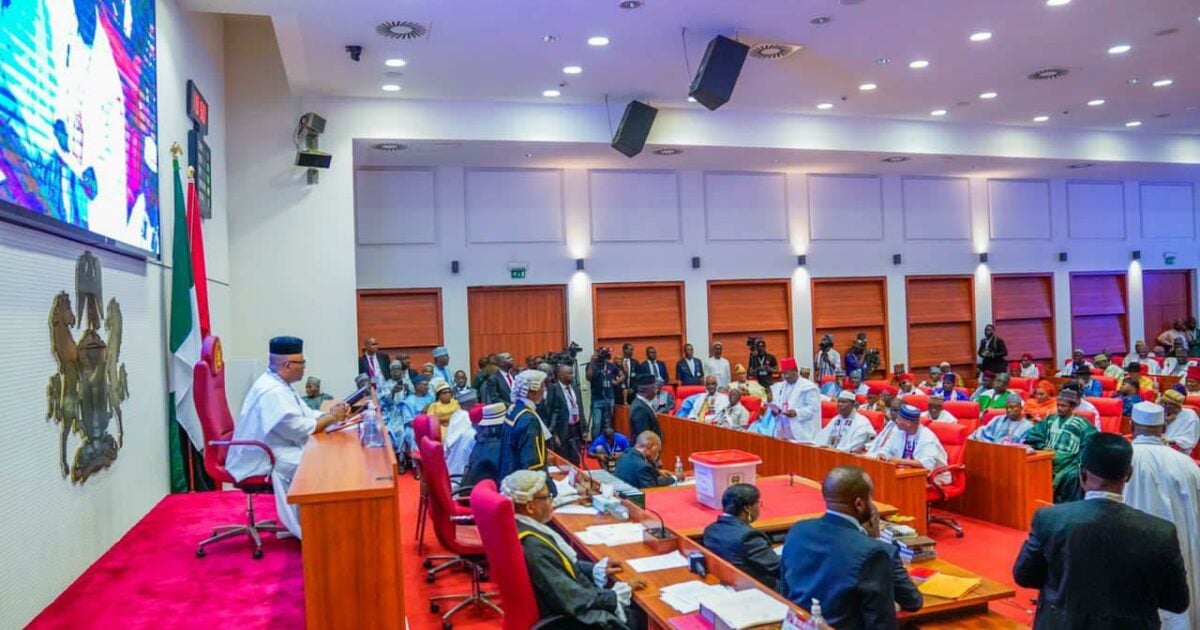
Nigerians have been reacting to the Senate’s ad hoc committee looking into crude oil theft in the Niger Delta’s recent finding that over N300 billion in crude oil revenues were missing.
Massive disparities, shoddy supervision procedures, and systemic flaws that have allowed for the widespread diversion of Nigeria’s crude oil earnings were described in the committee’s interim report to the Senate.
According to the report, a forensic examination of domestic crude proceeds and tax oil proceeds records uncovered discrepancies, inconsistencies, and unexplained funds totaling around $22 billion in crude oil sales. Additionally, it discovered a $81 billion discrepancy between the receipts reported by the Nigerian National Petroleum Company Limited (NNPCL) and the Central Bank of Nigeria (CBN) for the years 2016 and 2017.
Additionally, the committee reported that its analysis of crude oil transactions from 2015 to the present, bolstered by inquiries from foreign experts, estimated that more than $200 billion in revenues from these sales were still unaccounted for worldwide.
After months of document examinations, written submissions, and public hearings, the interim report identified flawed measurement systems, inadequate regulatory supervision, and a lack of agency collaboration as the root of the issue.
Crude oil theft was found to be largely facilitated by the use of unreliable measuring devices, a lack of metrological control, poor interagency cooperation, and disorganized enforcement measures.
However, the report criticized the Petroleum Industry Act (PIA) 2021’s suspension of the Weights and Measures Department’s operations in the upstream sector, claiming that the move compromised precise measurement and accountability in crude oil operations.
The lack of a specific court to punish oil thieves and the failure to implement the Host Communities Development Trust Fund (HCDTF) under the PIA were also mentioned as contributing factors to the ongoing theft and sabotage in oil-producing regions.
The committee called for immediate local and international tracking, tracing, and recovery of stolen crude oil profits for the nation’s benefit, estimating that the unaccounted proceeds from domestic crude sales amounted to approximately N300 billion.
It called on the Federal Government to either reinstate the Weights and Measures Department to its previous regulatory function or order the Nigerian Upstream Regulatory Commission (NUPRC) to enforce international crude oil measurement standards at all production sites and export terminals.
Additionally, they called on the government to give security forces access to cutting-edge surveillance tools and technology, such as unmanned aerial vehicles, so they could better monitor oil sites and quickly identify theft and leaks.
It asked for the construction of a special court to swiftly try crude oil thieves and their accomplices, as well as the establishment of a marine Trust Fund to fund training, safety operations, and the development and upkeep of marine infrastructure.
In order to lessen community sabotage and encourage participation in the administration of oil resources, the committee also recommended that the HCDTF be implemented right away.
Aside from monetary losses, the committee also voiced worry about the increasing number of badly decommissioned and abandoned oil wells around the Niger Delta, which it claimed were polluting communities and leaking gas and oil into the environment.
In order to boost the supply of oil for local consumption and lower vandalism, it was suggested that such wells be given to the NUPRC for transfer to modular refineries.
Crude oil output did, however, show a slight recovery, rising from 490.95 million barrels in 2022 to 537.57 million barrels in 2023—a 9.5 percent increase—indicating an improvement in both production and security conditions.
The Committee, which was reorganized on February 11, 2025, after Senator Ifeanyi Ubah, its previous chairman, passed away, asked the Senate to give it the power to investigate, trace, and retrieve proceeds of stolen crude oil worldwide.
It stated that recovering the money was essential to restoring accountability in the oil industry, bolstering Nigeria’s budget, and discouraging theft in the future.
The Senate emphasized that recovering stolen money was not the committee’s responsibility, even if it praised the committee for a job well done. It instructed the committee to wrap out its inquiry and identify the oil thieves before forwarding its recommendations to the administration for additional action.
However, there have been a variety of responses to the discoveries, including calls for serious measures to prevent similar financial corruption in the future as well as outbursts of rage, disappointment, and silence.
Those who are upset and dissatisfied with the study claim that it only confirms what has long been known—that the degree of corruption in the oil industry is abhorrent and pervasive.
Idowu Christopher, a prominent member of this organization and an analyst of the oil sector, claimed that although the government is aware of those responsible for oil theft, it has refused to take action.
Is anyone taken aback by the report? The response is no. Despite being aware of the source of the issue, the government has chosen not to take any action. What about the people who own the oil well, aside from those who steal our crude oil? Where’s that finished?
“How is an oil well owned by an individual? The government is doing nothing to stop one guy from owning a commonwealth of people? Only in Nigeria does such an anomaly occur without any repercussions.
“I agree with the committee’s suggestion that these oil wells be recovered and given to NUPRC, which would then give them to modular refineries in order to decrease vandalism and enhance the supply of petroleum for local use.
Why hasn’t the government adopted the HCDTF under the PIA once more? In regions that produce oil, the development has been found to be the cause of ongoing theft and sabotage. Therefore, in my opinion, the government ought to be held accountable for permitting such enormous profits to go unaccounted for as it has willfully neglected to carry out its duties,” he stated.
According to expert Chikia Umeayo, there is no reason to be upset or disappointed because this kind of development has become commonplace in Nigeria.
“To be honest, it would have been unexpected if the report had been different from what we currently have,” the prominent voice and attorney said.
He went on, “Some of us have been discussing these issues for a few years now without any outcome.” Since the government is unwilling to act, we have chosen to say nothing.
“I have stopped worrying about some of these reports since, in the end, nothing will be gained from them. Nothing at all, so why should I feel upset or unhappy over something I know will continue?

