

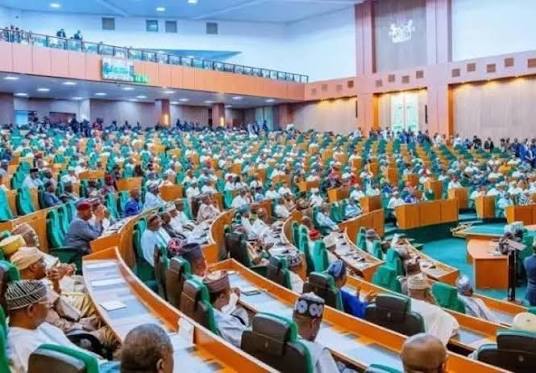
The House of Representatives recently opened its doors to the public for the third annual Open Week of the 10th House, a platform for the leadership to give account of its stewardship since the inauguration of the chamber on June 13, 2023 and receive feedback from constituents on its activities over the past three years.
Significantly, the event provided the House with an opportunity to build a national consensus on critical bills before the parliament, as part of the ongoing effort to review the 1999 Constitution (as amended). These include the state police bill, which seeks to amend the constitution to create a legal framework for states to set up their own police forces, and the special seats bill, aimed at creating reserved seats for women in the National and State legislatures.
Speaker Abbas Tajudeen, setting the tone for the three day event, said the Open Week, now an annual ritual in the Green Chamber, was basically intended to subject the House to scrutiny by the very members of the public it serves.
The initiative, he said, was conceived not as an exercise in self congratulation but as an act of accountability, for openness is not a courtesy the House extends at its pleasure but an obligation it owes to those it represents. In opening its doors, he said, the House affirms one enduring principle, that the making of the people’s laws remains their concern, and that they are entitled to observe it, interrogate it and help shape it. “No other arm of government submits itself to public examination in quite the same manner. The House does so with conviction rather than reluctance,” he added.
Read Also: INEC Official Kidnapped in Anambra as Abductors Demand ₦40 Million
A total of 2,747 bills were introduced in the House in the last three years, out of which 363 bills were passed while 72 bills have been assented to by the president, Abbas said, adding that the number was the highest recorded by any assembly since the return of democratic governance in 1999.
He said among the most impactful pieces of legislation were the National Education Loan Fund Act, the acts establishing various development commissions and a raft of tax reforms, alongside no fewer than 220 motions passed during the same period, many of them addressing the country’s pressing security challenges.
He said one of these laws now provides interest-free student loans to young Nigerians so that no student is turned away from a lecture hall for want of means, while another has reformed how the nation raises and shares its revenue, and others have established commissions to carry development into every region of the federation. Moreover, he said, over 800 citizens have petitioned the House in addition to these landmark statutes, with hundreds of those cases already resolved.
The Policy and Legal Advocacy Centre’s Executive Director, Clement Nwankwo, generally agrees that the House has done a good job since its inauguration, but argues that its work is still not done.
As the 10th National Assembly is now in its third year of office, it is appropriate to reflect on both its achievements and the tasks still outstanding, he said. He credited the Assembly for demonstrating commitment across a range of important areas, including the ongoing constitutional review process, efforts to modernise legislative procedures, consideration of key electoral and governance reforms, increased use of digital platforms and greater engagement with citizens and civil society, while also showing resilience in responding to emerging national challenges and maintaining a broadly stable legislative environment.
At the same time, he argued, citizens rightfully expect more from their legislature: stronger, more independent oversight of the executive, more timely consideration of critical national issues, more transparency in legislative business, more public participation in law making and reforms that directly improve governance, security, economic opportunity and social justice.
The Catholic Bishop Emeritus of the Abuja Diocese, John Cardinal Onaiyekan, who delivered a goodwill message at the Open Week, insisted that lawmakers must represent the people effectively and serve as a check on the executive, stressing that parliament cannot abdicate its role in a democracy. “The legislature, he said, is the heart of the three arms of a democratic government, the executive and the judiciary, and if democracy is truly a government of the people, by the people, for the people, then the legislature is that people and cannot abdicate its popular role, nor betray the sacred trust placed in it.
As Nwankwo noted, observers believe that citizens expect quite a lot from the House as it enters its final session, particularly on the review of the 1999 Constitution. There is a strong expectation that the Green Chamber will pass the Special Seats Bill, which seeks to establish special seats for women in the National and State assemblies as a way to ensure inclusive governance, along with other constitutional alteration bills aimed at strengthening governance across the country.
Clearly aware of these expectations, the House used Open Week to further galvanise support for the Special Seats Bill and broader security reforms, as well as forging new partnerships with the business community in pursuit of more robust, economy oriented legislation. At its interaction with the business leaders under the auspices of the National Assembly and Business Executive Roundtable, the House suggested institutionalising the roundtable so that regular interaction with the business community would help bridge the divide between legislative intervention and economic reality.
At a National Dialogue on the Special Seats Bill, the House unveiled an electoral college model for electing women to the proposed special seats, which is expected to make the process less cumbersome for women and the country at large. The model is being presented as a new initiative that can secure the bill’s passage in the current assembly. Policy and governance expert John Mutu, who provided an overview of the proposed model, explained that women would get these parliamentary seats through indirect election by office holders already elected at the local, state and federal levels within each special constituency. He admitted that the electoral college model is alien to Nigeria’s political tradition and poses clear implementation challenges, but argued that it nonetheless provides a practical vehicle for realising the strategic goals underpinning the Special Seats initiative.
The Speaker used the dialogue session on security to allay fears lingering around setting up of state police. The House has led the way in seeking to amend the 1999 Constitution to provide a legal framework for decentralising policing, whereby interested states can establish their own forces as part of wider efforts to address insecurity.
But there are still concerns of state governors abusing state police, and questions over funding. Abbas, however, insisted that the authors of the State Police Bill had anticipated these likely challenges and built in adequate safeguards, adding that the country must learn from the experience of others including Germany and Canada. He explained that the National Minimum Standards Act had to be in place before any state police force issued its first directive so that standards preceded structures and that implementation should proceed step by step, state by state, rather than switching on thirty six new forces at the same time. But the question of funding has to be addressed from the beginning, he added. Whether it’s a dedicated policing fund, shared services or federal support tied firmly to standards, he said, no state should create a police force it cannot pay for, and no unpaid officer should become a threat to the very citizens they have sworn to protect.

