

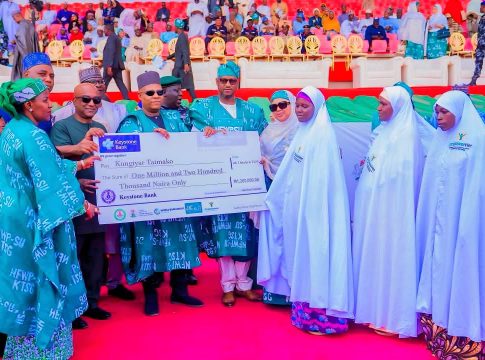
The World Bank has identified investment in Nigerian women as a major pathway to economic growth, saying closing gender gaps in agriculture, self-employment and wage employment could generate US$22.9 billion, equivalent to 5.8 per cent of Nigeria’s GDP.
World Bank Country Director for Nigeria, Mr Mathew Verghis, stated this in Katsina at the launch of the Community Investment Fund (CIF) under the Nigeria for Women Programme Scale-Up (NFWP-SU) performed by Vice President Kashim Shettima.
Verghis stated that barriers to finance, markets, skills, technology and productive assets remained an economic challenge, as such, “Investing in women is investing in Nigeria’s economy.”
Verghis said the US$540 million NFWP-SU was designed to expand women’s economic opportunities, strengthen livelihoods and promote inclusive and resilient growth, building on a pilot that supported more than 460,000 rural women.
The programme, he said, was designed to move women “from economic survival to economic opportunity; from individual economic activities to stronger enterprises; and from isolated efforts to collective economic power.”
He said participating women had mobilised and saved more than ₦20 billion and “the ultimate objective is not perpetual dependence on public or donor financing. The objective is to help women build viable and growing businesses that can access finance, compete in markets, create jobs and stand on their own,” he said.
Verghis declared that “Women are not simply beneficiaries; they are investors,” noting that their savings represented “discipline”, “trust”, “collective action” and, above all, “economic agency”.
According to him, the CIF would enable women to increase production, expand enterprises, access new markets, create jobs and strengthen economic resilience.
“This is an important shift in how we think about women’s economic empowerment. We are not simply providing support to women. We are investing alongside women who are already investing in themselves.”
Verghis commended Katsina State for matching the World Bank’s investment, saying the commitment helped expand NFWP-SU from six Local Government Areas to all 34 LGAs.
“This is much more than a financial contribution. It is a powerful demonstration that Katsina believes in its women and recognises that investing in women is investing in the future of the State,” he said.
Verghis also called on banks, financial institutions and other private-sector actors to treat WAGs and women-owned enterprises as customers, suppliers, producers and business partners.
“Today, we are launching a fund. But what we are really launching is greater opportunity. An opportunity for a woman to expand her business. An opportunity for a group of women to invest collectively. An opportunity for a community to create jobs and an opportunity for Nigeria to unlock a significant source of economic growth.”
“Together, we can turn affinity into opportunity, savings into investment, skills into jobs, businesses into enterprises, and collective action into shared prosperity. We are for women. We invest in women. And when women prosper, Nigeria prospers.”
Speaking, Governor Dikko Radda said the CIF would complement women’s savings with resources for new businesses, enterprise expansion and productive activities.
Read Also: President Tinubu Announces Operationalisation of New Army Formations in Four States
“Today’s flag-off marks the commencement of the disbursement process; it is not the conclusion of the process. Women Affinity Groups that are not receiving their grants today should remain confident that the process will continue,” he said.
Radda, while seeking additional financing and technical support, urged beneficiaries to invest funds in viable activities, maintain proper records and sustain savings and cooperation.
The Katsina State Commissioner for Women Affairs, Hajiya Aisha Aminu Malumfashi, said women had formed more than 2,393 WAGs and collectively mobilised more than ₦310 million in savings.
Malumfashi described the savings as evidence of growing financial discipline, collective responsibility and economic self-reliance among women.
Reacting to the launch, Minister of Women Affairs and Social Development Hajiya Imaan Sulaiman-Ibrahim stressed that the CIF is “not an individual handout, and it is not a bonanza.” It will be measured not by the amount disbursed today, but by the enterprises you build, the families you strengthen and the opportunities you create for others,” she said.
Sulaiman-Ibrahim says the intervention is helping women build sustainable businesses.
“The key to economic transformation is now in your hands! Protect it, build with it, and let your success inspire the nation. When women are trusted and empowered, whole communities prosper.”

