

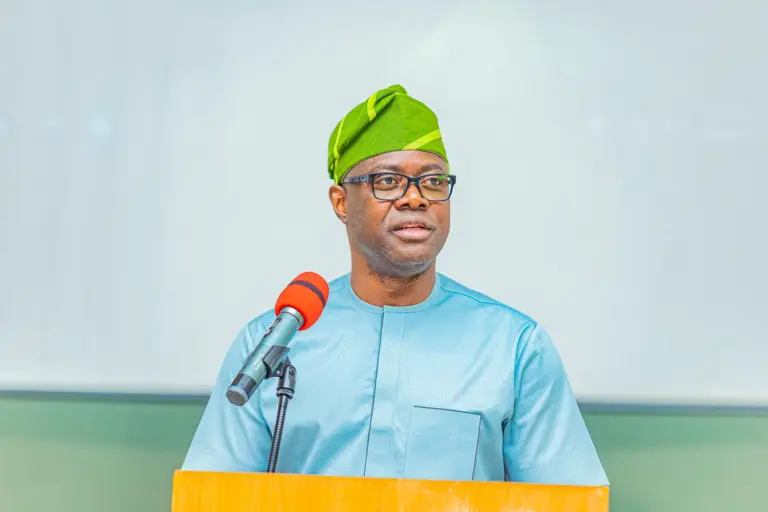
Allied Peoples Movement (APM) presidential candidate and Oyo State governor, Seyi Makinde, has accused the Federal Government of imposing taxes that further impoverish Nigerians instead of promoting productivity and wealth creation, declaring that the Tinubu administration is complicating the lives of citizens with economic policies that have failed to deliver meaningful relief.
Makinde also renewed his allegation that the Federal Government had withheld nearly ₦250 billion in Nigeria LNG dividend payments due to each state over the years, challenging the Presidency to publish records of the payments and explain how the proceeds had been utilised.
The governor, who spoke yesterday at the South-South town hall meeting organised by the Makinde-Daura Presidential Campaign Organisation (MDPCO) in Uyo, Akwa Ibom State, said the government’s approach to taxation, fuel pricing and revenue distribution was worsening the economic difficulties confronting households and businesses.
He accused the administration of pursuing grandiose infrastructure projects and announcing economic initiatives without demonstrating how they had improved the living conditions of ordinary Nigerians.
Makinde, who is seeking the presidency in the January 16, 2027 election, said his proposed economic reforms would prioritise entrepreneurship, employment generation and tax relief rather than policies that increased the financial burden on struggling citizens.
Referring to recent comments attributed to the senator representing the Federal Capital Territory, Ireti Kingibe, the governor criticised the Federal Government’s tax legislation, arguing that taxation should encourage productivity and target wealth rather than deepen poverty.
“But just as Senator Ireti Kingibe said a few days ago, they have passed a tax law that is not consistent with productivity. You are supposed to tax wealth. You are not supposed to tax poverty. But, they are only interested in taxing poverty,” he said.
Makinde maintained that government could increase revenue without necessarily raising taxes, citing his administration’s experience in Oyo State as evidence that economic expansion and improved revenue administration could deliver better results. “We will reset our economy. We will not all keep waiting for handouts from the federal allocation, because to expand our economy, we need two other elements. You need entrepreneurs. “I started my own company at the age of 29. I employed engineers. I took the risk on behalf of the state because government alone cannot provide the employment and expansion that we need.
Read Also: Eniola Badmus’ Peace Move Hits a Wall as Laide Bakare Rejects Apology
“We will ensure that people have tax breaks. And if you ask me whether we have done it before, yes, I did it in Oyo State. We increased Oyo State’s IGR without raising taxes on anybody. The records are there.”
Turning to the controversy over Nigeria LNG dividends, Makinde rejected the Federal Government’s earlier dismissal of his allegation that states had been denied their share of proceeds paid into the Federation Account. He insisted that the nearly N250 billion he referenced was not a single payment but the cumulative amount he believed was due to each state from dividends received over several years, including during the Tinubu administration.
“I said the Federal Government has withheld almost N250bn due to each state from Nigeria LNG dividend payments. Rather than come out and tell us what has been happening to dividends paid by Nigeria LNG, they said, ‘No, Governor Makinde, you be careful. You should not say things that are not true.’ “I stand by what I have said. The records are there. The papers are there. I did not say it was a one-off payment that is due to the states. They should listen, and listen very carefully.”
The governor argued that revenues accruing to the Federation Account were constitutionally required to be distributed among the three tiers of government and challenged the Presidency to account for the dividend payments.
“What I said is that, over the years, including during this administration, the Federal Government has been spending alone the dividends paid by Nigeria LNG into the Federation Account.
“Anything that goes into the Federation Account, according to our Constitution, should be shared between the Federal Government, state governments and local governments. Let them provide the amounts meant for the states and local governments in Nigeria.”
The Federal Government had previously disputed Makinde’s allegation, but the governor maintained that the disagreement could be resolved by making the relevant financial records available for public scrutiny.
He also criticised the administration’s infrastructure priorities and economic programmes, questioning whether their implementation had translated into lower transport costs and improved living standards.
“I have also told them that you cannot keep complicating the lives of Nigerians. Everything is mega. They want to build a superhighway from where to where? They want to do mega this and mega that.
“There is the Presidential Initiative on CNG. It came to nothing. Naira-for-crude came to nothing. Has it translated into lower transportation costs for millions of Nigerians?”
Makinde challenged the government’s proposal to modulate petroleum product prices, arguing that Nigerians deserved a clear explanation of how fuel prices were determined and what measures could be taken to make them affordable.
“Now, they say they want to modulate the prices of petroleum products. They want to modulate the lives of millions of Nigerians. They want to modulate the destiny of the most populous black nation on the face of the earth.”
He demanded the publication of the government’s petroleum pricing template, maintaining that greater transparency would allow independent experts to examine the figures and propose alternatives capable of reducing costs.
“So, do not complicate things by talking about this policy or that policy. You want to modulate prices? Give us the pricing template. Once we have the template, we can point out the real figures and tell you how to make this thing work for millions of Nigerians.”
On security and regional development, Makinde promised to overhaul Nigeria’s education system, security architecture and economic policies if elected.
He acknowledged that militancy in the Niger Delta had declined but maintained that the underlying problems had not been fully resolved.
“We will reset education and reset our security architecture. We know about the issue of militancy in this zone. Yes, it has gone down a little bit, but the problem is still not solved. The reset agenda will ensure that the issue of militancy is solved completely.”
The governor said his proposed economic agenda would encourage private investment, support entrepreneurship and reduce dependence on monthly allocations from the Federation Account, while creating opportunities for young people and businesses across the country.

