

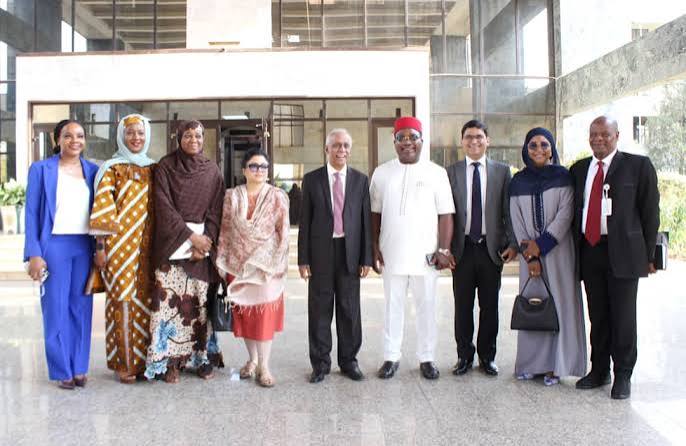
Nigeria and India have entered into a strategic partnership to strengthen human rights protection, improve access to justice and address systemic rights violations through institutional cooperation, legal reforms and the exchange of expertise between the two countries.
The partnership, formalised through a Memorandum of Understanding (MoU) between the National Human Rights Commission (NHRC) of Nigeria and its Indian counterpart, will focus on strengthening complaint management mechanisms, improving human rights compliance in the security sector and promoting reforms in justice administration.
The collaboration also seeks to address emerging human rights challenges associated with artificial intelligence, digital technologies, data privacy, intelligence gathering and environmental justice.
Speaking during a meeting with the Indian delegation at the Federal Ministry of Justice in Abuja, the Attorney General of the Federation and Minister of Justice, Lateef Fagbemi, SAN, described the agreement as a strategic initiative that would deepen institutional cooperation and strengthen Nigeria’s human rights protection framework.
Fagbemi said the partnership was particularly important at a time when effective human rights protection required stronger legal frameworks, institutional accountability, inter-agency collaboration and an unwavering commitment to the rule of law.
He stressed that the effectiveness of human rights protection should not be measured merely by constitutional provisions but by how far such guarantees translate into accessible justice, accountable public institutions and an independent judiciary.
The Attorney General reaffirmed the Federal Government’s commitment to ensuring that Nigeria’s legislative frameworks, policies and justice administration processes remain consistent with its constitutional and international human rights obligations.
He specifically highlighted the importance of the National Human Rights Commission’s statutory independence under Section 6(3) of the NHRC Amendment Act 2010, which protects the Commission from the direction or control of any other authority or individual in carrying out its statutory responsibilities.
According to him, the Ministry of Justice will support technical engagements, joint legal reviews, and policy consultations arising from the bilateral agreement, particularly in areas where improvements are needed to enhance the justice sector’s efficiency.
He also identified the growing influence of artificial intelligence as an emerging challenge requiring proactive legal safeguards to protect data privacy, prevent algorithmic bias and safeguard civic space.
READ ALSO:
- Nigeria Convicts 653 Suspects in Ongoing Terrorism Trials
- Nigeria Records 60% Drop In Maternal Deaths At BHCPF Facilities – FG
- NRS: Why Nigeria’s Creative Industry Must Embrace Tax Formalisation
Fagbemi expressed the expectation that the collaboration would produce actionable research and policy recommendations to strengthen justice delivery, particularly for vulnerable and marginalised citizens.
Earlier, the Executive Secretary of the NHRC, Dr Tony Ojukwu, SAN, said the agreement would provide an important platform for institutional capacity development, technical exchanges and comparative legal research between the two countries.
Ojukwu explained that the partnership would concentrate on strengthening complaint-handling mechanisms, enhancing human rights compliance in security sector governance and law enforcement, and promoting comparative research on legal reforms and access to justice.
He added that the collaboration would also extend to emerging areas of human rights protection, including artificial intelligence, digital rights, ethical intelligence gathering and environmental justice.
The NHRC boss noted that although the Nigerian Commission operates as an independent statutory institution, effective discharge of its responsibilities, including investigating complaints, recommending compensation for victims and monitoring compliance with international human rights treaties, requires constructive engagement with relevant justice sector institutions.
He expressed confidence that the partnership would generate practical legal insights and policy recommendations to support ongoing efforts towards comprehensive justice sector reforms in Nigeria.
Leading the Indian delegation, the Director of the Department of Health and Human Services, Dr Aravinda Chakraborty, described the relationship between Nigeria and India as unique, citing their shared democratic values, historical experiences, cultural connections and common commitment to human rights.
He said the agreement represented an opportunity to deepen cooperation between the two countries in promoting and protecting fundamental human rights.
Chakraborty expressed appreciation to the Federal Ministry of Justice for facilitating the engagement, noting that stronger collaboration between the two countries’ human rights institutions would provide opportunities for knowledge sharing and improved institutional performance.
Both countries expressed optimism that the agreement would translate into practical improvements in human rights protection, justice administration and accountability, with particular attention to citizens whose rights are most vulnerable to violations.

