

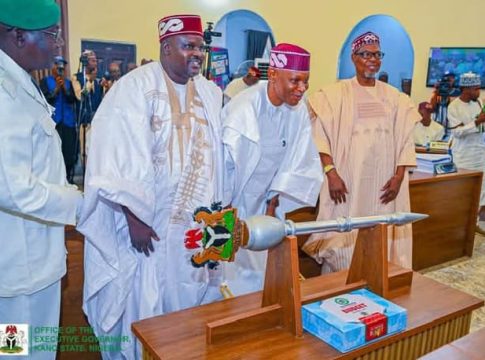
The Kano State Government has proposed allocating 30 per cent of its ₦1.107 trillion 2027 budget to the education sector, making it the highest-funded sector in the proposed fiscal plan.
Governor Abba Kabir Yusuf disclosed this on Wednesday while presenting the 2027 budget estimates before the State House of Assembly for consideration.
He said the allocation reflected his administration’s commitment to expanding access to quality education.
“This substantial allocation to education demonstrates our determination to consolidate the gains recorded in the sector and sustain reforms that improve learning outcomes across the state,” Yusuf said.
The governor disclosed that his administration recruited 8,588 teachers during the 2026 fiscal year, comprising 4,900 permanent teachers and 3,688 engaged under the Better Education Service Delivery for All (BESDA) programme.
He also listed the payment of examination fees for more than 150,000 students sitting for NECO, NBAIS and NABTEB examinations, the settlement of outstanding boarding school feeding obligations and the rehabilitation of school facilities among the government’s achievements.
According to him, the government also supported students preparing for the Joint Admissions and Matriculation Board (JAMB) examinations through the provision of registration forms and preparatory training.
Yusuf further announced that Kano maintained its leading position on the 2026 NECO performance chart for the second consecutive year.
READ ALSO:
- Governor Yusuf Presents 2027 Budget At Kano House Of Assembly Today
- Gov. Yusuf Swears In Two Commissioners, Tasks Them On Drug Abuse, Illegal Mining
- Gov. Yusuf Unveils N50,000 Monthly Empowerment Grants For 5,200 Kano Women
He assured residents that the administration would sustain investments in teacher development, school infrastructure, instructional materials and digital learning facilities.
On the overall budget structure, the governor said ₦693.47 billion, representing 63 per cent of the proposed expenditure, was earmarked for capital projects, while ₦413.55 billion, representing 37 per cent, would go to recurrent expenditure.
He explained that the capital-heavy structure was designed to expand infrastructure, strengthen human capital development and promote investments capable of stimulating economic growth.
Yusuf also projected recurrent revenue of ₦692.64 billion for the 2027 fiscal year, comprising ₦142.84 billion from Internally Generated Revenue (IGR) and ₦549.80 billion from the Federation Account.
The governor further claimed that his administration had achieved more than 90 per cent of the programmes, projects and policies outlined in its development blueprint.
He pledged to strengthen budget monitoring, transparency and accountability to ensure effective implementation of the proposed projects and value for public money.

