

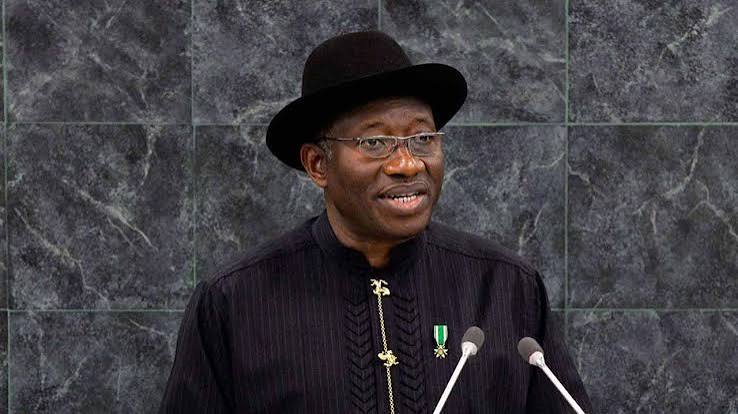
Jonathan stated this at a colloquium organised in memory of late Herbert Macaulay, foremost Nigeria political leader, held at Nigeria Institute for International Affairs, Victoria Island which also marked the 162th anniversary of the late nationalist’s birthday.
He said a situation where religious, ethnic and other narrow considerations were issues played up in choosing a leader does not make plans for the advancement of the country.
He noted that Nigeria must build a more transparent and accountable democracy in which political leaders are selected based on competence, character and their capacity to deliver, rather than religious affiliation, language or sectional interests.
The former president, who chaired the colloquium, said Nigeria needed to reassess her democratic practices, strengthen institutions and prioritise functional education if it the country aimed at achieving meaningful development before the centenary of its independence in 2060.Buy Maps
Jonathan identified four critical areas that required urgent attention, which he identified as democratic reforms, political recruitment, functional education and the development of a clear national vision capable of driving technological advancement and economic growth.
The former President described Nigeria’s present democratic arrangement as opaque and amorphous, arguing that it had not fully reflected the fundamental principles of democracy.
“My first thought is that we must reform our democracy. In summary, we must review our opaque and amorphous democratic system to align it with the fundamental pillars of democracy that constitute popular participation, the rule of law, respect for human rights, judicial independence, accountability, pluralism and a vibrant civil society,” he said.
Jonathan argued that Nigeria must also reform her political recruitment process, which he said had continued to produce leaders based on religious, ethnic and other sectional considerations rather than merit.Buy Maps
“Until we move away from this primitive way of recruiting political leaders, this country cannot go forward,” he said.
The former president maintained that Nigeria must develop a political culture that gives capable citizens equal opportunities to participate in governance, irrespective of their religious beliefs, ethnic backgrounds or other affiliations.
Jonathan also called for a clear national vision education system that would reposition the country’s educational institutions as centres of knowledge production, research and innovation rather than largely institutions of knowledge consumption.
READ ALSO:
- Global Health Reset: Why Nigeria Must Build A Stronger Health System – WHO Country Representative
- Atiku Blames Tinubu’s High Cost Economy For Collapse Of 40% Bakery Businesses
- Ethiopian Runner Wins Abuja Half Marathon As Nigeria’s Gang James Finishes Second
He expressed concern about the global competitiveness of Nigerian universities, citing the Times Magazine Higher Education 2027 rankings where none of the institutions in Nigeria were placed amongst the best-ranked institutions from 101–1,000 category.
He argued that Nigerian universities must aspire to compete among the world’s top 200 or 300 institutions to strengthen their contributions to scientific research, technological development and national productivity.
According to him, although Nigerian universities continue to produce competent professionals, including engineers, lawyers and historians, greater investment in intensive research and innovation is necessary to compete globally.
Jonathan said Nigeria must also begin to measure her development ambitions against the country’s 100th independence anniversary in 2060.
He wondered whether the country would have overcome its present challenges by then or whether another generation would still be lamenting the failure to realise the aspirations of the founding nationalists.
Comparing Nigeria’s development with countries such as South Korea, India and Singapore, Jonathan said those countries have made remarkable progress in industrialisation, technology, education and healthcare despite their own difficult histories.
He said Nigeria needs to honestly examine the reasons she had been unable to translate its enormous human and natural resources into comparable development.
The former president recalled that when Nigeria marked the centenary of its amalgamation in 2014, some Nigerians questioned the justification for the celebration, arguing that the country had not achieved sufficient progress in national development and unity.
He noted that he supported the commemoration because understanding the country’s history was important to assessing its progress and repositioning it for the future.
Jonathan also urged young Nigerians to take responsibility for advancing the ideals of the nationalist struggle through innovation, enterprise, civic participation and responsible citizenship.
He said the greatest tribute to Herbert Macaulay, Nnamdi Azikiwe, Obafemi Awolowo, Ahmadu Bello and other foremost nationalists was not merely celebrating their achievements but to build a country that will reflect the ideals for which they fought.
Earlier, former Deputy National Chairman of the Peoples Democratic Party (PDP), Chief Bode George, who was the chairman of the planning committee for the colloquium called on the Federal Government to rebuild Herbert Macaulay’s former residence, demolished by the colonial government because of their hatred to him, because he challenged their policies which anti black people.
According to him, his former residence is where the General Post Office is currently situated, saying rebuilding of the house will serve as a permanent memorial.
George, who described Macaulay as a distinguished nationalist and public servant, said the initiative was intended to preserve his legacy and remind contemporary politicians that public office should be regarded as a responsibility to serve the people rather than an opportunity for personal enrichment.
He alleged that the colonial authorities demolished Macaulay’s residence shortly after his death in 1946 and subsequently built the General Post Office on the site.
George said Macaulay’s descendants were prepared to develop a permanent memorial home showcasing his contributions to Nigeria’s political history and the struggle against colonial rule.
He urged President Bola Tinubu and the Federal Government to consider the request, arguing that preserving the nationalist’s legacy would provide an important historical reference for younger generations.

