

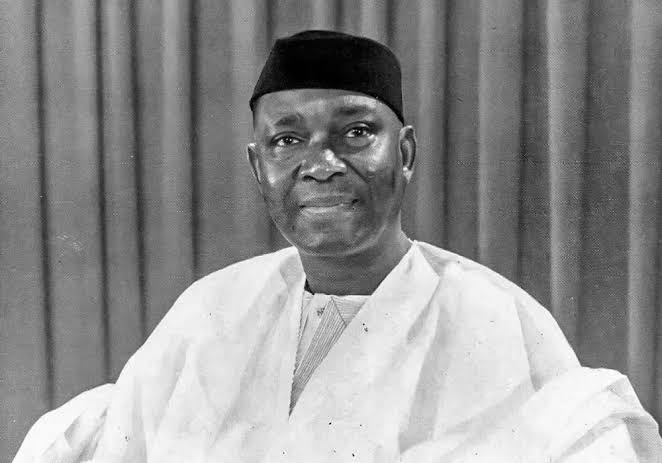
By Nwachukwu Ngige
As Nigerians commemorate the 122nd anniversary of the birth of Dr. Nnamdi Azikiwe, Nigeria’s first President and one of Africa’s most consequential nationalist figures, it is necessary to revisit an unfortunate tendency in contemporary Nigerian politics which is the reduction of historical personalities to the narrow calculations of regional entitlement and presidential rotation. This tendency was brought into sharp focus by the Minister of Works, Engr. David Umahi, who, during an interview on ARISE News Television’s The Morning Show on Friday, October 23, 2026, controversially argued that the legendary Zik of Africa had already taken Anambra State’s turn in Nigeria’s presidential arrangement.
Whatever the political argument Umahi intended to advance, the historical implication of such a proposition is deeply troubling. It reduces one of Africa’s most distinguished nationalist figures to a provincial political contender whose historical significance can supposedly be exhausted by the geographical origin of his presidency. That is not merely a questionable political argument, it is a fundamental misreading of history. Azikiwe was much more than a Nigerian politician who occupied the highest office in the land. He was an intellectual, journalist, nationalist and Pan-Africanist whose political imagination transcended the territorial boundaries of Nigeria. To measure his historical contribution by the contemporary arithmetic of presidential rotation is to mistake the geographical location of a man for the magnitude of his historical significance.
The Owelle of Onitsha belonged to a distinguished generation of Black intellectuals and freedom fighters whose ideas challenged the ideological foundations of colonial domination. His intellectual and political stature places him in the wider tradition of Pan-African thinkers such as Marcus Garvey and W.E.B. Du Bois, whose ideas helped awaken political consciousness among oppressed peoples and inspired the struggle for emancipation across Africa and the wider Black world. Zik understood that colonialism was not simply a question of foreign political administration. It was also a system of economic exploitation, intellectual subordination and the denial of human dignity. His journalism, political activism and Pan-African advocacy were therefore directed at a much larger historical objective, the liberation of African peoples and the restoration of their political and intellectual agency.
His influence was not confined to Nigeria. His intellectual engagement with Kwame Nkrumah, Ghana’s foremost independence leader and first President, reflected the transnational character of the African nationalist movement. It wss Zik who assisted Nkrumah’s study in the United States. Zik also belonged to the generation of African nationalists whose ideas and political example helped shape the consciousness of leaders such as Kenneth Kaunda of Zambia, Félix Houphouët-Boigny, the first President of Côte d’Ivoire and Julius Nyerere of Tanzania, among others.
His return from the United States to the Gold Coast in 1934 and his pioneering journalism as editor of the African Morning Post marked an important chapter in the radicalisation of anti-colonial thought in West Africa. Through his writings, Azikiwe challenged colonial assumptions, encouraged political self-awareness and strengthened the demand for self-government. His journalism was not simply an occupation, it was an instrument of political resistance.
READ ALSO:
- Shun Tribal Politics, Vote Tinubu In 2027, Tompolo Tells Anambra Voters
- 2027: ADC-PCC Demands Withdrawal Of Tinubu’s ‘All Is Fair In Politics’ Remark
- Senator Abdulaziz Yari And The Changing Face Of Zamfara Politics
It is important to understand that the struggle for African independence was not the achievement of one individual. It was the product of collective resistance by generations of nationalists, intellectuals, labour activists and ordinary citizens. But Azikiwe was undoubtedly among the most influential figures whose ideas and activities helped transform anti-colonial agitation into a more assertive demand for political emancipation. His contribution to Nigeria was equally significant. At a time when competing ethnic and regional interests threatened the country’s political cohesion, Azikiwe consistently articulated a vision of national unity that sought to rise above sectional loyalties. His political journey was not without contradictions, as was the case with many nationalist leaders of his generation. Nevertheless, his commitment to Nigerian independence and the larger African cause remains an enduring part of his historical legacy.
This is why Umahi’s argument deserves a firm intellectual rebuttal. There is nothing inherently wrong with discussing geopolitical balance, presidential rotation or the distribution of political opportunities in a plural society such as Nigeria. These are legitimate questions in contemporary democratic discourse. What is unacceptable, however, is the attempt to appropriate the historical legacy of a continental figure to settle a narrow argument about contemporary political entitlement. Azikiwe’s presidency was not a regional favour bestowed on Anambra State. It was part of a much larger national struggle for self-government in which Zik was one of the leading protagonists. His significance cannot be reduced to the fact that he was born in what is now Anambra State or that he eventually became Nigeria’s first President.
Indeed, it is possible to disagree with aspects of Zik’s political philosophy or question some of his political decisions without diminishing his historical stature. Greatness does not require historical infallibility. It requires an honest appreciation of the scale of one’s contributions to society and humanity. It is therefore necessary to remind the Minister that, commendable as his performance as Works Minister may be, ministerial achievement does not automatically confer historical understanding. Azikiwe was a leader far ahead of his time, whose vision transcended the narrow confines of regional politics and the petty calculations of contemporary political actors. But perhaps even more disturbing than Umahi’s remarks is the apparent silence of those who ought to be defending Zik’s intellectual and political legacy. Where are the custodians of his ideals? Where are the self-proclaimed Zikists? Where is Governor Chukwuma Soludo, who readily invokes Zikism in contemporary political discourse? Has Zikism become a convenient political ornament, paraded when it serves immediate political interests but abandoned when its principles demand courage and conviction? We do not need a Zikism of convenience, an opportunistic appropriation of a continental icon’s name without the intellectual commitment to defend the ideals he represented. The legacy of Azikiwe belongs neither to a political party nor to a particular geographical constituency. It belongs to Nigeria, to Africa and to the generations yet unborn who must inherit a proper understanding of the struggles that secured their political freedom.
This is particularly important in a country where the teaching of history has suffered prolonged neglect. Many young Nigerians have grown up with limited knowledge of the personalities, intellectual movements and political struggles that produced the independent Nigerian state. When historical figures are subsequently reduced to the narrow calculations of contemporary political actors, the danger is that an entire generation may inherit a diminished understanding of its national heritage.
Umahi should therefore retract his unfortunate remarks and tender an unreserved public apology to the memory of Dr. Nnamdi Azikiwe. This is not a demand for political deference or unquestioning reverence. It is a demand for historical responsibility and respect for a man whose contributions deserve to be assessed within their proper national and continental context.
Zik was not merely a son of Anambra State. He was a son of Africa, a symbol of the struggle against colonial domination and one of the intellectual architects of modern Nigerian nationalism. No geopolitical arrangement can confine the legacy of a man whose vision embraced an entire continent. No ministerial office confers the authority to diminish the historical stature of such a personality. Nnamdi Azikiwe belongs to history. And history must never be sacrificed on the altar of petty politics, regional entitlement and transactional power games.
Nwachukwu Ngige, a journalist, writes from Abuja

