

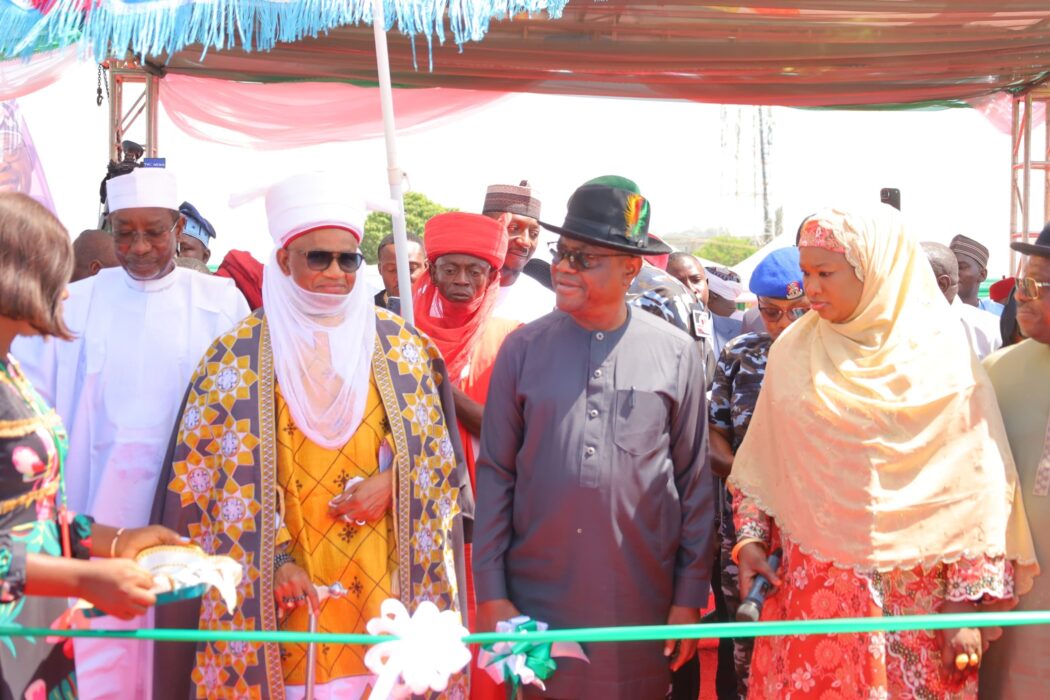
Minister of the Federal Capital Territory (FCT), Nyesom Wike, has announced plans to upgrade more traditional chiefdoms in the territory and provide befitting palaces for all first-class traditional rulers in the 2027 budget.
Wike also pledged to extend official vehicles and other logistical support to traditional rulers, saying the measures were aimed at restoring the dignity of traditional institutions and strengthening their roles in promoting peace, security and grassroots development.
The minister made the announcement on Friday in Abuja during the presentation of certificates, letters of office, staff of office and brand-new sports utility vehicles (SUVs) to newly upgraded first- and second-class traditional rulers from the 16 chiefdoms in the FCT.
The ceremony, attended by senators, traditional rulers, political leaders and other stakeholders, marked a major development in the history of the FCT traditional institution, following nearly three decades of agitation for the elevation of traditional stools.
Wike recalled that since the establishment of the FCT Traditional Rulers Council in 1997, only the stool of the Ona of Abaji had been elevated, leaving other traditional rulers without similar recognition despite their contributions to community development.
He attributed the latest elevation exercise to the approval of President Bola Ahmed Tinubu under the Renewed Hope Agenda, saying the decision reflected the administration’s commitment to inclusive governance and the involvement of traditional institutions in the governance process.
“Today is 29 years after the creation of the FCT Traditional Rulers Council. Since 1997, there’s only one stool that was elevated, and that is the Ona of Abaji. Since that period, no stool has been elevated.
“Mr President, as part of his programme of inclusivity under the Renewed Hope Agenda, thought it wise to bring the traditional rulers close, for them to also stand and be part of the governance process. Mr President approved the elevation of the various stools,” he said.
The minister said the excitement generated among the traditional rulers and their communities demonstrated the importance of recognising institutions that contribute to governance and community stability.
Defending the decision to provide official vehicles to the traditional rulers, Wike dismissed criticisms that the gesture amounted to bribery, arguing that such views failed to recognise the responsibilities traditional institutions discharge in society.
He questioned why ministers, political appointees and other government officials were entitled to official vehicles while traditional rulers, who are responsible for community mobilisation, conflict resolution and grassroots security, should be denied similar support.
“I’ve had so many people ranting in the various media houses that we intend to pay them bribe. It’s unfortunate. Chief press secretaries to area council chairmen, deputies to vice chairmen, ministers and special assistants to the President have vehicles. But the traditional institution should not have vehicles. Giving them vehicles means to pay them bribe.
“That’s how we have kept our traditional institution so low, that you see a traditional ruler in a car or on a tricycle. That’s what we want for our system. If this is paying bribe, we’ll continue to pay it,” he said.
Wike said traditional rulers remained indispensable to governance because of their roles in maintaining peace, stabilising communities and creating an enabling environment for government projects.
“Traditional institutions play a lot of roles to stabilise communities for government to carry out their projects. If traditional rulers cannot organise their communities, you will see the level of insecurity in this country,” he said.
Recalling the administration’s consultations with traditional rulers and communities shortly after its inauguration in 2023, the minister said President Tinubu had directed government officials to visit the six area councils, engage traditional rulers and other stakeholders and identify their immediate needs.
He said the FCT Administration had responded to several demands raised during the consultations, including road construction, provision of police stations and residential accommodation for security personnel.
According to him, traditional rulers had also complained about years of inadequate recognition by successive administrations despite their responsibilities as custodians of culture and leaders at the grassroots.
Wike assured traditional rulers awaiting elevation that the exercise would be extended to additional chiefdoms in the coming months, adding that they would also receive appropriate recognition and support.
He further disclosed that the FCT Administration would make provision in the 2027 budget for the construction of befitting palaces for first-class traditional rulers before extending the intervention to second-class chiefs.
The minister said the decision followed a request by former senator Philip Aduda, who had advocated the provision of befitting palaces for traditional rulers in the territory.
“I do agree with you. By the grace of God, in the next 2027 budget, we’ll see what the funds can take and make sure that, at the end of the day, all the first-class chiefs are taken care of. Then we’ll move to the second class,” he said.
He also directed chairmen of the six area councils to provide necessary logistical support, particularly fuel, to ensure that the newly presented vehicles were effectively utilised by the traditional rulers.
Speaking at the ceremony, Chairman of the Senate Committee on FCT, Senator Ibrahim Mohammed Bomai, congratulated the upgraded traditional rulers, their families and communities, describing the elevation as recognition of the important contributions of traditional institutions to society.
He particularly encouraged them to ensure that women and young people were given a voice in decisions affecting their communities.
The senator assured the traditional rulers that the Senate Committee on FCT would continue to work with the FCT Administration to address community needs and support development across the territory.
READ ALSO:
- 2027: Wike Woos Abuja Market Traders For Tinubu’s Re-election
- Lawyer Accuses FCT High Court Judge Of Bias In Forgery Trial
- National Library Needs N70bn For Completion – First Lady
Similarly, chairman of the Senate Committee on FCT Area Councils and Ancillary Matters, Senator David Jimkuta, representing Taraba South, commended President Tinubu and Wike for restoring recognition to the traditional institution.
Jimkuta described the gesture as evidence of the administration’s recognition of traditional rulers as partners in promoting peace, security and grassroots development.
He said the provision of official vehicles would improve the mobility of the traditional rulers and enable them to reach their subjects more effectively.
He urged the royal fathers to reciprocate the government’s gesture through greater cooperation with the administration, while appealing to Wike to convey to the President the need to provide befitting palaces to complement the elevation and vehicle distribution.
In her remarks, the minister of State for the FCT, Dr Mariya Mahmoud, described the presentation of letters and staff of office as a major milestone in the administration’s efforts to strengthen traditional institutions and promote inclusive governance.
Mahmoud appreciated President Tinubu for his commitment to grassroots development and commended Wike for extending the administration’s interventions beyond physical infrastructure to institutional empowerment.
She also commended community leaders, stakeholders, security agencies and members of the organising committee for their contributions to the success of the ceremony.
Urging FCT residents to appreciate the administration’s development efforts, Mahmoud asked rhetorically, “If not Bola Ahmed Tinubu, who?” to which the audience responded, “Tinubu.”
Earlier, the Etsu Nupe, Alhaji (Dr.) Yahaya Abubakar, who chairs the coordinating committee of the National Council of Traditional Rulers of Nigeria, expressed appreciation to Wike on behalf of traditional rulers across the country.
Abubakar said the provision of official vehicles would address one of the longstanding challenges confronting traditional institutions, particularly the difficulty of travelling across their domains to attend to the needs of their subjects.
He noted that the vehicles, including those suitable for inter-state journeys, would strengthen the capacity of the newly upgraded first- and second-class chiefs to discharge their responsibilities.
He urged them to promote cooperation, loyalty and peaceful coexistence in their respective communities.
Also speaking, the Ona of Abaji, His Royal Majesty, Alhaji (Dr.) Adamu Baba Yunusa, who spoke on behalf of the FCT Council of Chiefs, commended Wike for his commitment to the recognition, development and welfare of traditional rulers.
Yunusa said the upgrading of traditional stools and provision of official vehicles had brought renewed dignity and encouragement to the traditional institution.
He expressed appreciation for the minister’s attention to the welfare of royal fathers and prayed for divine guidance and strength for him.
Speaking on behalf of the newly upgraded first-class chiefs, the Sarkin Karshi, Alhaji Ismaila Mohammed, described the elevation as the fulfilment of an agitation spanning nearly three decades.
Mohammed recalled that some traditional rulers who began the struggle for recognition in 1997 had died without witnessing its actualisation.
He expressed gratitude that the longstanding demand had finally been addressed, crediting Wike with reviving the traditional institution in the FCT.
He assured the minister that the relationship established with the indigenous communities would endure beyond his tenure in office.
Similarly, the Emir of Jiwa, His Royal Highness, Alhaji (Dr.) Idris Musa, who spoke on behalf of the upgraded second-class chiefs, described the exercise as the completion of a long process of transformation in the FCT Traditional Rulers Council.
Musa commended Wike for his commitment and urged traditional rulers to understand that their relevance should not be determined by their traditional ranks alone but by their capacity to serve their people, maintain peace and contribute to community development.
In her welcome address, the director of Administration and Finance, Area Council Services Secretariat (ACSS), FCTA, Omolola Olanipekun, described the ceremony as a historic correction of a longstanding gap in the chieftaincy structure of the FCT.
Olanipekun said the presentation of letters of office to chiefs from the 16 chiefdoms was significant because traditional rulers had continued to serve as custodians of culture, mediators in communal disputes and promoters of grassroots peace despite the delay in their elevation.
She said the development would strengthen the traditional governance structure and enable FCT royal fathers to enjoy recognition comparable to that of their counterparts in other states.
On behalf of the staff of the Area Council Services Secretariat, she thanked Wike for responding to the longstanding appeals of traditional rulers, noting that the secretariat had regularly received complaints and requests from royal fathers seeking the actualisation of their elevation.
She urged the newly upgraded chiefs to sustain their partnership with the FCT Administration and continue to promote peace, unity and stability across their respective domains.

