

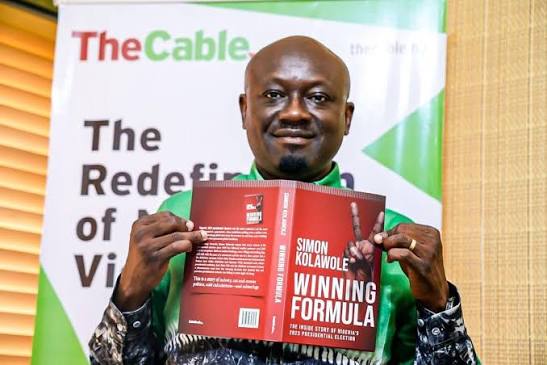
The Founder of TheCable, Simon Kolawole, has said President Bola Tinubu would easily have lost the 2023 presidential election if an overwhelming majority of northerners across the three geopolitical zones in the region had played the ethno-regional card against him.
The Independent National Electoral Commission (INEC) declared Tinubu of the All Progressives Congress (APC) the winner of the 2023 presidential election with 8,794,726 votes, representing 36.61 per cent. He was followed by Atiku Abubakar of the Peoples Democratic Party (PDP), who scored 6,984,520 votes (29.07 per cent), while Peter Obi of the Labour Party came third with 6,101,533 votes, accounting for 25.40 per cent. Rabiu Musa Kwankwaso of the New Nigeria Peoples Party (NNPP) garnered 1,496,687 votes (6.23 per cent), clinching fourth position.
Kolawole said Atiku had banked on near-total support from the entire North and fragments of support from the South, as southerners were likely to vote for Tinubu and Obi because of sentiments surrounding power rotation.
The journalist and author made this observation in a book titled Winning Formula: The Inside Story of Nigeria’s 2023 Presidential Election, in which he recounted the political intrigues, power struggles, strategic alliances and electoral calculations that shaped one of Nigeria’s most fiercely contested presidential elections.
Kolawole said Atiku’s calculations in the North did not play out as projected. Instead, 39 per cent of the region’s votes went to Tinubu, while the PDP presidential candidate secured 36 per cent and Obi got 13 per cent.
“Tinubu’s big northern share was one of the stunning highlights of the election. Tinubu led in two of the three zones, north-west and north central, while Atiku led in the north-east. In the 10 core northern states, Atiku had 3,492,881 votes while Tinubu polled 3,287,858, a narrow difference of 205,023,” the author said.
He highlighted the factors and other intrigues that worked in Tinubu’s favour in the 2023 presidential election, against all odds.
Kolawole said Tinubu had been cultivating political affinity across Nigeria since his time as governor of Lagos State between 1999 and 2007, if not earlier.
“He (Tinubu) was part of the botched transition programme in the early 1990s. He aligned with the powerful political group of Major General Shehu Musa Yar’Adua and was elected senator in 1992.
“Some of those alliances were still active when he became governor seven years later. He regularly supported candidates in different elections across the country, sometimes offering his party platform as an alternative for those who might have been edged out elsewhere. His well-oiled political network in the North paid him back in his hour of need,” the author said.
He also noted that some political leaders in the North were committed to the North-South power rotation understanding and wanted it maintained after the North had completed eight years under Buhari.
“Breaking the agreement could unsettle the polity, as it did when Jonathan ran in 2011 despite the North’s turn having been truncated by the death of President Umaru Musa Yar’Adua, less than three years into his first term in office.
“The bad blood this generated was carried over to the 2015 elections, which saw a groundswell against Jonathan in northern Nigeria. He became the first sitting president to be defeated.
“It was said that there was an agreement in the APC in 2015 that power would shift to the South in 2023. Some key northern politicians wanted fidelity to the understanding,” he stated.
Kolawole further said that, contrary to calculations in Atiku’s camp that northerners would treat the election as a battle between the North and the South, partisan allegiance eventually came to the fore.
“Rather than being seen as a contest between a southerner and a northerner, many northern voters saw it as the APC vs. the PDP. There are people who will always vote along partisan lines, even if they are not certain their candidates will win.
“For many voters in the North, it was a case of loyalty to the party, not the region. Those who harbour primordial sentiments might also have supported Tinubu because of the Muslim-Muslim ticket,” he said.
The author also said that one state where Tinubu was not expected to win because of the Muslim-Muslim pairing was Benue, as the APC had been portrayed as a Muslim party since its formation, amid trending allegations of the Islamisation of Nigeria.
He said that, being predominantly Catholic, Benue had become a proxy battleground between the Muslim North, which the Fulani herders “represent”, and Christians in the state.
“How then did Tinubu win? The PDP was divided between Obi and Atiku. Their combined votes would have relegated Tinubu to second place. Nonetheless, 310,468 votes would still have been a huge haul for Tinubu in the state, given the religious sensitivity that had ruled its atmosphere for nearly eight years,” the author stated.
He said Tinubu’s outing in Plateau, another Christian-majority state in the North, was also surprising.
“It had been embroiled in Muslim-Christian acrimony for decades, and a Muslim-Muslim ticket was not going to be an easy sell. Obi polled 466,272 votes to win the state, but Tinubu’s 307,195-vote haul was not bad by any standards. Atiku came third with 243,808 votes. An all-Muslim ticket securing 307,195 votes in what was supposed to be a hostile constituency was a form of victory, as it outscored the religiously mixed ticket of the PDP,” Kolawole stated.
He also said that the most obvious reason for Tinubu’s overall victory in the presidential election was the animosity within the ranks of the opposition.
The author stated that the combined tally of votes garnered by Atiku, Obi and Kwankwaso in the presidential election was 14,582,740, or 60.70 per cent, whereas Tinubu polled only 8,794,726.
“Theoretically, a united PDP (opposition) could have flattened Tinubu, even if not by a difference of 5,788,014. The margin might have been more or less. This is not an assertion that the PDP would definitely have won, but a suggestion that the breakup did not help the opposition in any discernible way.
“Hypothetically, most of the 1.96 million votes Obi got from the South-East were PDP votes. In 2019, PDP’s Atiku got 1.69 million votes from the zone, with Obi as his running mate. Also, Kwankwaso’s 997,000 votes in Kano looked like a PDP asset that could have bolstered Atiku’s position.
“Most of Obi’s 582,000 votes in Lagos would have gone to Atiku, given the voting pattern in previous presidential elections…,” he stated.
Kolawole also alluded to Nyesom Wike’s influence, saying, “If the defections from the PDP before the presidential primary were such a big blow, the situation became even more complicated after Atiku defeated Nyesom Wike to clinch the party’s ticket.
“The relationship between the two titans broke down completely. Tinubu, determined to take maximum advantage, swiftly walked in through the cracks by courting Wike.
“They first held exploratory meetings through proxies… to ensure Atiku did not record a runaway victory in the core North, especially in the North-West, which has seven states and boasts the largest vote bank.
“A massive margin for Atiku in the core North could deadlock the election. He might have the highest numbers and not the spread, while Tinubu might have the spread and not the highest numbers. That would lead to a run-off—which Tinubu could not be confident of winning. If it came to a run-off, the South-East and South-South could decide to align with Atiku for old times’ sake,” he added.
Kolawole also revealed that the G5 might have decided to reach out to Kwankwaso for a strategic alliance. The logical tactic would have been for Tinubu to support the APC, but that was never going to happen.
“Kwankwaso had been engaged in a bitter fight with Dr Abdullahi Ganduje, his former deputy and successor as governor of Kano in 2015…
“If Kwankwaso made the mistake of endorsing the APC presidential candidate, he would be digging his own political grave in Kano State, where he was the godfather. Because of local politics, openly supporting Tinubu was not an option for Kwankwaso,” the author stated.
READ ALSO:
- 31 APC States’ Youth, Sports Commissioners Targets 8.9m Votes For Tinubu
- North-East Demands Urgent Leadership Change –Kwankwaso
- Parties, CSOs Pick Holes In Tinubu’s Five-Year Security Plan
According to him, amid the ensuing intrigues, Kwankwaso remained the presidential candidate of the NNPP and weakened Atiku in the North-West, cornering 997,279 votes in Kano State and leaving Atiku with 131,716, while Tinubu came second with 506,412 votes.
Kolawole also pointed out that, despite his strong outing in the North, Tinubu lost the South, the Federal Capital Territory, Osun and Lagos.
“Losing the South was perhaps less of an embarrassment than losing Lagos, where he had been the political godfather since 1999. Obi won 43 per cent of southern votes, polling 4,020,687. Tinubu had 3,206,969 votes, representing 34 per cent. Atiku was third with 1,751,047, or 19 per cent.
“Tinubu’s loss in Osun was made possible by the fact that the state had gone the way of the PDP in the 2022 governorship election, and Governor Ademola Adeleke was determined to keep it so. Atiku, who won there, also had a good political structure on the ground.
“For the APC, losing the FCT was not that strange—it also lost there in 2015 and 2019. The APC has never won the nation’s seat of power in presidential elections, but it got 48 per cent of the votes in 2015 and 36 per cent in 2019. Tinubu’s performance was so woeful that the APC did not get up to 25 per cent in the Federal Capital Territory. He got only 19.76 per cent of the votes,” he said.
The author asserted that Tinubu had the most difficult pathway to victory in the Fourth Republic, as there was fierce competition for the votes of different segments of the electorate.
“The fault lines were well pronounced along regional and religious lines, but he managed to tiptoe through the landmines to get the highest votes. Partisan voters, whose allegiance is primarily to parties, contributed immensely to his tally in northern Nigeria. Primordial voters in the South-West and western North-Central also voted massively for him,” the author said.
He also noted that, before Tinubu was nominated as the APC presidential candidate in June 2022, he had faced serious internal opposition, calling into question a supposed gentleman’s agreement between him and then-President Muhammadu Buhari when the party was formed in 2013.
Kolawole equally pointed out the pre-primary booby traps, such as the touted consensus candidature arrangement, and post-primary issues, including the currency redesign policy, which was believed to have been targeted against Tinubu.
He also observed that while Atiku, who came second in the certified result, claimed to have won the election, his supporters were not as assertive as the Obidients, who intensified their claims to victory locally and internationally.
The author said Obi’s claim to victory was hinged on the failure of the IReV portal, which gave rise to other allegations of rigging.
“Some Obidients claim to this day that the results were never uploaded to IReV, whereas, in fact, the uploading started on the evening of election day.
“Some argued that because the results were not uploaded to the portal in real time, they were manipulated. They also claimed that the manipulation led to the undercounting of Obi’s votes and the inflation of Tinubu’s.
“While some cited the same IReV as evidence that Obi won in Rivers, many still asserted that the results that were eventually uploaded to the portal were mutilated or blurred.
“…If Obi claimed that the results were manipulated because his party did not have agents on the ground, as alleged by Okoro (his supporter), this would be another layer of argument that is not based solely on the IReV portal.
“It is a plausible claim because elections are easier to rig where parties are not represented by agents. That would be a complicated argument, however, since parties usually don’t have agents where they do not have a sizeable following,” he added.
The veteran journalist declared that, ultimately, Obi did not win the 2023 general election, saying, “The official result and judicial record say he did not win, and the evidence reviewed here does not establish an alternative national tally sufficient to reverse the declared outcome.
“In an interview with the BBC in October 2026, Obi insisted he won, curiously adding: ‘But there is no evidence.’ It, indeed, remains a very strong claim in dire need of verifiable evidence.”
He submitted that the 2023 presidential election could comfortably be described as the most competitive since 1999, as, for the first time in the Fourth Republic, four candidates each won more than a million votes.
“It was so close that the winner got only 36.61 per cent of the valid votes. That is the lowest in this dispensation. Also, for the first time since 1983, the winner polled less than 50 per cent of the valid votes.
“…It was the first in which a ‘third force’ broke the dominance of the two major parties with a serious challenge, almost turning the tables,” Kolawole said.
He also observed that religious sentiments were among the motivations of primordial voters in the 2023 presidential election, as some voted for Tinubu because of the Muslim-Muslim ticket, while Obi attracted conspicuous support from Christian organisations and communities, being the only Christian candidate with a realistic chance.
“He (Obi) was seen as a counter to the possibility of another Muslim president after Buhari. Likewise, Tinubu and Obi had a great deal of primordial support in their own geopolitical zones, accounting for 54 per cent and 88 per cent, respectively,” Kolawole said.
He added that the only state won by Kwankwaso was Kano, where he had twice been governor, while Atiku secured the most votes in his home zone.
Kolawole also noted that the 2023 presidential electioneering was characterised by calumny, citing instances such as:
“Atiku was born a Cameroonian. He is not eligible to participate in Nigeria’s presidential election as per the 1999 Constitution.”
“Bola Tinubu is terminally ill. He has been asked by his doctors to withdraw from the presidential race on medical grounds.”
“Peter Obi only operated a kiosk at the University of Nigeria and did not undertake any undergraduate course. The university certificate he submitted to INEC was a forgery.”
“Rabiu Musa Kwankwaso does not have a PhD degree. He lied about his education.”
The author added that, characteristically, there were many primordial ingredients in the 2023 electoral pot.
“There was religious fanaticism, which whips up the most intense emotions in many parts of Nigeria. There was regional loyalty, which plays a divisive role in political choices across the North and the South, and there was ethnic jingoism, which shapes many people’s choices in local and national elections.
“The top presidential candidates played up the sentiments that favoured them, depending on which part of the country they were campaigning in.
“Where religious sentiments were helpful, they were deployed as much as possible. Where regional emotions were suitable, they came in handy. Where ethnic passion was good fuel, it was utilised. The top candidates applied a mixture of these primordial sentiments,” he noted.

