

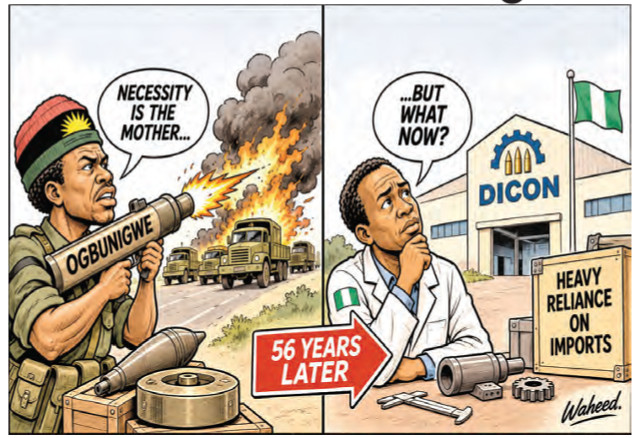
As a postgraduate student at the Nigerian Defence Academy in the Department of History and War Studies, one of the courses I took at PhD level was Major Battles in the Nigerian Civil War. The course lecturer was Dr Lawrence Udeagbala, now an Associate Professor of Military History. Dr Udeagbala is an expert on the civil war. He wrote his PhD thesis on the role of the Nigerian Navy in the Civil War. He lectured without blinking or hesitation, which is typical of military historians.
It was in one of those lectures that he took us through the intricacies of the Battle of Abagana of March 31, 1968. It was an ambush orchestrated by Biafran forces against troops of the 2nd Division of the Nigerian Army, led by Col. Murtala Muhammed. He later became Head of State after the coup of July 29, 1975, which ousted General Yakubu Gowon while he was attending the 12th Summit of the Organisation of African Unity (OAU) in Kampala, Uganda.
Col. Murtala Muhammed might not have anticipated an ambush as he marched his troops and logistics along the narrow path on the Onitsha-Enugu Road towards Abagana to link up with the 1st Division of the Nigerian Army holding in Enugu, and commanded by Col. Mohammed Shuwa to isolate and encircle the Biafran heartland of Awka, Nnewi, Umuahia, and Owerri.
Major Jonathan Uchendu commanded the Biafran Army’s 18th Battalion under whose Area of Responsibility was the Abagana–Ukpo–Enugu-Ukwu corridor along the Onitsha–Awka–Enugu highway. A historical account suggests that the 18th Battalion panicked when it got wind of the movement towards Abagana by the federal troops. This was recounted by Major General Alexander Madiebo in his 1980 war memoir, “The Nigerian Revolution and the Biafran War.”
As Madiebo documented, panic initially rippled through the thinly spread Biafran defensive positions when scouts reported a massive federal column, stretching nearly five miles, with over a hundred armoured cars, supply trucks and thousands of troops advancing along the Onitsha–Enugu Road toward Abagana. The Biafran troops feared they would be completely overrun. That panic turned into euphoria when a volley of Ogbunigwe rockets and mortar fire hit a fuel tanker in the convoy, igniting a chain reaction of explosions that brought the human and military assets of the advancing column into ruins.
Ogbunigwe
The Battle of Abagana remains one of the most devastating ambushes of the civil war. And the locally produced weapon system dubbed Ogbunigwe was credited with giving the Biafrans victory in that operation. What was Ogbunigwe, and how was it developed into such a potent weapon of war? These are very tall questions. I wish I had simple answers for them. Ogbunigwe was not just a single weapon. It was an entire family of homegrown munitions engineered out of sheer wartime necessity. Under that single Igbo name, which translates to “mass killer”, Biafran scientists in the Research and Production (RAP) directorate built everything from command-detonated bucket and cone mines packed with scrap-metal shrapnel, to heavy anti-vehicle box mines, improvised mortar bombs, and the ground-to-ground rockets.
There is an important historical fact I wish to emphasise, because it forms the bulk of my argument in this article. Federal troops had in their arsenal the Soviet-made RPG-7. Biafran troops relied on used scrap metal, local fertilisers and industrial chemicals put together by their own engineers.
Why was the technology behind Ogbunigwe jettisoned after the war? I can’t give a neat answer to that. But I have a recommendation, and I’m using the Defence Industries Corporation of Nigeria (DICON) as my anchor. What is DICON, and what has it done and not done since its establishment in 1964 to build local weapons manufacturing capacity and reduce Nigeria’s dependence on foreign military imports?
READ ALSO:
- Michael Jackson’s Brother, Marlon, Reveals Four-Year Battle With Stage 4 Prostate Cancer
- Northern States Battle Tuberculosis As Region Accounts For 58% Of Reported Cases
- Nick Cannon Hospitalised, Asks Fans For Prayers Amid Lupus Battle
DICON
During the civil war, DICON produced only small arms and small-arms ammunition, even though it was established three years before the war. And curiously, its operations dwindled after the war. DICON lost its primary wartime demand and struggled for decades with underfunding, obsolete machinery and heavy national reliance on foreign arms imports, at the expense of building on the ingenuity of the Ogbunigwe.
The death of Ogbunigwe after the war was a missed opportunity. But not a lost one. Missed, in the sense that DICON was positioned to build on the technology behind it. But it didn’t happen. That it didn’t happen doesn’t mean it can’t still happen. That is why I think DICON is the game changer in our quest to develop indigenous defence capabilities. I don’t need a soothsayer to tell me this. It’s common sense.
The dependence on foreign sources in our defence needs takes a huge toll on the resources of the country. I am not completely against it. But the earlier we make that transition from importation to local production the better for us. And let’s be honest about something. The civil war was fought 56 years ago, and it doesn’t appear that a thing or two with regards to indigenous defence capabilities were adopted as a national defence strategy. I stand to be corrected.
After the Biafran surrender, led by Major General Philip Effiong, it is unclear whether any attempt was made to build on the technical resources of the Biafran Science Group. That is a dicey subject. There is no doubt that a lot of dynamics were at play. Justifiable as some of them might have seemed at the time, 56 years is too long a time to let things be in the cooler.
Is it too late?
Whether it is too late is not a question I can answer definitively. I can only offer a perspective. My perspective is that we must be intentional about our peculiarities and honest enough to admit what we haven’t done, what we need to do, and how to go about it. Missed opportunities are temporary. Lost opportunities are eternal. I’m not convinced that we have lost our opportunities in indigenous defence capabilities. We have only missed some as in the case of Ogbunigwe.
I am not suggesting that the files on Ogbunigwe should be particularly revisited. I am advocating that we look inwards towards developing our indigenous defence capabilities, drawing from the lessons of the Battle of Abagana and the effectiveness of Ogbunigwe. This is why the new drive at DICON has impressed me so far.
The point is that technological innovation in military armament is not the exclusive preserve of industrialised nations. Even under the most difficult circumstances, the ingenuity of the Biafran forces demonstrated an extraordinary capacity to respond to military challenges. What was missing was the institutional continuity required to transform wartime innovation into lasting industrial capability after the civil war.
Today, the question is no longer whether Nigeria possesses the capacity to develop indigenous defence capabilities, but how quickly we can learn from our experiences. The enduring lesson of the Battle of Abagana and other major battles during the war is that innovation born of necessity must never be allowed to die through institutional neglect.

