

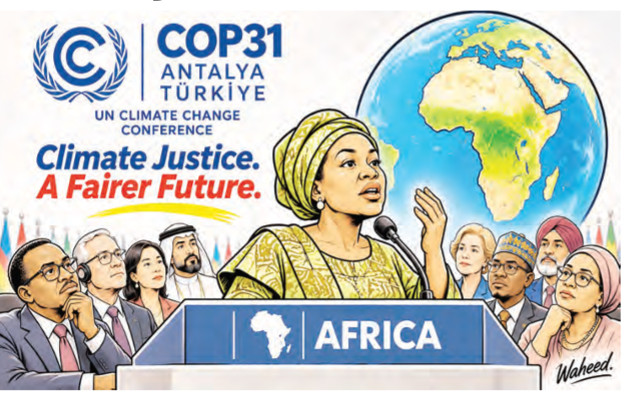
After two extra days in Antalya, Türkiye and the longest United Nations climate summit on record, COP31 ended on November 22 without an overarching political pact. The world’s climate negotiators could not agree on what to do next. The disagreement was not over whether the planet is warming. It was over fossil fuels, money and who should carry the cost of keeping the world habitable.
Countries that accumulated wealth by burning coal, oil and gas are reluctant to accept obligations commensurate with their historical contribution. Countries that contributed least to the stock of emissions are being asked to adapt, rebuild, protect food systems and finance a transition, often with borrowed money. The atmosphere is shared; responsibility is not.
For Africa, Antalya exposed a crisis of power: who sets the terms, controls the finance, whose losses count and whose future can be postponed.
The Price of a Crisis we did not Create
Africa contributes relatively little to global greenhouse gas emissions, yet communities confront erratic rainfall, prolonged drought, destructive floods, coastal erosion, heat stress and pressure on food and water systems. They affect farmers, pastoralists, fishers, traders, informal workers and children whose opportunities are shaped by the climate. Africa’s contribution is estimated at just 2–3 per cent of global CO₂ emissions, despite its disproportionate exposure to climate impacts.
Africa must reduce avoidable emissions, protect forests, improve energy efficiency and build resilient economies. The injustice is that the capacity to act is profoundly unequal. A country burdened by debt, expensive borrowing and infrastructure gaps cannot finance adaptation on the same terms as a wealthy industrialised economy.
When floods destroy infrastructure or drought undermines harvests, rebuilding with debt makes governments pay twice: for the disaster and its recovery. Climate finance that deepens indebtedness turns solidarity into another transaction.
The principle of common but differentiated responsibilities recognises that all countries have a role, but not the same historical responsibility or capacity. That is the foundation of climate justice, not an excuse to avoid action.
Antalya’s Failure was about Money as much as Oil
The most visible disagreement at COP31 concerned the absence of an explicit reference to fossil fuels in the proposed Antalya pact. The European Union and several climate-vulnerable countries rejected the text because it failed to name the principal drivers of global warming. Other countries resisted stronger language. The proposed pact was not adopted.
Beneath the argument over a phrase was a more consequential dispute over finance. Developing countries sought progress on adaptation funding, including a proposed target of $120 billion. That figure did not survive into the final draft. Negotiations on climate finance produced limited substantive progress, while the loss-and-damage funding gap remained largely unresolved. The UN climate body cited progress on just transition and adaptation processes. Those steps matter but are no substitute for money reaching communities.
Announcing targets is easy. Providing predictable, accessible and additional finance is harder, as is ensuring that grants arrive on time rather than disappearing into layers of intermediaries and complex procedures.
Private capital has a role, but investors seek returns; they will not reliably finance every flood barrier, early-warning system or protection programme for a low-income community. Public obligations cannot be outsourced to the market. Nor can historical responsibility be diluted by asking the most vulnerable countries to compete for investment.
A climate deal that speaks confidently about transition but hesitates over who pays is not a complete deal. It is an invoice addressed to the wrong people.
READ ALSO:
- Court Of Appeal Launches E-Filing Platform To Fast-Track Justice Delivery
- Sokoto Students Crisis: ADC Accuses Aliyu Of Abandoning Scholarship, UDUS Students Blocked From Results
- 10-year-old Launches Foundation, Pays Medical Bills For 10 Patients
Africa must not be Trapped Between Oil and Poverty
Africa cannot be told to leave fossil fuels in the ground without a credible pathway to affordable, reliable energy and decent livelihoods. Hundreds of millions of people across the continent still lack access to electricity or depend on unreliable supply. Energy poverty constrains hospitals, schools, businesses, manufacturing and job creation. A just transition must take those realities seriously.
This is not an argument for locking Africa into carbon-intensive infrastructure, but against pretending the transition has the same starting point everywhere. Wealthy countries industrialised using fossil fuels and built the financial and technological capacity to diversify. African countries are being asked to develop differently, while facing higher borrowing costs and limited access to technology. Africa must not reproduce the old model, but neither should it deny people the energy required for development.
Nigeria illustrates the tension. As an oil-producing country, it must confront the fiscal and political consequences of dependence on petroleum while expanding cleaner energy, improving electricity access and protecting communities affected by extraction and climate change. The transition must create jobs, strengthen local industry and widen access to power, not replace one dependency with another: importing expensive technology and exporting raw minerals.
Africa’s critical minerals are central to batteries, renewable energy systems and other technologies. The continent must not become a warehouse of raw materials for somebody else’s green industrial revolution. Resource extraction must be matched by environmental safeguards, human rights, local processing, skills and fair value addition. A green economy that reproduces extractive economics is not transformation.
From Climate Diplomacy to Climate Accountability
The next test begins well before COP32 in Addis Ababa. African governments must arrive with a clearer common position, credible national plans and evidence of what communities need. They must also demonstrate that climate finance received is transparently allocated and produces measurable results. Governments cannot demand accountability abroad while tolerating waste and opaque climate spending at home.
Nigeria, in particular, should treat climate budgeting as a governance priority, not a technical exercise for environment ministries. Federal and state budgets should show what is being spent on adaptation, resilience, clean energy and disaster preparedness, who benefits and whether the spending reaches vulnerable communities. Local governments, women’s organisations, disability groups, farmers and young people must help shape priorities, not merely appear in consultation photographs.
But accountability must travel in both directions. Developed countries must be held to their commitments, including the provision of climate finance. The international system cannot demand transparency from recipients while donors delay pledges, re-label them or deliver them as loans. Trust requires resources to arrive.
COP31 did produce some progress, including work on just transition and a wider push for electrification. These matter, but procedural progress is no solution to a crisis already displacing people and destroying livelihoods. The failure to agree an overarching pact exposed the distance between the urgency of the science and the caution of politics.
The unfinished business now moves to Africa, with Addis Ababa hosting COP32. This gives the continent an opportunity and responsibility. African leaders must resist division by short-term deals and speak clearly on finance, adaptation, loss and damage, energy access and a fair transition. They must connect international negotiations to the lived realities of citizens.
Despite all this, Ghana’s Minister for Environment, Science and Technology, Dr Zanetor Agyeman-Rawlings, demonstrated remarkable composure and diplomatic intelligence when interrupted by COP31 President Murat Kurum while presenting Africa’s collective position, firmly reclaiming the floor and ensuring that the continent’s voice was neither silenced nor sidelined in a negotiation where it has too much at stake to be ignored.
Climate justice is not charity; it is responsibility, fairness and survival. Africa is not asking the world to pay for its development. It is asking those who benefited most from polluting the atmosphere to honour their obligations, so that those who contributed least are not forced to pay most.

