

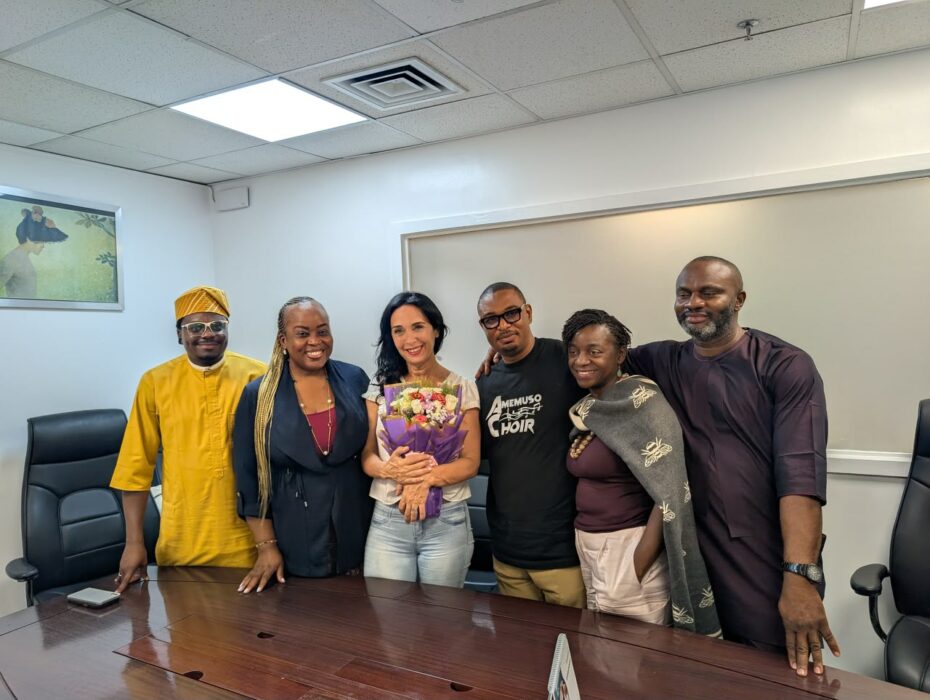
The Abuja Music Society, AMEMUSO, will stage an operatic adaptation of Wole Soyinka’s Death and the King’s Horseman titled The King’s Horseman on 29 November at the Transcorp Hilton, Abuja.
The production is this year’s Opera Abuja offering and continues the group’s shift from performing Western operas to creating indigenous operas drawn from Nigerian literature and culture.
Speaking to journalists at a press conference in Abuja on Thursday, November 26, 2026, AMEMUSO founder Maria Cecilia Toledo said the production reflects how far opera has grown in Abuja since the group began 19 years ago as a small gathering of church singers.
She said opera was largely unfamiliar to Abuja audiences when she arrived in Nigeria, with organised classical vocal performance mostly associated with church choirs and the MUSON Centre in Lagos.
Toledo, who founded the group with co-founder and music director, Samuel Ezugwu, said their early work focused on developing vocal talent before attempting bigger productions such as Carmen and Mozart’s _The Magic Flute
She said those early productions adapted Western operas to accommodate Nigerian cultural expressions without changing the original music.
The decision to develop entirely Nigerian operas, she said, was a development she did not anticipate at the start, but one that has now defined the group’s artistic identity.
Toledo said she was moved to tears when she watched the group’s first indigenous opera production, describing the audience response as proof that Nigerians wanted to see their own stories told through opera.
For her, the move from interpreting Western compositions to creating Nigerian operas marked a major shift in AMEMUSO’s development.
She also described her relationship with the Nigerian musicians as deeply personal, saying their commitment to preserving cultural traditions and their recognition of those who helped develop their talent had continued to inspire her.
Also speaking, Samuel Ezugwu said the push for indigenous opera was driven by a desire to create productions that reflected Nigerian experiences, rather than simply reproducing works that audiences could already see in Europe.
He said Nigerian cultural elements had always featured in the group’s earlier productions, even when it was performing Western operas.
“We do not just want to do whatever that person did. I have always been an advocate of culture,” he said.
He said the idea of a fully Nigerian opera had been discussed for years before the National Assembly Library Trust Fund challenged the group about three years ago to undertake an indigenous production with its support.
The challenge initially appeared daunting, he said, given the technical and cultural demands of developing an opera from Nigerian literary material.
The group therefore assembled academics and musicologists to provide historical and cultural guidance, alongside composer Ayo Ajayi, who worked on the musical development.
Ezugwu said the collaboration laid the foundation for the group’s indigenous operatic productions and its engagement with Nigerian literary works.
He disclosed that the suggestion to explore Death and the King’s Horseman came from the Executive Secretary of the National Assembly Library Trust Fund, Hon. Henry Nwawuba, as part of an effort to broaden the geographical and cultural representation of the group’s productions.
The forthcoming production follows the group’s earlier engagement with Nigerian literary material and reflects its intention to explore stories from different parts of the country.
Despite the artistic progress, Toledo acknowledged that establishing opera in Abuja had involved considerable difficulties, particularly in securing funding, finding suitable venues, recruiting performers and assembling technical expertise for large-scale productions.
She said financial constraints remained a persistent challenge, recalling occasions when funding was uncertain until shortly before performances.
She appealed to the media to be intentional about projecting opera, saying media involvement and documentation were critical to the growth of the art form.
READ ALSO:
- AMAC Mourns Death Of Mother, Daughter Killed By Truck In Abuja
- Kano Records 8 Lassa Fever Cases As Nigeria’s Death Toll Hits 278
- Plateau Attack: Death Toll Rises To 19 As 17 Victims Get Mass Burial
Ezugwu also identified inadequate performance infrastructure as a major obstacle to the growth of opera and other theatrical productions in Nigeria.
He argued that Nigeria lacked a properly equipped theatre capable of accommodating the technical requirements of major stage productions, a situation that limited opportunities for local performers to develop and present their work to international audiences.
“There is no appropriate theatre. Nigeria does not have a proper theatre,” he said.
He also expressed concern about the difficulty creative organisations face in securing institutional support, despite repeated efforts to engage government agencies.
According to him, AMEMUSO has consistently written to relevant authorities, sometimes sending 20-30 letters to secure government attention and support.
He urged the Federal Ministry of Art, Culture, Tourism and Creative Economy and other relevant institutions to move beyond public appearances at cultural events and provide the infrastructure and sustained assistance required by creative organisations.
Ezugwu acknowledged the contributions of the National Assembly Library Trust Fund and Transcorp Hilton to the group’s development, saying their support had helped sustain its productions.
He particularly praised the consistency of Transcorp Hilton’s involvement, stressing that opera was an expensive undertaking requiring substantial financial resources, technical equipment, musicians and specialised production personnel.
He said the group’s ambition extended beyond staging annual performances to developing a sustainable creative industry through training, international exposure and professional development for Nigerian performers.
Among its long-term aspirations is the establishment of a performing arts centre that would incorporate a theatre and conservatory, providing structured music education for children.
Toledo said the Abuja Performing Arts Centre project had already secured a plot of land, with its groundbreaking performed during the administration of former President Goodluck Jonathan.
The proposed facility was designed to include a music school for children, while the AMEMUSO Children’s Choir was established as part of efforts to introduce younger generations to structured musical training.
However, she lamented that the proposed music school had yet to materialise, despite the passage of about 20 years since the project was conceived.
She appealed for renewed attention to the initiative, stressing the importance of identifying and nurturing musical talent at an early age.
In her remarks, Ijeoma Cassandra Osuji, Communications and Marketing Manager of Transcorp Hilton Abuja, said the hotel had maintained its support for the creative industry because of its belief in the transformative potential of young people’s talents.
She said the organisation’s involvement was not limited to one-off sponsorships but was driven by a commitment to supporting creative initiatives over time and witnessing their development.
Osuji cited AMEMUSO as an example of the impact of sustained support, noting that some of the children she had encountered through the group over the years had grown into young adults.
“We believe in it. We believe the next is 20 years, and we’ve maintained a consistent support,” she said.
She added that the organisation also supported other creative initiatives, including the Abuja Literary Society, particularly those focused on developing young people’s artistic abilities.
Describing Nigerian musical talent as exceptional, Osuji said the ability of AMEMUSO members to interpret and transform musical compositions demonstrated the depth of talent available in the country.
For the organisers, the 29 November production of The King’s Horseman represents another opportunity to demonstrate the possibilities of indigenous opera while bringing Nigerian literature and cultural history into a musical theatrical format.
The performance is expected to bring together singers, instrumentalists, actors and other creative practitioners in an adaptation of one of Soyinka’s most recognised dramatic works.

