

The growing menace of drug abuse among young people in Jalingo, Taraba State, has raised concerns among health professionals, security agencies and community stakeholders, who warn that substance misuse is exposing youths to serious health complications, social problems and criminal tendencies.
Stakeholders say the challenge requires urgent and coordinated intervention, including public education, effective law enforcement, access to rehabilitation and stronger community participation, to protect young people from the consequences of addiction.
The concern has become more pronounced in the state capital as public health advocates intensify campaigns against inappropriate medicine use, while security agencies strengthen partnerships with youth organisations and community groups to tackle drug-related challenges.
Health experts warn that prolonged substance abuse can damage the brain, heart, liver and other vital organs, while increasing the risk of mental health disorders, dependence, accidents and premature death.
Young people who abuse drugs may also experience impaired judgment, poor concentration, memory problems and reduced decision-making abilities. These consequences can undermine academic performance, disrupt family relationships and limit their prospects of productive employment.
For students, drug dependence may contribute to irregular school attendance, declining academic performance, withdrawal from social activities and eventual abandonment of education.
The problem also has implications for public safety, as substance misuse can impair judgment and increase the likelihood of risky behaviour. However, stakeholders caution against assuming that drug use automatically leads to criminal activity.
They insist that addressing the challenge requires more than arrests and punishment, stressing the importance of prevention, treatment, rehabilitation and community-based interventions.
The Centre for Initiative and Development (CFID), in collaboration with the Taraba State Antimicrobial Resistance Technical Working Group, has been leading advocacy efforts against the inappropriate use of antimicrobial medicines, another growing public health concern.
At a town hall meeting in Jalingo to commemorate the 2026 World Antimicrobial Resistance Awareness Week, stakeholders called for responsible medicine use and stronger coordination among the health, agriculture and environmental sectors.
The meeting, themed: “One Health, One Action: Prevent AMR Now,” brought together representatives of the World Health Organisation, Taraba State Ministry of Health, security agencies, medicine vendors, academia, civil society organisations and the media.
Speaking at the event, CFID Executive Director, Dr Danjuma Adda, explained that antimicrobial resistance occurs when bacteria, viruses, fungi and parasites no longer respond effectively to medicines designed to treat infections.
He warned that the development could make common infections more difficult to treat, increase disease transmission and lead to severe illness and death.
Adda attributed the growing threat to the misuse and overuse of antimicrobial medicines in humans, animals, agriculture and the environment.
He urged residents to avoid self-medication, sharing antibiotics, using leftover medicines and taking incomplete doses.
He particularly cautioned young people against obtaining antibiotics without medical advice or relying on friends and unqualified medicine vendors to determine appropriate treatment.
According to him, residents should seek medical attention from qualified healthcare professionals, undergo appropriate tests and complete prescribed treatments.
He stressed that antibiotics do not treat viral infections such as influenza and the common cold, warning that their unnecessary consumption could contribute to antimicrobial resistance without providing any health benefit.
“Preventing AMR requires collective responsibility across sectors, and behavioural change must begin within households and communities, alongside sustained government investment, effective regulation and stronger health systems,” Adda said.
Although antimicrobial resistance and psychoactive substance abuse are distinct public health challenges, stakeholders say both demonstrate the dangers of inappropriate medicine use and the need for informed decisions about drugs.
The CFID executive director disclosed that the organisation had implemented antimicrobial stewardship interventions across six states, 12 local government areas, 48 communities and 63 schools.
He said the programme had strengthened the capacity of more than 400 community pharmacists and medicine vendors, while interventions in 14 hospitals had reached over 1,000 healthcare professionals.
The organisation also conducted school-based awareness activities on November 19 and 20, 2026, across four secondary schools in Jalingo.
During the engagements, students and teachers acknowledged that self-medication, sharing antibiotics and discontinuing treatment once symptoms improved were common practices.
The activities were designed to equip young people with the knowledge to make responsible decisions about medicines and discourage practices capable of undermining public health.
The Taraba State Commissioner for Health, Dr Bordiya Buma, represented by the Director of Public Health and Chairman of the State AMR Technical Working Group, Abe Agbu, commended CFID for its support and assured stakeholders of the state government’s commitment to strengthening the response.
Buma pledged to facilitate the inclusion of antimicrobial resistance activities in the state’s Annual Operational Plan, noting that stronger institutional ownership and sustainable financing were necessary for effective implementation.
“We acknowledge the need for stronger institutional ownership and sustainable financing, and we are committed to facilitating the inclusion of AMR activities in the State Annual Operational Plan,” he said.
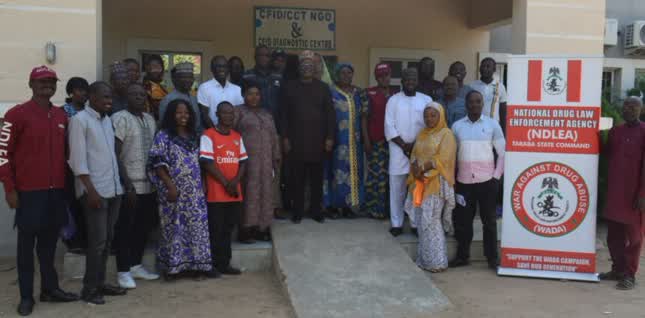
Beyond health advocacy, the National Drug Law Enforcement Agency (NDLEA), Taraba State Command, has intensified engagement with youth organisations and community groups as part of efforts to address drug abuse.
The command recently received separate courtesy visits from the National Youth Council of Nigeria (NYCN), Taraba State Chapter, and the Retired Nigerian Army Officers’ Wives, who sought stronger collaboration in the campaign against substance abuse.
During the visits, the NYCN president solicited the agency’s partnership and support in youth sensitisation, community engagement, intelligence sharing and capacity building.
The State Commander of the NDLEA, CN Javanson Talayedi Kwalma, welcomed the initiatives and assured both organisations of the command’s readiness to collaborate on programmes aimed at protecting young people and communities from drug abuse.
Kwalma encouraged greater community participation, stressing that the fight against drug abuse could not be left to security agencies alone.
The Retired Nigerian Army Officers’ Wives also presented the commander with an Award of Excellence in recognition of his leadership and commitment to the campaign against drug abuse.
In response, Kwalma appreciated the recognition and acknowledged the sacrifices of their husbands towards Nigeria’s unity and security, assuring them that the honour would strengthen his resolve to sustain the campaign.
The command’s emphasis on community participation comes against the backdrop of a recent operation in Jalingo, where three young men were arrested over alleged house-breaking and theft.
According to the NDLEA, the suspects, identified as Ahmad Nura, 19; Jafar Mohammed, 18; and Joshua Ishaya, 20, were intercepted on September 22, 2026, during a motorised patrol and stop-and-search operation at Lankaviri Checkpoint while allegedly travelling out of Jalingo towards Yola.
A search conducted by operatives reportedly led to the recovery of three laptops, three iPhones, 10 Android phones, four power banks and an MP3 player.
The agency said preliminary investigations indicated that the suspects allegedly admitted involvement in breaking into houses within Jalingo and stealing valuables.
The suspects and recovered items were subsequently handed over to the Nigeria Police Force for further investigation and possible prosecution.
The NDLEA urged residents and students who might have recently been victims of house-breaking or theft to report to the police.
Although the arrests do not establish a direct connection between drug abuse and the alleged offences, stakeholders say the incident highlights wider challenges confronting young people, including unemployment, peer pressure, substance misuse and limited access to constructive opportunities.
They argue that effective prevention requires sustained investment in youth development, vocational training, mental health services, rehabilitation and community-based support systems.
For many families, the consequences of drug abuse can be devastating, as addiction may strain household finances, damage relationships and create emotional distress for parents and caregivers.
Stakeholders have also called for stronger regulation of pharmaceutical outlets and medicine vendors, improved access to professional counselling and treatment, and public campaigns encouraging young people to seek help without fear of stigma.
They stressed that young people struggling with substance dependence should be treated as individuals requiring appropriate health and social support, while those involved in criminal activities should face the law through due process.
Participants at the Jalingo town hall meeting urged every stakeholder to sensitise at least 10 people before December 2026 as part of efforts to translate awareness campaigns into measurable action.
They said government agencies, schools, religious institutions, traditional leaders, parents, security organisations and civil society groups must work together to build a healthier and safer environment for young people.
As campaigns against drug abuse and inappropriate medicine use gather momentum in Taraba State, stakeholders insist that the future of Jalingo’s youths depends on collective commitment to prevention, responsible medicine use, treatment, education and sustained community engagement.

