

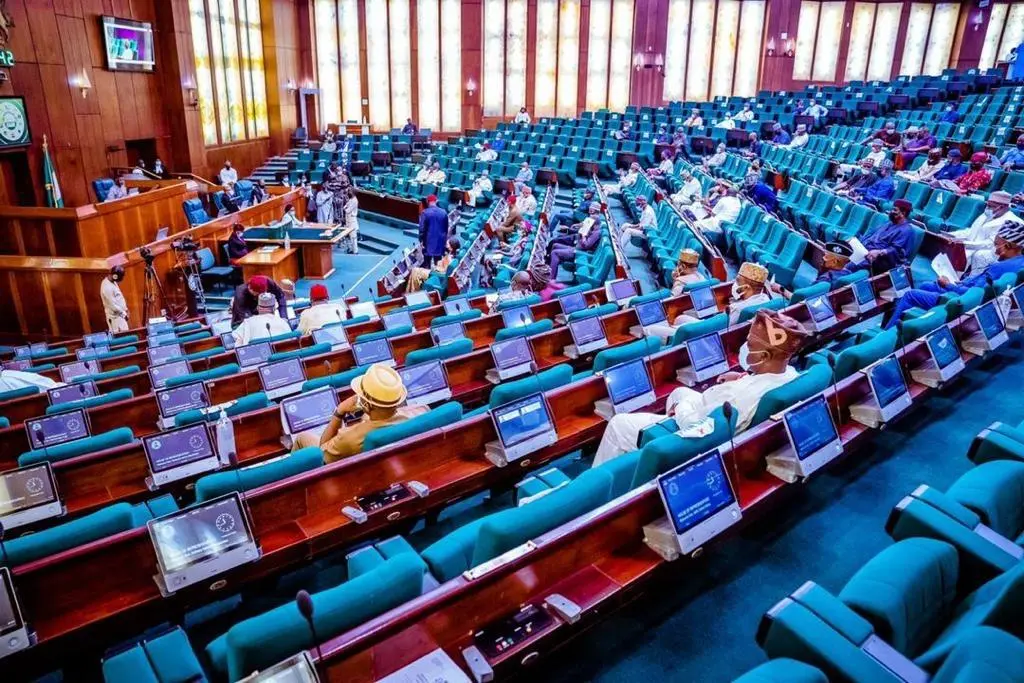
A joint committee of the Nigerian Senate and the House of Representatives has suggested that the nation be divided into six more states.
Following a two-day retreat led by Deputy Speaker of the House of Representatives Benjamin Kalu and Deputy President of the Senate Barau Jibrin in Lagos, the lawmakers came to the resolution.
The committee unanimously decided to establish six more states in the nation after reviewing 55 bids for state establishment.
During the retreat, they reviewed 278 requests for the creation of local governments, two boundary revisions, 55 state creation requests, and 69 bills in all.
Therefore, the number of states in the nation would rise from 36 to 42 if the plan is implemented.
According to the resolution, each of the six geopolitical zones—North West, North East, North Central, South West, South South, and South East—would see the establishment of one extra state.
South West seven, South East six, North West eight, North East seven, and North Central seven are the new states that make up South South after the approval.
With the Federal Capital Territory (FCT), Abuja, being regarded as a state, the North Central could also claim seven states. Benue, Kogi, Kwara, Nasarawa, Niger, and Plateau are all added.
Adamawa, Bauchi, Borno, Gombe, Taraba, and Yobe are the six states that make up the Northeast.
There are currently seven states in the North West: Jigawa, Kaduna, Kano, Katsina, Kebbi, Sokoto, and Zamfara.
With just five states—Abia, Anambra, Ebonyi, Enugu, and Imo—the South East clearly lacks one state.
Similar to the South West, the South South comprises six states: Akwa Ibom, Bayelsa, Cross River, Delta, Edo, and Rivers.
The South East, which felt marginalized in that regard, made the loudest complaint throughout the discussion on state creation, which focused on balancing the numbers.
The South East needed a single state to implement justice and equity, according to regional stakeholders and other well-meaning Nigerians.
But according to the joint committee’s plan, a region would have eight states, others seven, while the South East would only be increased to six.
Concerns about the recommendation have been voiced by certain local political players, who maintain that it will increase inequality.
Elder statesman Dr. Chike Obidigbo was more worried about what he called the unnecessary rancour over a new state for the South East while discussing the development.
Obidigbo said that the ongoing disputes over the location of the new state for South East should be avoided, claiming that they are unnecessary.
He emphasized that there was a clandestine attempt to sow discord among Igbo and expressed regret for the political ploys used in the attempt to address the structural marginalization of South East.
He pointed out that leaders of the Igbo nation under the auspices of the Ohanaeze Ndigbo should call a meeting to carefully consider the various requests in order to reach a peaceful conclusion, rather than agitating the polity with conflicting demands for the additional state.
One of the first known demands for the establishment of a state is Adada.
However, we have heard the benefits of dividing the current five South East states into homogenous areas in order to create an Etiti State.
“I believe that Anioma should be considered as a separate state when the proposed one state from each of the six geopolitical zones is taken into consideration, if Etiti State is given priority consideration.”
“I am forced to adopt this stance because, in contrast to the military regimes, the state construction endeavor would still require a vote.
Furthermore, Obidigbo clarified, “I do not believe that the Delta State House of Assembly would readily vote for an Anioma State as an appendage of the South East.”
He revealed that some outside forces were responsible for the arguments and proposal to merge Anioma State with South East, noting that the political strategy of those promoting that agenda is to create division among the Igbo community due to the pernicious ideas of core and periphery Igbo.
“I believe the issue of geography should be respected,” he said. It would be up to Igbo leaders to determine which state should be given priority if the Igbanke people of Edo State agree to join Anioma and the Igbo communities of Benue and Kogi agree to join Adada.
Additionally, keep in mind that the political office holders in those regions would be inclined to cast their ballots based on where they believe their electoral interests are well-served. Although I value Senator Chinedu Nwoko’s efforts to reach out, a group, not a single person, would ultimately make the final choice.
Additionally, Dr. Chuka Nnabuife, Managing Director of the Anambra State Civic and Social Reformation Office, stated, “I don’t really engage in discussions of marginalization or non-marginalization.”
“To start, I have to applaud the National Assembly for taking the initiative to acknowledge the need for more states.
“Take it or leave it; the claim that there should be numerous states is unpersuasive. It’s similar to suggesting that a company’s economy will suffer if it has numerous corporate entities. Bringing those entities—entities that can truly draw funding loans—is the best thing it can do. Thus, it leads to development.
“And anyone who has lived in Nigeria during the time we had twelve states, 19 states, 30 states, and now 36 states will understand that the standard of living has significantly improved.
Nonetheless, justice and equity are necessary. Balancing the equation is necessary, not because of disagreements about Southeast or anything else.
“There should be a balance between the number of states in the Southeast and those in other regions since equity and fairness are served.
“One area even has seven at the moment. The South East has five, but some have six. Therefore, the South East will continue to have a shortage if one more state is added throughout the regions, and that shortfall must be balanced.
“I support the establishment of more states. Additionally, I support the establishment of a new state in the Southeast.
“Therefore, I don’t mind if we create one more state in the Southeast, but the imbalance will continue if we create one more state in the Southeast and more states for the other regions.”
“I propose two states in the Southeast, one in other areas, and, if feasible, none in a region that has seven states currently. We refer to that as equity and justice.

