

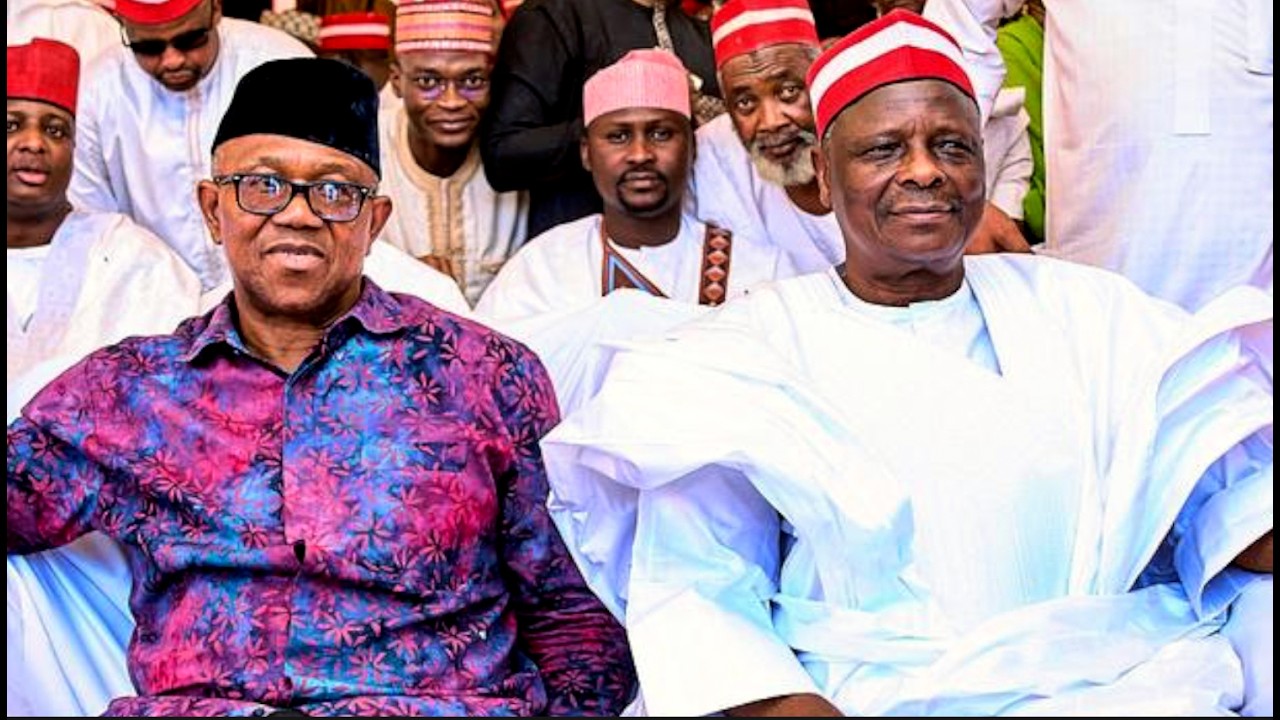
For months, the African Democratic Congress (ADC) coalition had been buzzing with a tantalising prospect for the opposition: a united front capable of ousting the ruling All Progressives Congress (APC) in 2027.
The ADC coalition also gained momentum after two political heavyweights, Peter Obi and Rabiu Musa Kwankwaso, defected to ADC.
But the party was hit with a crack just as the blueprint for an opposition mega-coalition was being drawn up with the dramatic exits of both Peter Obi and Kwankwaso, sending shockwaves through the political landscape.
As the duo moves to a new vehicle, the Nigeria Democratic Congress (NDC), a critical question hangs over the country: is the opposition alliance already on life support or merely engaged in a charade to hand the ruling All Progressives Congress (APC) victory on a platter?
Ego of 2023? Repeating itself?
The splitting of votes between the Peoples Democratic Party (PDP), Labour Party (LP) and New Nigeria Peoples Party (NNPP) gave President Bola Tinubu the keys to Aso Rock in 2023.
The issue of zoning the presidential ticket to the South, which is the root cause of the current crisis in the PDP, is repeating itself in the ADC as the former Vice-President, Atiku Abubakar, has shunned zoning and is ready to slug it out with the ex-Minister of Transportation, Rotimi Amaechi, at the party’s primary election.
Meanwhile, NDC has moved to solve the ultimate issue of zoning, which Peter Obi and Kwankwanso had feared while in ADC.
Kwankwaso endorsed the zoning formula and indicated his willingness to run as Peter Obi’s running mate, a move that could clear the path for his presidential ambition.
Divided Opposition, Tinubu Factor
Public affairs analyst cum lecturer at the Nigerian Institute of Journalism (NIJ), Jide Johnson said in an exclusive interview that the opposition parties are not showing any sign of stability.
“In Nigeria, there are no opposition parties, and there are no ruling parties,” he said. You have just opportunists using political party platforms to try to seek and control the levers of government. Because the political parties in Nigeria do not have control of any ideology. The political parties in Nigeria have similar attributes, similar principles in terms of governance. The question you are asking is that the major actors that were in the PDP, 16 year administration, are also in the APC, 11th year administration.
“So for the past quarter of a century, the actors and players in the political space in Nigeria, whether at the state or especially at the federal level, have been doing the same. So when you talk about opposition, you are talking about Kwankwaso, you are talking about Atiku Abubakar, with the exception of Peter Obi, all of them in the opposition have either been in PDP or APC in the past. So what is the difference? As far as I am concerned, there is no difference between the political parties we have in Nigeria as they are now constituted. “What we have is a special purpose vehicle that people are using to confuse Nigeria so that they can have a sense of deliver so far.”
Asked if the proposed alliance between Peter Obi and Kwankwaso further divides or unites the opposition, Jide said, “Well, we don’t, until the parties are through with their primaries, and once the parties are through with their primaries, then you begin to see. No one is likely going to be talking about the result of the election until we get to November or December 2026. That’s when you see the clearest indication whether the breaking of the opposition into different splinter groups will have an effect on the ability of the opposition to rally around and from the APC, or whether the APC will be able to push its house in order to manage the internal crisis that will likely arise out of the way the party has conducted its primaries thus far.
“Thus, it might be too far fetched for us to speculate on the outcome of the January 2027 presidential poll. The probable outcome will be known when the parties come, conduct their primaries and we know how they are able to manage their internal crisis post-primary. And you do not know if, after the candidacy by the merger, you will remember that in 1999 there was an understanding, a merger between the AP and the APP to present a candidate against the PDP. But the current set-up tends to favour the incumbent as the opposition is splintered across various interest groups. It is in favour of the incumbent, which is the APC and that is what people are thinking. But you don’t actually feel for a fact what will likely be the outcome in January, until we get to that period I’ve spoken about.”
Jide Johnson, speaking on fears of a possible implosion within the APC, especially given the results announced so far said, “There will always be internal post-primary crisis, depending on how it is managed. How it is managed will go a long way to preventing the implosion you talk about. And when you talk about the power of equivalency I think the APC has a lot of opportunity to dispense. I think those who are not happy with the outcome might likely be compensated. They might think their stock is better with the APC, than with an uncertain opposition.
“To me, the 2026 Electoral Act has boxed everybody into a corner. In the past you saw those who lost out in the primaries likely go to another political party. But we don’t have that option anymore. Unfortunately, the members of the National Assembly, they play the role of a tortoise and the same sword that they thought that would be used against them, their opponents in their respective constituencies, is the same sword that has been used against them presently. And so the same provisions they require for the 2026 Electoral Act, the same provisions that have been used to collude in their political ambitions. And we wait and watch the outcome. But it is APC’s advantage now to some extent because the opposition is fragmented.

