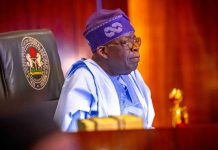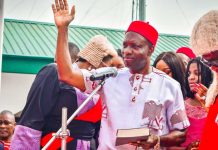

With the defection of Plateau State Governor Caleb Mutfwang from the Peoples Democratic Party (PDP) and hints that Kano State Governor Abba Yusuf may soon leave the New Nigeria Peoples Party (NNPP) for the country’s ruling party, the All Progressives Congress (APC) is getting closer to controlling up to 30 of Nigeria’s 36 states.
According to reports, Mutfwang officially resigned from the PDP in a letter dated December 29, 2025. However, the action was made public on Thursday, January 1, 2026, which made it possible for him to register with the APC, which is anticipated to be finished today.
When his defection is finalized, the APC will have 28 governors, matching the record achieved by the PDP during the general elections of 2003.
But unlike the PDP’s post-2003 development, the APC’s rise from 20 governors following the 2023 elections has been primarily fueled by opposition party defections, raising worries about power concentration and a potential slide towards one-party domination.
Zamfara, Kano, and Abia After that?
Abba Yusuf, the governor of Kano State, is thought to have made a suggestion that he will soon register with the APC.
29 states would be under the authority of the ruling party if he defected.
First-term governors like Alex Otti of Abia State (Labour Party) and Dauda Lawal of Zamfara State (PDP) are reportedly considering their political options, with the APC thought to be a key factor.
The party might have more than 30 states under its control if they do eventually switch.
Governor Agbu Kefas of Taraba State has already established a date for his defection to the APC and resigned from the PDP, but he has not yet finished the symbolic procedure of obtaining his membership card. Due to a national emergency, his official reception into the party was first delayed, but it is now anticipated later this month.
Ademola Adeleke, the governor of Osun State, who switched from the PDP to the Accord Party last month, was also rumored to have considered joining the APC but was allegedly prevented by local political dynamics inside the party.
According to reports, Plateau Governor Mutfwang defected just two weeks after APC National Chairman Nentawe Yilwatda made a public announcement that he would be joining the ruling party.
Although some APC leaders in Plateau State reportedly opposed the decision, party sources stated that the opposition was overcome after the president intervened, paving the way for the governor’s handover.
Mutfwang stated in his letter of resignation to the PDP ward chairman of Ampang West Ward, Mangu Local Government Area, that the necessity of “purposeful leadership, clarity of direction, and effective service delivery” guided his choice.
He thanked the PDP for giving him a platform to follow his political goals and thanked supporters and party members for their allegiance.
The governor stated that his decision to join the APC would help expedite growth and provide observable benefits of democracy, and that it was in keeping with Plateau State’s and the federal government’s development goals.
The governor is still dedicated to “inclusive governance, unity, and breaking barriers of division” as crucial instruments for attaining sustainable development, according to a statement released on Tuesday by his Director of Press and Public Affairs, Gyang Bere.
Mutfwang is scheduled to meet with party leaders and members at the APC State Secretariat at Kalwa House, Yakubu Gowon Way, Jos, after receiving his APC membership card at 11 a.m. today at Victoria Gowon Hall, Government House, Rayfield.
The increasing number of defections into the APC, according to political observers, is a reflection of deeper structural flaws in Nigeria’s political system.
According to Prof. Hassan Saliu, National President of the Nigerian Political Science Association, the tendency indicated that power preservation and personal interests were more important in Nigerian politics than philosophy.
“The nature of Nigerian politics cannot be separated from the defection of governors to the ruling party,” Saliu stated in an interview with Daily Trust.
Moving between Nigerian political groups is easy because their ideologies are generally similar. The checks and balances necessary for democracy are sadly threatened by this.
He cautioned that an overabundance of power in the legislature, executive branch, and state governments could erode accountability.
He continued, “Policies may be pursued without opposition oversight if a ruling party controls the presidency, National Assembly, governors, and even local governments.”
Saliu also voiced concerns that if Nigerians start to see the system as essentially one-party dominated, voter apathy would get worse.
Nigeria seemed to be moving toward an unofficial one-party system, according to Prof. Gbade Ojo, a political scientist at the University of Ilorin.
Although a multi-party system is guaranteed by the Constitution, he told Daily Trust that defections have been made easier by the opposition parties’ lack of unity, especially among governors who want to be re-elected or gain political significance before 2027.
He claims that the tendency runs the risk of offending people and strengthening the idea that politics is more about self-interest than public service.
Additionally, Ojo cautioned that a single party’s growing membership could exacerbate internal strife during the primaries.
“What is frequently presented as consensus is sometimes coercion or manipulation, undermining internal democracy and alienating voters,” he stated.
Don’t Let the Opposition Fix Its House
Dr. Edun Abdulkareem, the head of political science at the University of Ilorin, maintained that the APC had not violated democratic principles.
“Lobbying or convincing politicians to join a party is not intrinsically anti-democratic; rather, it is a part of politics,” he stated.
Instead of criticizing the ruling party for defections, he stressed that opposition groups should concentrate on bolstering their internal unity.
There have been accounts of governors being forced to change allegiance, either directly or indirectly. In reference to recent assertions made by the governor of Bauchi State, he stated, “Citizens should watch how these dynamics unfold.”
The lack of a reliable opposition, Abdulkareem continued, was a serious danger to democracy.
“Maintaining a robust opposition is essential to democracy. Without it, citizens have few ways to demand responsibility and policymaking lacks oversight, he said.
Analysts point out that the APC’s quick consolidation of power across the country is demonstrated by its climb from 20 governors following the 2023 elections to a possible 30 by early 2026.
It was noted that the party had also won a two-thirds majority in both chambers of the National Assembly, a fact mostly ascribed to defections from the Labour Party and the crisis-ridden PDP.
The APC now has unparalleled power over national politics as a result of its dominance, which has improved its ability to push its legislative agenda and harmonize state policies with the federal government.
Opposition groups may find a focal point in the coalition-led African Democratic Congress (ADC), but there are still worries that more defections could erode public involvement and supervision.
However, the APC has continuously denied any intention to erode democracy, maintaining that political recruitment and persuasion are still acceptable aspects of a competitive political system.