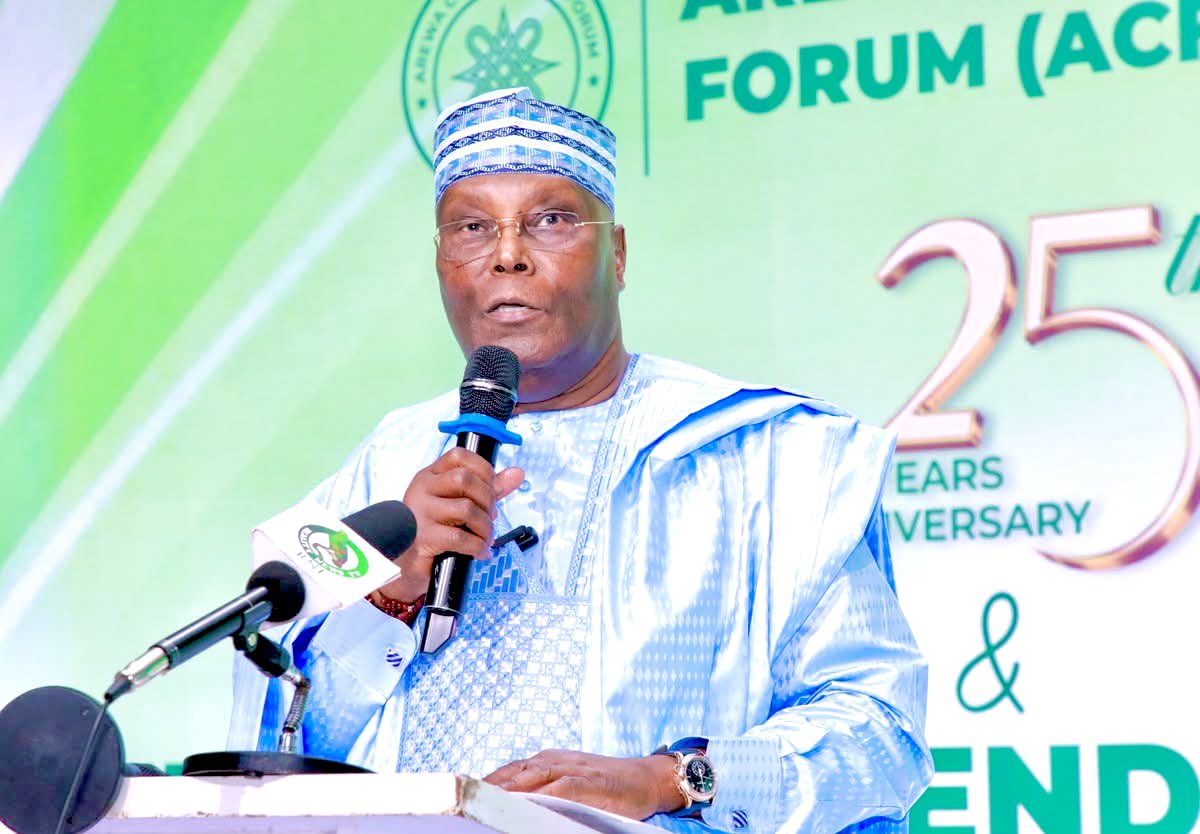
Atiku Abubakar, a former vice president and leader of the African Democratic Congress, has voiced serious concerns over reports that President Bola Ahmed Tinubu’s request for a new $6 billion external loan was approved by the Senate in a record amount of time—less than four hours after it was presented.
According to a statement released by Phrank Shaibu, Atiku’s Senior Special Assistant on Public Communication, the situation is not only concerning but also alarming.
He pointed out that a choice with such significant national ramifications, one that will put more strain on an already fragile economy and jeopardize the future of future generations, cannot be handled with such careless rush.
“What Nigerians have seen is a disturbing erosion of oversight responsibility, not legislative diligence,” he stated.
He emphasized that the National Assembly is a constitutional safeguard intended to question, examine, and defend the interests of the Nigerian people rather than acting as a simple rubber stamp.
Instead of acting as a constitutional safeguard, the Senate has devolved into a conveyor belt that processes petitions of significant national importance without conducting adequate research. Decisions on borrowing that will affect future generations cannot and should not be handled with such a casual hurry.
“Where was the discussion? The thorough analysis was missing. The accountability was missing.”Atiku asked.”
He cautioned that it raises severe concerns about due process and the legislature’s devotion to its constitutional obligation to approve a multibillion-dollar borrowing request in record time without visible examination.
Atiku cautioned that although these goals might seem standard on the surface, they reveal more serious structural flaws in the country’s financial management.
“It is not a strategy—it is a risky cycle—to turn to new borrowing in order to pay off current debts, fill budget gaps, and fulfill regular obligations. It shows a concerning lack of sustainable economic planning, clear prioritization, and fiscal restraint,” he stated.
He further grounded his worries in new fiscal indicators, pointing out that the World Bank revealed that Nigeria’s exposure to the International Development Association (IDA) had increased to $18.7 billion between January and February 2026, making it one of the world’s biggest recipients of concessional loans.
“Even as the Debt Management Office continues aggressive domestic borrowing through high-volume bond auctions, as evidenced by the March 2026 FGN Bond Offer Circular, the President is requesting an additional $6 billion external loan in March 2026 alone, largely to finance immediate government obligations and service existing debt,” he continued.
Atiku claims that this pattern indicates an unsustainable borrowing trajectory that puts the nation on a risky fiscal course.
The former vice president also questioned whether the move represents a conscious attempt to mortgage the nation’s future.
“Because that’s what it implies,” he said.
In addition to the growing debt it has already accrued in the first quarter of 2026, what does a government that seems to be getting ready for an election defeat in 2027 plan to do with an extra $6 billion in borrowed funds?
Atiku emphasized that prudence, not haste, should direct fiscal decisions at a time when Nigeria’s debt profile is still rising and debt servicing takes up a sizable amount of national revenue.
He stated, “Borrowing is not intrinsically bad, but reckless borrowing made possible by legislative complacency is dangerous.”
The quickness of the approval, he continued, points to a concerning feeling of desperation that undermines trust in the nation’s long-term economic trajectory.
“Nigeria cannot be used as a private enterprise at will. “We cannot sign away our country’s future in a matter of hours,” he said.
Atiku insisted that Nigerians should have openness, accountability, and responsible governance and urged the Senate to recall its constitutional function as a check on executive excesses rather as an extension of it.
“History will document this moment—and the decisions made,” he said in closing.
…Due to BUA Food’s N1.77 trillion in revenue and N28 dividend, Rabiu and Elumelu are aligning on capital size and industrial expansion.
However, BUA Group’s founder and chairman, Abdul Samad Rabiu, hosted Tony Elumelu, the chairman of United Bank for Africa, and his executive management team at BUA Group’s corporate headquarters in Lagos in an effort to strengthen a partnership that has subtly supported decades of business growth.
The engagement was more than just a visit; it brought together two organizations whose capital and industrial capacity alignment has continuously resulted in scale, execution, and long-term value creation throughout the economies of Nigeria and Africa.
A reinvigorated drive to broaden financing frameworks for large-scale manufacturing, strengthen local production assistance, and unleash the next stage of growth across food, infrastructure, and export-oriented value chains was at the center of the conversations.
Reflecting on a nearly thirty-year connection, Rabiu charted its development from Standard Trust Bank’s early days to its current state as a solid, reliable alliance with UBA.
According to Rabiu, “lasting partnerships are built on conviction, not on transactions.” Over the years, we have developed a common perspective of Nigeria’s future and the steps necessary to get there alongside UBA and the Nigerian banking sector. That alignment is still as strong now as it was when it first started.
Elumelu placed the partnership within a larger framework of African-led development, emphasizing its strategic significance.
According to Elumelu, “organizations like BUA Group show what is possible when long-term capital meets disciplined execution.” “We must continue to facilitate that scale, assisting businesses that are not only expanding but also transforming the Nigerian economy.”
At a time when Nigeria’s growth story is increasingly being driven by indigenous size, operational depth, good government action, and persistent investment in genuine industries, the gathering represents a continued convergence between capital and industry.
BUA Foods, a BUA company, issued its audited results for the fiscal year that concluded on December 31, 2025, showing a 16% growth in revenue from N1.53 trillion in 2024 to N1.77 trillion, providing a parallel illustration of that magnitude.
Along with ongoing implementation of its expansion strategy, the performance shows consistent demand across its core categories, such as sugar, wheat, pasta, and rice.
Profit after tax increased by 95% to N518.4 billion from N265.99 billion the year before, while gross profit increased to N737.26 billion from N540.82 billion.
The company’s profitability profile was strengthened when earnings per share rose to N28.80.
The Board has proposed a dividend of N28 per share, up 115% from N13 in 2024, in keeping with its commitment to shareholder value. Subject to shareholder approval, the total proposed payout is N504 billion.
While total assets increased by 27% to N1.39 trillion, the cost of sales remained at N1.037 trillion, indicating consistent investment throughout operations and the wider value chain.
Abdul Samad Rabiu, Chairman of BUA Foods, commented on the findings, saying, “Our 2025 performance reflects a business that is not only growing, but scaling with discipline.” While preparing for the future, we are increasing capacity, strengthening local production, and consistently providing value to shareholders.
Engineer, the Managing Director. “Our strategy remains to expand capacity, strengthen market presence, and optimize the entire supply chain,” Ayodele Abioye continued. solid demand signals indicate that we are in a solid position to maintain this momentum.
When combined, the meeting between BUA Group and UBA and the record-breaking success of BUA Foods indicate a more significant change for Nigeria. Institutions that combine scale, capital discipline, and long-term vision are increasingly influencing Nigeria’s progress, which should be viewed as a consolidation of industrial leadership rather than merely an expansion.
With its headquarters located in Lagos, Nigeria, BUA Group is one of the top manufacturing, mining, food, and infrastructure corporations in Africa. BUA, which was founded in 1988 by industrialist Abdul Samad Rabiu, has substantial stakes in infrastructure and mining, including construction, real estate, plaster production, cement manufacturing, quarrying, and mining.