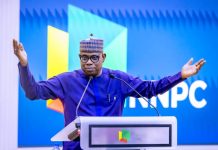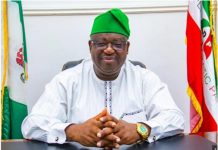
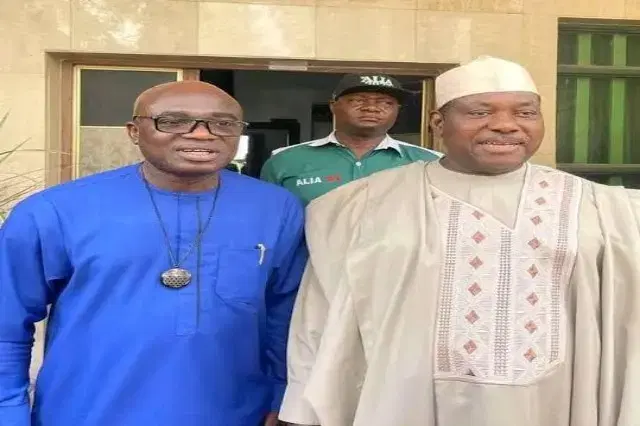
Senator Dr. George Akume, the Secretary to the Government of the Federation (SGF) and a prominent figure in Benue politics, is allegedly engaged in a political battle with Benue state Governor Hyacinth Alia. This is an odd story that has been going around in the often heated world of Nigerian politics, where rumors usually take the place of facts.
It is a story that depends more on speculation than on facts, more on political rumors than on any solid fault line.
The political history of Benue—and even its current structure—can be studied more closely and methodically to uncover a different, much more complex reality.
Political history’s weight
The discussion must be appropriately positioned by starting with the long-lasting political structure that George Akume created over almost thirty years. Akume has not only engaged in the system since he entered partisan politics in 1998, but he has also influenced it.
A unique continuity of influence can be seen in Akume’s career, which included two terms as governor of Benue State, three terms as a senator of the Federal Republic, where he became Senate Minority Leader, and finally a position as a minister of the Federal Republic.
His present position as SGF in President Bola Ahmed Tinubu’s administration emphasizes his importance in Nigeria’s governance structure even more.
Chance is not the foundation of this career. It is the result of careful coalition building, persistent grassroots involvement, and an uncommonly adept handling of Nigeria’s convoluted political landscape.]
The Political Equation of Benue
Akume’s effect is evident in Benue State and is neither fictitious nor overstated. The state’s succession of governors—Gabriel Suswam, Samuel Ortom, and now Hyacinth Alia—indicates a political system that has occasionally collided with Akume’s strategic course.
This is not intended to undermine these leaders’ legitimacy or agency. Instead, it is to recognize the underlying political community that enabled their emergence. Politics, especially in Nigeria at the subnational level, is rarely an accident; rather, it is frequently the result of established networks, institutional memory, and layered alliances.
2023: Putting Strategy Before Emotion
The most vivid example is perhaps the Benue governorship election in 2023. There were several seasoned candidates in the field, including well-known national figures with significant political clout. The synchronization of structure, timing, and strategic mobilization, however, proved crucial in a competition where ancestry alone could not ensure victory.
Therefore, it is necessary to view Governor Alia’s rise within this larger framework, not as a singular political miracle but rather as the result of a concerted effort in which several players, including Akume’s powerful political apparatus, played crucial roles.
Organization, Ability, and the Politics of Organizing
The current All Progressives Congress (APC) membership registration and revalidation process in Benue State is equally telling. Concerns regarding grassroots penetration were raised by the initial attempts’ poor results. However, the changeover was quick and dramatic once Akume’s network, which was part of the larger party organization, was activated.
A crucial element that is sometimes missed in political research is that, despite rhetoric, power in Nigerian politics still lies in organization, reach, and the capacity for mass mobilization. This was highlighted by the sharp increase in participation that occurred within days.
Disproving the Story of the “Battle”
The idea of a political conflict between Akume and Alia becomes more and more implausible in light of this. Hierarchy, context, and the dynamics of political mentoring—all of which frequently determine relationships inside party systems—are all ignored in this story.
It is a misinterpretation of Akume’s political status and the changing role of Governor Alia in that system to portray the two men’s encounter as a contest. The latter is still establishing himself in a system that has been created by long-standing players, despite being relatively fresh to the complexities of party politics.
This is a continuum, where experience and incumbency coexist, often awkwardly but not always antagonistically. It does not imply subservience.
The Need to Maintain Party Stability
Nigeria is currently confronted with a variety of governance issues, ranging from national security to economic transformation, and the internal unity of the ruling party structures is still crucial. As SGF, Akume’s duties go beyond politics at the state level and have a national reach, necessitating administrative concentration, stability, and coordination.
Therefore, to imply that he is focused on subnational rivalry would be a misinterpretation of his interests. Right now, it makes more sense for him to use his political capital to maintain governance results and strengthen party unity.
Beyond Speculative Politics
The assertion that Akume and Alia are involved in a political conflict ultimately sheds more light on the character of modern political discourse than it does on the actual situation. In a setting where perception is frequently used as a weapon, stories can become independent, divorced from reality yet powerful in their impact.
But careful consideration necessitates moderation. It necessitates separating structure from speculation and noise from subtlety.
Throughout his political career, Senator George Akume has demonstrated depth, consistency, and lasting significance. The government of Governor Hyacinth Alia marks a new stage in that changing environment. In addition to being oversimplified, portraying their relationship as antagonistic is also analytically incorrect.
Not every disagreement in politics or government is a battle, and not every silence is a war. It is important to reiterate that Akume’s priority is still on providing the country with high-quality services while establishing the necessary stability within the ruling party. He is also working to galvanize support for President Bola Ahmed Tinubu not only in Benue State but also throughout the North-central region and the entire nation. His stature in politics is self-evident.