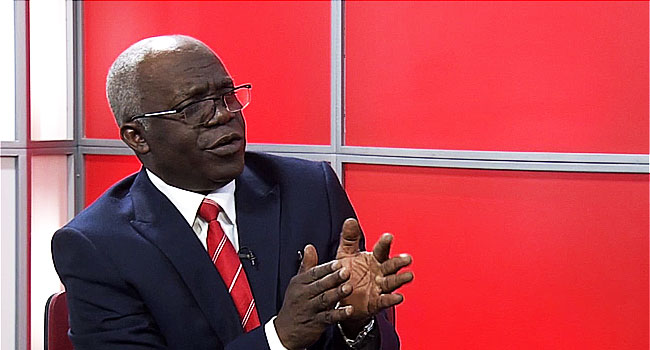
The Federal Government’s plan to try military officers accused of plotting a coup against President Bola Tinubu before a court martial has been criticized by human rights attorney and Senior Advocate of Nigeria Femi Falana, who maintains that the offense is criminal in nature and should be prosecuted under the Criminal Code Act.
In response to the Defense Headquarters’ disclosure last week that certain military personnel and civilian accomplices had planned to topple the Tinubu administration in October 2025, Falana reportedly made this known in a statement issued from Lagos.
The attorney particularly cited Section 41 of the Criminal Code Act, which stipulates that anyone who tries to overthrow the government or remove the president by force faces life in jail.
The contentious story by Sahara Reporters that 16 officers, ranging from captain to brigadier general, were arrested in October 2025 for organizing covert meetings to overthrow the government was finally addressed by Defense Headquarters this week after months of silence.
Brig. Gen. Tukur Gusau, the Director of Defense Information at the time, denied the claim as dramatic and insisted that the problem was an internal disciplinary issue. The Defense Intelligence Agency did, however, later affirm that a thorough inquiry had been conducted and that the results will be made public.
Maj. Gen. Samaila Uba, the new Director of Defence Information, gave an update, stating that the inquiry had been completed in accordance with military protocols and that the accused would face trial before a military tribunal.
The accused would face court-martial proceedings in accordance with military laws, according to Defense Minister Gen. Christopher Musa, who also addressed the development.
In response, Falana wrote, “I am compelled to point out that the alleged coup plotters cannot be tried by a court martial or any other military tribunal under the current democratic dispensation, even though I am involved in the ongoing campaign against unconstitutional change of governments in Africa.” It is a serious offense that needs to be tried under the Criminal Code Act since the military commanders involved in the coup attempt intended to remove an elected president from office. It is important to note that the accused coup plotters can only be tried under section 41 of the Criminal Code Act, which states that anyone who plans to overthrow the government by using criminal force or to overthrow the president while he is in office and discloses that plan through an overt act is guilty of a felony and faces life in prison.
The Umoru Mandara v. Attorney-General of the Federation (1984) 4 S.C. 8 case should be studied by those who are putting increasing pressure on the Federal Government to have the accused coup plotters convicted by a court-martial. At the Federal High Court in Lagos, the appellant was tried on four counts of treasonous crime, incitement to mutiny, and attempting to foment disaffection. The defendant was found guilty and given a 15-year prison sentence at the conclusion of the drawn-out trial. However, the Supreme Court overturned his conviction, arguing that the Federal High Court lacked the authority to try the appellant. The Federal High Court is empowered by the Constitution to hear cases involving treason and related offenses.
But after President Shehu Shagari was overthrown on December 31, 1983, the Constitution was suspended and altered, and the head of state and governors, respectively, issued decrees and edicts that governed the nation. In order to deal with perceived political opponents, several of the annoying decrees were hastily implemented. For example, the Treason and Other Offenses (Special Military Tribunal) Decree 1 of 1986 was issued after General Ibrahim Babangida, the military president, learned that General Mamman Vatsa and the other military officers could only be sentenced to life in prison under section 41 of the Criminal Code Act.
Treason and treasonable felonies were punishable by death under the Treason Decree. The accused coup plotters were put on trial under the Treason Decree, which was issued on January 6, 1986, despite the fact that they had been detained in December 1985. As a result, they were found guilty by a military court and put to death in a planned manner. General Babangida’s assertion that he killed his close buddy Vatsa because the law prohibited him from doing so is wholly false. When Major Gideon Orkar and his associates tried to kill General Babangida and split up Nigeria on April 22, 1990, but were unsuccessful, they were aware of the legal repercussions of their actions. Therefore, the trial, conviction, death sentence, and execution of the coup plotters under the Treason Decree did not come as a surprise to Nigerians.
In May 1992, the next batch of suspected coup plotters was taken into custody. Section 41 of the Criminal Code Act charged the five accused with treason and conspiracy. They were charged in front of a Chief Magistrate Court in Gwagwalada, the Federal Capital Territory, since they were civilians. They were accused of starting a “Babangida Must Go” campaign across Nigeria. Among the five defendants were me and the late Chief Gani Fawehinmi. We appeared on behalf of ourselves and our allies since we were detained incommunicado.
Fawehinmi said, “It is ironic that Babangida and his comrade-in-arms, who should have been put on trial for toppling the Shehu Shagari government in December 1981, have turned to charge us with treasonable felony for campaigning against the criminal manipulation of his political transition program,” as she prayed for our bail. I argued that while the president is in office, section 41 of the Criminal Act allows for the formulation of an intention to remove him from office. I came to the conclusion that the law was meant to defend an elected President with a limited term of eight years rather than a military dictator because the General had no set term of office.
“The prosecutor dropped our trial after we confirmed that we intended to use the case to put the serial coup plotters in power on trial. Because of the lack of thorough prosecution, the accusation was dropped, and we were released. Babangida then issued the Treason and Treasonable Offenses Decree No. 29 of 1993, which gave the former military junta the authority to establish military tribunals for the trial of coup plotters. Under the Treason and Treasonable Offenses Decree, the military and civilians—including journalists detained for organizing the 1995 phantom coup d’etat—were prosecuted in front of cameras.
“There was no legal justification for the military tribunal to try the civilians. The commission found in Media Rights Agenda v. Nigeria (2000) AHRLR 5 that the arraignment, trial, and conviction of civilians by a Special Military Tribunal presided over by active military officers violated both the duty to ensure the independence of the courts under article 26.63 and the fundamental principles of a fair trial guaranteed by article 7 of the Charter. “Military courts should not, in any circumstances whatsoever, have jurisdiction over civilians,” the panel said, citing its Resolution on the Right to a Fair Trial and Legal Aid in Africa. In a similar vein, crimes falling beyond the purview of regular courts shouldn’t be tried by Special Tribunals.
It is documented that General Abdulsalami Abubakar overturned anti-democratic laws, including the Treason and Treasonable Offenses Decree No. 29 of 1993, in order to restore civil rule to the nation, which took effect on May 29, 1999. However, the 1999 Constitution’s authors added section 251(2), which states that “The Federal High Court shall have and exercise jurisdiction and powers in respect of treason, treasonable felony, and allied offences,” in response to the Lagos High Court’s ruling over the Interim National Government, which was led by Chief Ernest Shonekan, on November 10, 1993.
The purported involvement of certain people in the scheme is another reason why the claimed coup plotters cannot be convicted in a court-martial. The accused civilians cannot be tried in a military court since they are not covered by service law. Even in the Federal High Court case of Chief Moshood Abiola vs. The Federal Republic of Nigeria (1995) 1 NWLR (Pt.370) 155, the defendant was accused of treason. In a similar vein, the Federal High Court accused the defendants in Ameh Ebute vs. State (1994) 8 NWLR (Pt 360) 66, including Senator Bola Tinubu (now President), of treason.
In the case of Dr. Kizza Besigye & Others v. Attorney General and Others (Miscellaneous Cause 31 of 2025) [2025] UGHCCD 29 (24 February 2025), the Supreme Court of Uganda has put an end to the unlawful practice of prosecuting civilians in military courts. In that instance, on November 16, 2024, Dr. Kizza Besigye and Haji Obeid Lutale were brutally kidnapped from Nairobi, Kenya, transported to Uganda, and unlawfully imprisoned at the Makindye military barracks. On November 20, 2024, they were hauled before the General Court Martial on charges of possessing firearms and committing security offenses. They questioned the trial’s legal competence. The Supreme Court ruled on January 31, 2025, that military courts lacked the authority to try civilians. As a result, officials were ordered to stop any existing military prosecutions of civilians and move them to the nation’s civilian court system.
In light of the aforementioned, the case file of the suspected coup plotters ought to be sent right away to the Federation’s Attorney General’s office. In accordance with section 251(2) of the 1999 Constitution, the Attorney-General must review the case file upon receipt and file a charge of treasonable felony before the Federal High Court. It is important to remind the military authorities that the plot to overthrow a civilian government is not a military matter, even though they have threatened to trial the accused coup plotters in a military court. Treasonous felony is not one of the offenses mentioned in the Armed Forces Act, and the decree for the trial of coup plotters that the military officers were depending on has been revoked.