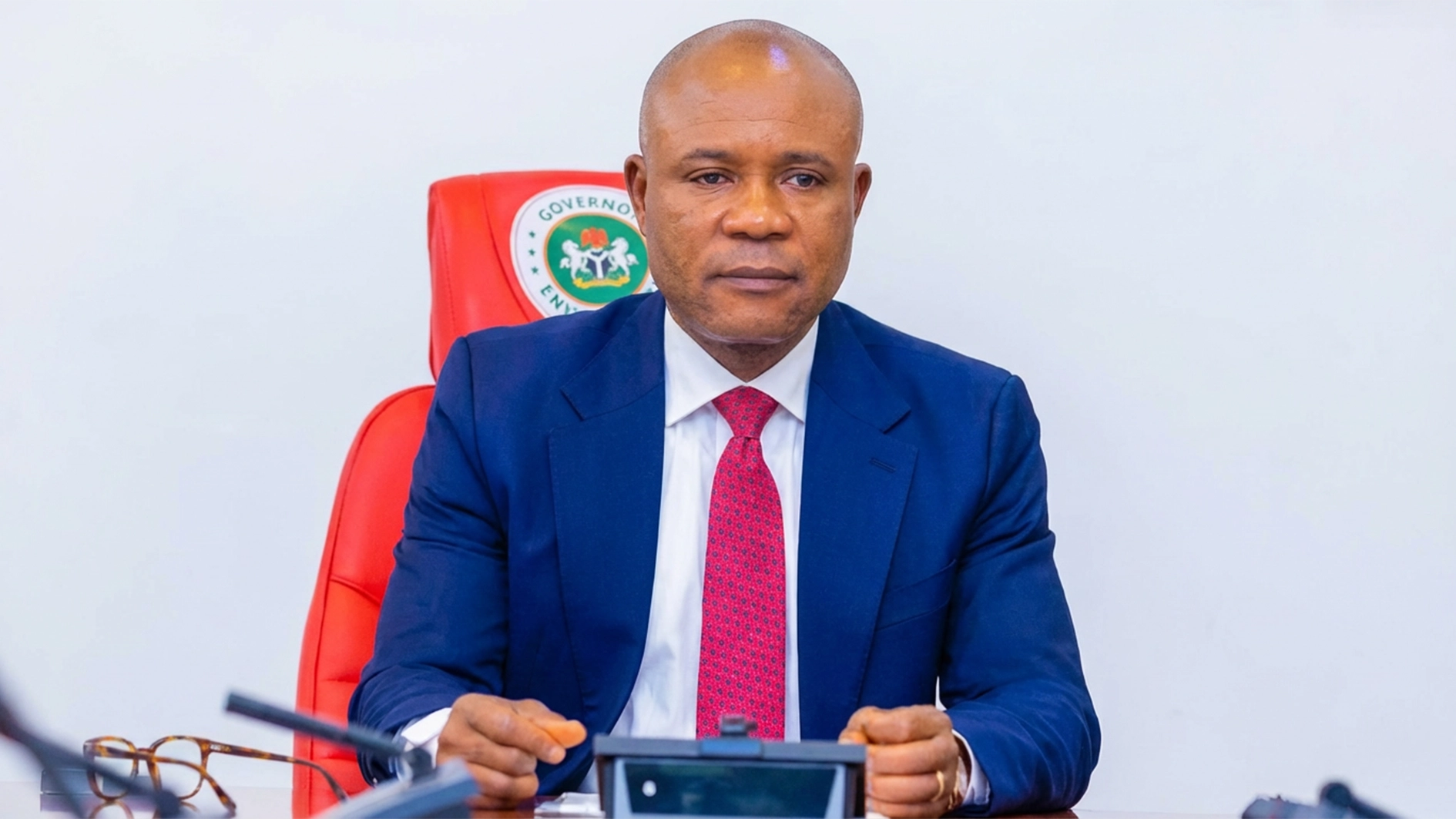
The nearly three-year tenure of Enugu State Governor Peter Mbah is quickly turning into a fascinating case study of how contentious political beginnings may develop into legitimacy based on performance. Jonathan Eze is a writer.
In a comparatively short time in office, Peter Mbah has completely changed the landscape of subnational leadership in Nigeria. He went from being a governor whose 2023 election victory was hotly contested to one whose style of governance is increasingly focused on strategic development and visible performance.
His election results in Enugu State were anything from peaceful. Early on in his presidency, the election was contested on a variety of grounds, from procedural violations to more general concerns about legitimacy.
However, instead of staying mired in protracted political defensiveness, Mbah has adopted a strategic and purposeful shift that centers public discourse around governance delivery.
His administration’s shift from political contestation to constructive governance may be its most distinguishing characteristic.
Mbah has taken a different approach in a political climate where disputed mandates frequently result in lethargy or overzealous politicking. His strategy demonstrates a thorough comprehension of the fact that performance eventually solidifies legitimacy, even though it is decided by the law.
His broad and multisectoral development program needs to be positioned within this framework.
Mbah’s innovative approach to infrastructure and human capital development forms the basis of its governing ideology.
One of his most notable projects is the Enugu Smart Green Schools project, an educational reform initiative that aims to incorporate innovation, sustainability, and digital learning into the state’s basic education system.
The project, which positions Enugu as a potential leader in technology-driven education in the South East, is more than just a symbolic intervention. It is an investment in the next generation.
In order to decentralize healthcare delivery and guarantee that high-quality medical services are available at the local level, Type-2 Primary Healthcare Centers are being implemented in all of the state’s wards.
In a state with varied demographic realities, this effort reflects a governing paradigm that is both urban-centric and mindful of rural participation.
Additionally, urban regeneration has become a prominent feature of the government. A government determined to change the physical and economic environment of the state is evident in the upgrading of transportation infrastructure, the expansion and renovation of main roadways inside Enugu metropolis, and the enhancement of drainage systems.
These initiatives are not just aesthetically pleasing; they are intended to improve mobility, boost trade, and draw in capital.
The Enugu Air project, which aims to create a state-backed airline, is possibly one of the most ambitious projects.
The program, which is still in its early stages, highlights Mbah’s larger economic goal of establishing Enugu as a hub for connectivity, business, and tourism in the region.
Together with more extensive investments in digital governance systems targeted at enhancing effectiveness and openness in public administration, this is accompanied by the construction of a Command and Control Center outfitted with surveillance technologies to reinforce security architecture.
These interventions differ not only in their extent but also in the speed and coordination with which they are carried out. Mbah’s approach to leadership is corporate, results-driven, decisive, data-driven, and goal-oriented.
As a result, Enugu’s governance has taken on a new pace that stands in stark contrast to the slower, more gradual methods typically associated with subnational administrations.
It should come as no surprise that notable Nigerians of all political persuasions have praised this performance-driven strategy. President Bola Tinubu has praised the administration as an example of proactive governance and hailed its economic agenda and infrastructure advancements.
Atiku Abubakar, the former vice president, has also highlighted the scope of the reforms in progress, while Peter Obi, the former governor of Anambra state, has continuously stressed the value of wise and influential leadership—a philosophy that is congruent with current events in Enugu.
Mbah’s initiatives have also been cited by regional colleagues, such as Governor Hope Uzodimma, as indicative of a developing competitive dynamic among South East governors.
In fact, Mbah’s vision is helping to reevaluate leadership standards in the South East more broadly than just Enugu. His focus on performance, innovation, and scalability is progressively raising the bar for regional governance.
Such an approach presents a new template, one that stresses concrete results over political theatrics, in a region of the nation long plagued by economic underperformance and infrastructure shortfalls.
But it’s crucial to remember that no administration is without criticism. The sustainability of the state of Enugu’s growth rate, the financing of large-scale projects, and the inclusiveness of decision-making procedures are all being questioned.
Although not exclusive to Enugu, these issues highlight the necessity of ongoing involvement, openness, and institutional development in order to prevent the benefits of the present from turning into the drawbacks of the future.
The effects of Mbah’s governing trajectory are already being seen politically. The opposition environment has seen substantial changes after the Labour Party’s 2023 election, which greatly galvanized it.
Dr. Chijioke Edeoga, the governor’s main opponent from the Labour Party platform, defected first to the Peoples Democratic Party and then to the All Progressives Congress (APC). This development effectively broke up opposition unity and changed the state’s political power dynamics. Such realignments are important in Nigeria’s electoral setting, where incumbency advantage frequently interacts with party structure and elite consensus.
When combined with observable governance results, they imply that Mbah might have significant influence going into the 2027 gubernatorial race. Although it would be premature to call the battle a given, the signs suggest a potentially more straightforward political road in contrast to the unpredictability of 2023.
However, his political destiny will ultimately depend on the longevity and inclusivity of his governing style rather than just the weakness of the opposition.
All facets of society must perceive and feel development for it to be politically beneficial. The administration’s initiatives must be perceived by young people, the business class, rural communities, and urban residents as having concrete advantages.
All things considered, Governor Mbah’s administration is quickly turning into a fascinating case study of how contentious political beginnings may develop into legitimacy based on performance.
His administration has shown that governance can overcome the constraints of election conflicts if it is approached with decisiveness and clarity of vision. The trajectory is one of intentional change, from smart green schools to the growth of healthcare, from urban renewal to large-scale economic initiatives like Enugu Air.
In addition to securing his political future, this momentum has the potential to permanently alter Enugu State’s and the South East’s governance structure.
The Mbah example presents an alternative story in a country where political promise and governmental performance frequently continue to diverge, one in which ambition is matched with execution and where leadership is judged by outcomes rather than just words.