
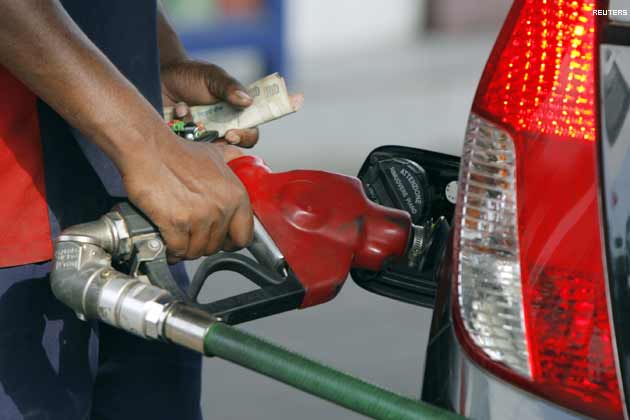
In December 2025, Nigeria’s domestic Premium Motor Spirit (PMS), also referred to as petrol supply, averaged 32.01 million litres per day (MLD), up from 19.5 MLD earlier. Dangote Refinery contributed 5.783 MLD at up to 71% capacity utilization.
The Nigerian Midstream and Downstream Petroleum Regulatory Authority (NMDPRA) published a December 2025 data sheet on Thursday that highlights notable advancements in fuel delivery, refinery operations, and stock sufficiency across key products.
According to independent reports, the increase was caused by improved performance by Dangote Petroleum Refinery Products (DPRP), NNPC, and Oil Marketing Companies (OMCs). As a result, the country’s PMS sufficiency reached 29 days, the highest level in more than a year.
Sufficiency increased by 77% over November, with marine stocks at 4.2 days and inland stocks at 25.1 days.
Aviation Turbine Kerosene (ATK) at 2.7 MLD (compared to 3 MLD), Automotive Gas Oil (AGO) at 16.4 MLD (compared to 14 MLD), PMS at 63.7 MLD (compared to 50 MLD), and LPG at 4,380 metric tonnes per day (mtd) (compared to 3,900 mtd) all had average daily truck-outs above benchmarks.
25 days for AGO, 20 days for ATK, 8 days for LPG, and 51 days for Low Pour Fuel Oil (LPFO) were the levels of sufficiency.
Supply chain stabilization is seen in trends from October 2024 to December 2025, where PMS sufficiency peaked at 29.2 total days in December.
While AGO remained closed beyond May 2025, the Dangote Refinery had an average capacity utilization of 64.02%, providing the scheduled PMS supply.
Train 1 at Waltersmith Refinery ran for 13 days at 63.24% utilization, supplying 0.051 MLD AGO, while Train 2 (5,000 barrels per stream day) finished pre-commissioning and is scheduled for hydrocarbon introduction in January 2026.
With OPAC and Duport out, modular refineries like Edo (85.43% utilization, 0.052 MLD AGO) and Aradel (53.89%, 0.289 MLD AGO) added up to 0.392 MLD AGO.
One construction license and one new refinery establishment license were granted by NMDPRA.
The average daily supply of wholesale gas was 4.787 billion standard cubic feet (Bscf/d), with 2.912 Bscf/d going to Nigeria LNG (NLNG), 1.875 Bscf/d going locally (0.586 Bscf/d to electricity, 0.430 Bscf/d to industries), and 0.569 Bscf/d going overseas.
NLNG Trains 1-6 (82.67%), Gbaran-Ubie (86.36%), and Soku (105.69%) all had strong usage rates.
The domestic supply of LPG was 5,201 mtd, and the retail price per kilogram was between N1,120 and N1,600.
While real averages hit N861-N935 across cities, with maximums up to N975, indicative PMS pump prices (at N1,450.97/USD NFEM rate, Brent at $62.68/bbl) varied from N832.31 (Lagos) to N900.49 (Maiduguri).
These numbers highlight market dynamics in the context of increased domestic output and decreased imports.