
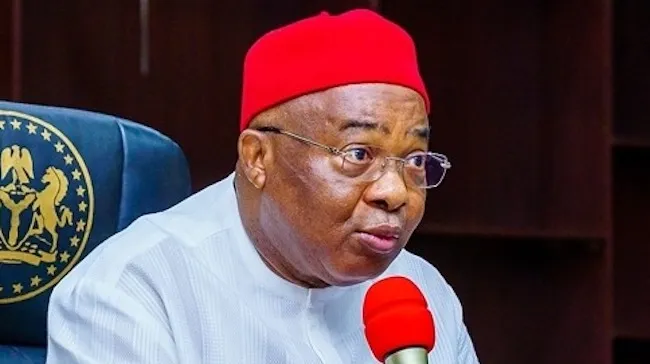
It was more than just the inauguration of a substation when Hope Uzodimma appeared in front of Owerri locals to launch the first phase of the Orashi Electricity Project. In the context of Imo State’s 50th anniversary festivities, the governor had characterized the project as a gift to the populace, one that aims to change the state’s economic course in addition to lighting houses.
Many sections of Nigeria have experienced decades of energy uncertainty, with companies relying more on diesel generators than the national system and brief moments of hope interspersed with protracted darkness.
Like in other states, Imo’s generator-driven economy reduced household incomes, suppressed productivity, and raised prices. For this reason, the opening of the 15MVA, 33/11KV Injection Substation operated by Orashi Electricity Company Limited marked a conscious departure from the past.
“Everything is altered by power,” Uzodimma said. By commissioning the Orashi Electricity Company Limited 15MVA, 33/11KV Injection Substation in Owerri, Imo is securing energy sovereignty in addition to developing infrastructure.
Megawatts are just one aspect of energy sovereignty, a concept that has great resonance in modern-day Nigeria. It denotes authority, stability, and a state’s ability to set its own economic pace free from constant interference from other forces.
The Orashi Power Project is, in Imo’s opinion, the first concrete step in that direction. The Electricity Act of 2023, which Bola Tinubu signed into law, is the cornerstone of this breakthrough.
By giving states the power to directly invest in the production, transmission, and distribution of electricity, the Act decentralized Nigeria’s power industry. It signaled a structural change in an area that had previously been dominated by federal regulation.
“We wouldn’t be here today if it weren’t for this visionary law,” Uzodimma stated, publicly praising the President for empowering states to take the initiative. In addition, he expressed gratitude to the federal government for granting permission to shift the Ohaji-Egbema power plant, which had previously been abandoned, to Imo State. This action improves the Orashi framework’s long-term prospects.
The Orashi commissioning was characterized by Nigeria’s Minister of Power, Adebayo Adelabu, as proof that the country’s electrical reforms are effective. He claims that since 2023, more than $2 billion in private sector investment has been drawn to decentralization nationwide.
“A reliable power supply is an economic enabler, not just infrastructure,” Adelabu stated. The larger significance of what Imo is trying to accomplish—converting reform into results—is contained in that straightforward statement.
The central component of Phase One is a 45-kilometer distribution network and a 15-kilometer 33KV transmission line that runs from Egbu to New Owerri. These facilities, along with the 33/11KV injection substation, are intended to stabilize the supply of electricity throughout the Owerri axis, encompassing residential neighborhoods, marketplaces, governmental institutions, and industrial clusters.
The ramifications for small company owners that operate cold rooms, hair salons, welders, tailors, cybercafés, and craftsmen are immediate. In the past, staff salaries have frequently fallen short of monthly generator fuel costs. Whether or whether a shop opened at all was frequently determined by the price of gasoline or diesel.
It is anticipated that operational expenses will decrease as grid dependability improves. Higher margins, reinvestment opportunities, and possibly the creation of jobs are all correlated with lower overhead. As Uzodimma put it plainly, the project reduces energy expenses, increases investor trust, and gives small businesses the stability they require to prosper.
The concept encompasses all 27 local government units in addition to the state capital.
The integrated electricity supplier Orashi Electricity Company Limited and the Imo State Government have a Memorandum of Understanding that commits the company to statewide expansion. The goal is systemic change rather than gradual progress.
Orashi Electricity Company Limited presents itself as something more than a distributor. In line with international best practices in energy management, it is envisioned as an integrated provider that handles generation, transmission, and distribution.
Its goal is to become the top integrated power company in Nigeria, known for its sustainability, innovation, and quality. Its goal is to transform Nigeria’s energy system by providing dependable, reasonably priced, and environmentally friendly electrical solutions.
This goal is supported by technical collaborations. The inauguration of the injection substation is a symbol of cooperation and strategic partnership in bolstering Imo’s infrastructural backbone, according to Mustapha Madkour, Chief Executive Officer of Madkour Holding, whose company acts as a technical partner.
This kind of infrastructure requires not just money but also technological know-how, operational discipline, and long-term maintenance scheduling. Imo is trying to combine state-level ownership with international standards by combining foreign technical assistance with local policy guidance.
The multiplying impact of electricity goes well beyond light. It affects healthcare delivery, digital innovation, industrial output, and agricultural processes. Uninterrupted medical procedures and refrigerated storage of vaccinations are guaranteed in hospitals with steady power. It improves digital learning and research capabilities in educational institutions. It helps startup ecosystems, data centers, and coding laboratories in technological hotspots.
This energy effort seems to be in line with Imo’s larger development ambitions. To maintain its momentum, the Skill-Up Imo program, which has purportedly taught digital skills to 65,000 youth, needs steady electricity. In the dark, entrepreneurship driven by technology cannot thrive.
Similar to this, a stable power source is essential to the hospitality and conference facilities, such as the restored Concorde Hotel and the Emmanuel Iwuanyanwu International Conference Centre, in order to draw both domestic and foreign events.
In this way, Orashi is a platform that facilitates other industries rather than being a stand-alone enterprise.
Infrastructure projects frequently fail due to erratic political commitment rather than technical shortcomings. The Light Up Imo program has been presented by Uzodimma as a pillar of the legacy of his administration on numerous occasions.
Through its National Convener Eugene Dibiagwu, the Imo Progressives Movement (IPM) has expressed satisfaction with the level of development in each of the state’s three senatorial zones, pointing to the Orashi Power Project as one of its major accomplishments.
Commissioning ceremonies alone do not guarantee energy sovereignty. Sustainable practices necessitate infrastructure preservation, timely bill payment, and ethical consumption. In order to maintain financial sustainability, Uzodimma has encouraged locals to protect installations and fulfill payment obligations.
Effective revenue management and cost recovery are critical to the success of decentralized power solutions. Whether Orashi becomes a template that can be replicated or has financial difficulties will depend on transparent billing systems, metering expansion, and customer involvement. The opportunity presented by the Electricity Act of 2023 will determine the outcome.
States all around Nigeria are keeping a careful eye on it. Subnational governments can now innovate in a more competitive environment because to the decentralization of power governance. Because of its early action, Imo is now one of the pioneers pushing the limits of state-led energy change.
Imo recently celebrated its 50th anniversary, and the symbolism of light is potent. Both literally and figuratively, electricity is associated with opportunities and street illumination.
The Orashi Power Project is a manifestation of investor attraction, economic self-determination, and enhanced quality of life.
“Today, we are freed from unpredictable power supply and unsustainable business expenses,” Uzodimma stated. Continuity, upkeep, and growth will determine if history finally validates that assertion. For the time being, the 15MVA injection substation’s commissioning is a significant step in ensuring Imo’s power sovereignty and paving the way for the company’s next 50 years.