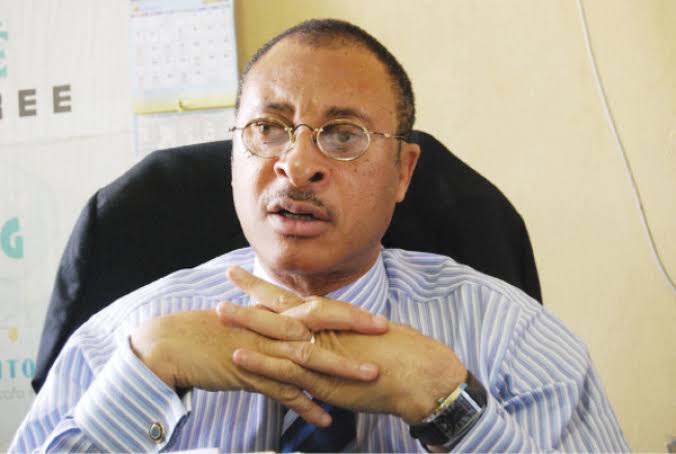
As Nigeria’s 2027 political permutations gather momentum, former ADC presidential candidate Professor Pat Utomi, who turned 70 on February 6, speaks exclusively correspondents ANTHONY UFOH and Israel Oluwadare on the party’s prospects against the ruling APC ahead of the next general elections, the debate surrounding Atiku Abubakar’s presidential ambition, and growing calls for him to step aside for Peter Obi or a younger generation of candidates, among other national issues.
Looking ahead to the 2027 general elections, how would you assess the chances of the ADC against the ruling APC?
Well, I think first and foremost, you have to recognise that Nigeria has a fundamental problem that needs to be corrected, and part of that fundamental problem is that democracy is dying in Nigeria.
And don’t take my word for it. There is a scientific study that has been carried out every year since 1999 by an international research group called the Afrobarometer Group. One of the things that Afrobarometer has established is that Nigerians want, love, and desire democracy, but are very frustrated with the fact that what is on offer in Nigeria cannot really be called democracy; so, they are frustrated.
They cannot remove governments that they know are not performing because they know that their votes don’t count; so, there is a national redemption necessity. That national redemption requires that a solid elite come together to create a broad base that can actually address the problems of Nigeria. So, it’s not about elections—removing this one and replacing this one as is the traditional way we look at it—because that’s why we are where we are.
If I can tell you, as an academic and a scholar in that area, I have followed every election in Nigeria since the return to civil rule (1999), as an activist who has been involved in the whole process, and as a political actor who ran for office in this country, what we have at best can be called a farce. It’s not working for the Nigerian people.
So, there is a need for a thoughtful elite to recognise that unless we reform the entire system, Nigeria is all dressed up with nowhere to go. Nigeria is not functioning; it will not function. It is the need to then bring together this elite to begin to think about Nigeria away from the “machine politics” of how you win elections—if we can even call what we do in Nigeria winning elections.
A disease has brought about a conversation among serious-minded people, which has culminated in many of them now coming into the ADC. ADC is a party that I know very well. I was the very first presidential candidate of the ADC and I remember the values that we tried to establish there. I remember the commitments of the people, and when groups of politicians were coming together to say, “What do we do? Which party do we literally acquire?” seeing that the establishment is trying to kill the PDP as an opposition and to kill whatever else is opposition.
I can say clearly that I was one of those who urged that the ADC be the base. And now that that has happened, the role of some of us is to ensure that the first thing to do with this new ADC is to ask: who are we? What do we represent for Nigerians? How can we together change the trajectory of our country?
Forget the propaganda of people who are in power; any thinking person knows Nigeria is going in the wrong direction. Any thinking person knows Nigeria is far from the dream that we had as young people. And so, how can we restore Nigeria? That’s why I pushed colleagues to make this the central conversation of the leadership of the ADC, and our hope is that that conversation will lead us to a few new ways of thinking about governance in Nigeria.
First of all, the presidential system has gone the way that we’ve allowed it to go, and the corruption is literally slaughtering this country. That corruption has manifested in an extraordinary way in the political class and political parties where governors don’t think about the people. How much are they being given to move to another party? All that is nonsense. All these guys will pay for it—no question, they will pay. Take my assurance. They will pay for treating the Nigerian people with such contempt in pursuit of their self-interest by trying to move into one party. Judgment is coming, and they will pay very, very dearly. I assure you.
So anyhow, the meeting of this group which then birthed the new ADC provided an opportunity for an inclusive effort to rescue Nigeria. So, that’s how I see the move. Does it have a chance? Absolutely. People say, “Ah! Fifty governors in one party.” Did any of them win in their state in the last election? No. These guys are disconnected from the people. This election is not about these characters versus another set of characters. It’s about the Nigerian people against those characters. That’s what the election is about. And the Nigerian people will show them that the ability to rig… you know, fire will meet fire. As they say in my village, “The rat that does not run, the tail will be burnt.”
Do you agree with the view that Atiku should step aside for Peter Obi or a younger candidate in the 2027 presidential race?
Well, first and foremost, let’s go through the logic of the suggestion. You know, the Waziri, Atiku Abubakar, is a good man who has made so much effort to ensure that democracy works in Nigeria. I have been associated with him in so many ways through the years. I’ve served on the Board of Trustees of the American University of Nigeria, which he founded, and I’ve had him as a good ally in the early days when the PDP was in power.
I think he means very well for Nigeria. However, I think that there is a stage when biology has its effect. I’m a person of principle. Everything I do is driven by some very clear principles. Thank God, if you can go back and read most of what people have written about me. I can even find one of my books here. Just look at the back. Professor Tunji Olaopa—he is the Federal Civil Service Commission chair—this is his contribution to the back page of one of my books titled Power, Policy, Politics and Performance.
Professor Olaopa’s statement says, “I pointed out some years ago that there is no aspect of Nigeria’s socio-economic and political landscape that Professor Patrick Utomi does not traverse solidly with sufficient evidence and demonstrated knowledge. His unrelenting quest to refocus the country’s politics and parties on a contest of policy platforms, rather than a debilitating trading in primordial sentiments, provides the perfect backdrop and logical point of departure for this new book on the value and content of the public policy process that is focused on superior performance.” He made this comment years ago.
Anybody who knows me knows that from the very beginning, ethnicity has never been something that I pay attention to. When I was in Nsukka (UNN), I was called a “Yoruba boy” because I came from Ibadan, and many of my friends there were people who came from that area. Anytime I take any position, it’s about principles. And one principle that is in my mind very clearly is that Africa, not just Nigeria, is making a fundamental mistake by allowing democracy to become a gerontocracy—that is, a government of old people.
African state houses are increasingly becoming old people’s homes. Paul Biya, my friend Museveni, in Côte d’Ivoire, Alassane Ouattara, and on and on. It’s not good for Africa. We all know that our strengths begin to diminish at a certain age.
I’m 70 years old. I have already ruled myself out of any executive position because I’m 70. Nobody thinks I’m stupid. I’m probably smarter than I was 10 years ago. Still, the realisation that biology means something is such that I don’t think it’s proper for the Nigerian people for me to be holding public office at this time at age 70. People who think that they can hold public office at 80 may be somehow driven so much by ego that they are not seeing a clear picture.
Narcissism?
Well, narcissism is an affliction of politicians generally, but in this case, the victims are the countries that they purport to love. We need to put ourselves above our egos to realise certain things. So, my hope and my expectation are that Waziri Atiku can be the father of the nation, can be the grand adviser that holds accountable whoever is the executive in office. For younger people, my view is the candidate should not be more than 70 years old to run for office and hold positions like presidency, governor, and so on and so forth.
What is your assessment of Nigeria’s tax reform policy, particularly in terms of its timing?
Well, you know, it’s a very nuanced issue. It’s a very complex issue, and we shouldn’t take a simplistic approach to it. First of all, one of the great strengths of democracy is taxation. Why is this so? Because taxation puts pressure on accountability.
“No taxation without representation.” That was the war cry of the Boston Tea Party. In the United States, one consequence of the Boston Tea Party was that you have to have representation—not just representation, but one that the people are close to and can recall if they don’t do their will. This is why in the U.S., the Senate does not have “Ways and Means” power. The Ways and Means power is domiciled in the House of Representatives, and because of that, the elections are every two years, whereas the Senate can be there for six years.
Now, the idea of re-electing the people every two years is to make sure if the government gives you any task you don’t believe in, you can recall the representative that doesn’t speak your mind. So, it is the ultimate relationship between accountability, representation, and taxation.
The problem that we have in Nigeria is not so much that people are being told to pay taxes; it is because there is no representation. The National Assembly, as far as I’m concerned, is a joke in Nigeria right now. Until we carry out successful reforms, we don’t have a National Assembly; there’s no representation. They’re not there in the interest of the people; they’re there in their personal interest. I say it to their faces all the time.
So how do you hold people accountable? They collect all this money from you. We know the government doesn’t perform in most parts of Nigeria. So, tax reform must begin with electoral and representation reform. That’s where you start. When you are sure that the people are actual representatives of the people, then you reform the taxes such that they can be accountable.
Second point to make: you mentioned fuel subsidies being withdrawn. There are many things already that have thrown up plenty of cash for the government. Let me tell you how economies run. There are essentially four sectors: households that spend the money that leads to taxes and all of those things, and their spending drives the private sector. Then there is the public sector—government. Finally, there’s the external sector. These four sectors really constitute the essentials of the so-called flows of income. If everything is sucked in by the public sector, look at an atrophied private sector, look at households coughing and trying to survive as is the case right now. If the external sector is neither here nor there, you’ve got a major problem.
So, the situation we’ve created is where a huge amount of money is in the public sector and then they’re sharing the thing. They say, “Ah, you see this government.” Governors are very happy because the center is giving them money as if it’s Father Christmas. They don’t even know it’s their own money, so to speak. And they are killing the economy. They don’t understand this. If you ask the meaning of circular flows of income and how these flows affect savings, investment, and economic growth.
Another point to make: we keep thinking about the demand side, but there is supply-side economics. If we don’t recognise that there is an optimal level of tax and that taxes get to a point where people don’t invest, then we will see investments dry up and there will be nothing to tax down the line. So many years ago, a really well-known professor of economics at USC (University of Southern California), Arthur Laffer, offered a framework for analysing this. It was the Laffer Curve, and Arthur Laffer basically became the champion of the movement that brought Ronald Reagan to power. Supply-side economics triumphed in that period. I think that we need to go back and look at the whole idea of supply-side economics instead of getting excited about taxing people who are already overburdened.
You have often referenced Lee Kuan Yew’s views on Nigeria. Do you think elements of his leadership style can be applied in the Nigerian context?
In fact, there’s a clear example. I was interviewed on one of the television channels a few weeks ago and the interviewer actually quoted from Lee Kuan Yew’s book about Nigeria and mentioned that while his ministers and permanent secretaries were going to work by bus, in Nigeria, they are going to work in Mercedes-Benzes and SUVs—even civil servants. Yet, the roads in Nigeria are not motorable, but the roads in Singapore are.
It makes a very salient point about leadership. Leadership is about sacrifice. If people sacrifice to advance the common good of all, that is leadership. But if people who are in a leadership position think, “Me, myself, I, my car, my motorcade, my this,” which is the way many Nigerians think…
One of the most sordid sights I’ve ever seen in my life was seeing Godswill Akpabio entering the motorcade the first day he became Senate President. I nearly puked. I’ve lived in Washington and I have seen senators walking down the streets. In fact, I can tell you one particular story. Years ago, I wasn’t even living in Washington; I just came on a visit and I went to lunch at the Republican Club because I have many friends who are Republicans. One of them took me to lunch, and the senator who became Attorney General under Trump (before they disagreed)—we had lunch with him.
My friend afterwards was taking me to get the train from Union Station and it was the day before that this senator from the east there switched from being Republican to being Independent and gave the majority to the Democrats. So, as we’re getting to the station, there was a guy crossing the road and this my Republican friend said, “Look at this useless man that changed the politics of this country yesterday. If I were in Nigeria, we would just hit his leg now.” He was just walking on his own. A man who the day before caused the whole politics of America to change—moving the majority from Republican to Democrat. He was just walking on the streets unmolested, going to take a train.
I first met Joe Biden, who became president, at the Union Station. He was going to his constituency. He was a Senator at that time in Delaware. One day I saw him and the one that played basketball from New Jersey, the tall Senator from way back. And both of them were just walking down, buying their tickets to get on the train as I was buying my ticket. But Godswill Akpabio has to be escorted by this wasteful motorcade just to show off that he’s Senate President in a very poor country.
So, it’s those kinds of things that make me feel we need to reorient. Bola Tinubu becomes president and he has to buy a new presidential jet with yachts. In aid of what? People are dying on the streets. These are not really politicians in the classic sense of people of service. And this is the kind of thing that I am pushing the people in the ADC to recognize and make the soul of the party.
You go to Egypt, or you’re talking about Singapore—you don’t do that in Egypt. It’s only the President who, when he’s moving, you will see security or force. Everybody else just gets in one Toyota Corolla and they’re going their way. So, there’s something fundamentally wrong about Nigeria’s democracy that needs to be corrected. And Lee Kuan Yew pointed that out so clearly in his writings.
Why do you think some NADECO leaders appear to lose their principles after getting into power?
Well, you see, the nature of human beings is that you have authentic leaders, and then you have people who use excuses or alibis to grab power, but really never believed in people-centered leadership and the kinds of things they were mouthing platitudes to.
You talk about the National Democratic Coalition (NADECO). Well, I can tell you who really created NADECO. There’s a group called the Concerned Professionals. I was one of those who founded it. I started the Concerned Professionals.
Regarding the annulment of the elections: we had voted. I used to live around here actually, on Aboyade Cole. I voted near the school near ExxonMobil; that’s where I voted on 12 June 1993. Then two days later, I flew to the U.S. I actually met Kola Abiola at the airport. He was flying to London, I was flying to New York, and I was in the U.S. when the annulment took place. And from there, I wrote an op-ed piece for The Guardian that was titled, “We Must See Never Again.” That became the trigger for the founding of the Concerned Professionals.
When I came back, I wrote a second piece and then I invited Atedo Peterside and Sam Oni to be co-authors. And we invited other professionals to a meeting at Engineering Close. That’s how the Concerned Professionals started. It was the Concerned Professionals—and I can give you those who were given that assignment specifically. They include Asue Ighodalo, who ran for governor of Edo state recently, Tola Mobolurin, and Tunde Akinleye. They were requested by the Concerned Professionals to intervene with a group of elders who used to meet in the home of General Adeyinka Adebayo, the father of Niyi Adebayo.
That group was called the Council of National Unity and Understanding (CNUU). It included people like Commodore Ebitu Ukiwe, Baba Adesanya, Papa Ayo Adebanjo, and so on and so forth. And that group more or less, with the support of the Concerned Professionals, transmuted into what became NADECO. So that’s how NADECO was created, because there’s so much falsehood in the environment. People who ran away are now trying to claim NADECO. NADECO then started from there and connected up to those who had escaped abroad, who were called “NADECO Abroad.” Ultimately, that group was led by Chief Anthony Enahoro.
So, when Abacha died and the return to civil rule was initiated by General Abdulsalami Abubakar, some of those who came back, who may not have been authentic leaders but opportunistically got involved in this movement, took advantage of it to get elected into positions in public office and began to show their real colors. So, you have to always bear in mind the difference between authentic leadership and those who take advantage of opportunity.
An American executive who became an academic at Harvard called Bill George, CEO of Medtronic, has written a book titled Authentic Leadership. Part of the tragedy of Nigeria is that people who were not real leaders, who took advantage of being seen as part of NADECO to step into political office, now showed us who they were, and we’re suffering from it till today.
Why has corruption persisted across many of Nigeria’s institutions, despite repeated reforms and promises of change?
Well, you see, Nigeria is not peculiar in any way. Human beings have a tendency, where there are no strong institutions, toward wrongdoing. What are institutions? Institutions are those things that create boundaries beyond which there is consequence.
So, if your institutions are weak, it means that consequence does not come for doing the wrong thing, and Nigeria has very weak institutions. Because it has weak institutions, many people take advantage of it and abuse it. The only people who don’t, technically speaking right now, are people who were raised such that their character is extremely strong. Maybe they were people with a certain moral texture.
So you see, because many people who claim to be leaders are not really authentic leaders, they think it is a game. They don’t realise that those corrupt games diminish the possibilities of progress in the country. That corruption kills—really kills. It’s like murder. Imagine that you were Minister of Works. You put half of the money for the building of a road in your pocket and you “paint” the road, as they say. One day, you are not the minister anymore; you are going to your village. Because the road was just painted and washes away within weeks, you run into a pothole and you have an accident. People shout, “Rush him to the hospital!” but our hospitals are not working.
Okay, he has money—order an ambulance from London. It takes six hours for the plane to get from London to Lagos or Abuja. And before you can say “Jack Robinson,” the man has died. I’m giving you real-life stories. I’m not mentioning names, but this has happened. So, until the political class gets wise enough to know that they hurt themselves in the long run with all these funny things, we will continue going through it. Everything that you try to do in Nigeria, funny interests in the bureaucracy and in the political class will find excuses to prevent progress.
But they don’t realise they are preventing progress. They think they’re just playing games for their own pocket—‘Chop chop’. In the end, they prevent progress. I was speaking in Ghana just last week and I gave them a series of examples. I mean, the GSM we’re using today nearly failed completely but for the last-minute courage of the Chairman of the Nigerian Communications Commission (NCC) at the time, Ahmed Joda.
That’s what saved Nigeria. We could still be petting the Nigerian Telecommunications Limited (NITEL). Even this hospital that Afreximbank built in Abuja—they still play the usual games and nearly aborted the flagging off of the thing. Why do they do those things? I can’t figure it out. They think they’re doing it to favour one person or another. In the end, they are hurting their country. Corruption has crippled Nigeria.
In your view, can INEC deliver a credible and transparent election in 2027?
I don’t know them. I don’t know what they can or cannot do. But I can assure them of one thing. Many of them, and those who were involved in the last election, will spend most of the rest of their lives in jail—perhaps in Papua New Guinea or somewhere.
Many years ago, I started an international campaign to build or to achieve what we call supranational institutions: one, a court on genocide, and two, a court on economic crimes. People said it was impossible and it would not happen. I tell the story of how in January 1997, I went to make a presentation to the boards of newspapers in Boston and they told me pointedly, “This is a pipe dream. It will never happen.”
Two years later, the Treaty of Rome passed and we have one of them (the ICC). I did not get my international economic crimes court, but I am telling you, the bombs that dropped in Sokoto and dropped there, they will drop again and INEC officials will be among those who will go to jail. I assure you of that. They will drop and they will go to jail. They will live out the rest of their lives in prisons in Papua New Guinea.