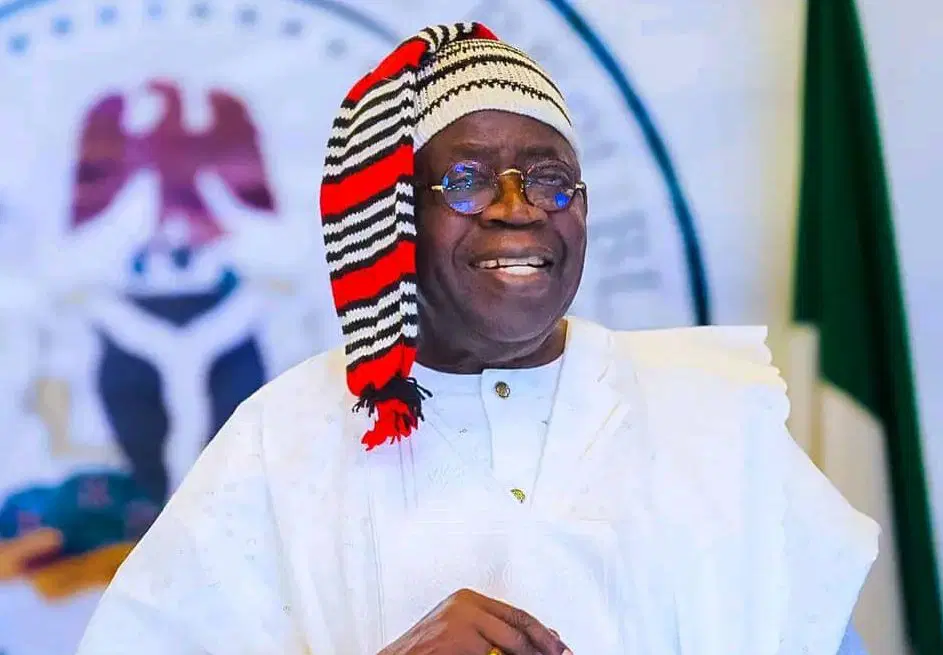
Yesterday, the president released a brief report on the nation’s counterterrorism efforts, including arrests, convictions, and notable drops in terror-related fatalities since 2023.
Following charges of genocide against Christians in Nigeria by US President Donald Trump and the classification of Nigeria as a “Country of Particular Concern” (CPC), the update was released on its verified X handle, @NGRPresident.
Additionally, the US had made threats of penalties and alluded to potential military action.
The update coincided with the denunciation by the Nigerian Supreme Council for Islamic Affairs (NSCIA) of the US president’s accusation of genocide against Christians and the classification of Nigeria as a country of particular concern as part of an American government plot to destabilize Nigeria.
In a similar vein, Trump’s proposal to designate Hamas as a terrorist organization was denounced by Muslim Ummah, Bauchi State Chapter, and the leadership of Muslim Students’ Society of Nigeria (MSSN), who described it as unfair and detrimental to resolving the Palestinian conflict.
The Nigerian government consistently denied the genocide accusation, claiming that terrorism, banditry, and communal violence—rather than religious persecution—are the main causes of the nation’s complicated, ten-year security crisis.
The government insisted that people of all religions and geographical locations had died as a result of the security problem, and it persisted in requesting assistance from international allies, such as the United States, in its continuous efforts to overcome the crippling obstacle.
In the briefing, the administration reiterated President Bola Tinubu’s position that “the security of Nigeria is non-negotiable,” emphasizing that since 2023, tougher measures against terrorists and insurgents have resulted from increased interagency cooperation.
According to the data made public, security services had “vigorously pursued, arrested, eliminated or successfully convicted” extremists connected to some of the deadliest incidents in the nation.
Over 124 terrorists and insurgents have been found guilty by Nigerian courts since 2024, according to the update, while a number of high-profile suspects, such as Ansaru leaders, those connected to the 2022 Owo Church massacre, and those involved in the Yelwata reprisal killings in Benue, were on trial.
The federal government also outlined a number of counterterrorism initiatives, such as bolstered joint security task forces, improved border patrols with regional allies, ongoing joint operations in high-risk areas, more compensation for attack victims, and increased intelligence cooperation with foreign partners.
The administration stated that as of 2025, terror-related deaths in Nigeria had decreased by 81% from 2015, citing quantifiable statistics. The reduction was attributed to increased counter-insurgency operations and improved contact with affected communities.
Additionally, it disclosed that more than 124,000 fighters and their dependents turned themselves in to the police, and more than 13,000 terrorists were neutralized in the last year alone.
More than 2.1 million internally displaced people (IDPs) have returned to their communities, according to the presidential message, and many regions were seeing restoration and restored stability.
According to the government, it also implemented a Resettlement Scheme for Persons Affected by Conflict in order to promote reintegration efforts, reconstruct devastated settlements, and facilitate rehabilitation.
Nonetheless, the administration persisted in advocating for international cooperation, stressing that international assistance is still essential for destroying terror networks that operate internationally.
NSCIA: US Claims of Christian Genocide as a Justification for Destabilizing Nigeria
The Nigerian Supreme Council for Islamic Affairs (NSCIA) condemned the accusation of genocide against Christians and the designation of Nigeria as a country of particular concern, claiming that they are part of an American government plot to destabilize Nigeria. At a press briefing yesterday, NSCIA Secretary General Professor Ishaq Oloyede reaffirmed this stance in response to Trump’s claims of ongoing genocide against Christians and his threat to authorize the US to strike Nigeria if no meaningful action was made to stop the atrocity.
According to Oloyede, Nigeria was dealing with a terrible and complicated ongoing security situation that was causing unimaginable suffering to all of its people, regardless of their ethnicity or religion.
He emphasized that Amnesty International, which conducted a thorough investigation into the country’s insecurity and concluded that there was “no evidence of a religious motivation” to classify it as genocide, has confirmed that many parts of the country are experiencing horrific savagery against Muslims, Christians, Imams, and priests.
“On behalf of the Nigerian Muslim Ummah, the Nigerian Supreme Council for Islamic Affairs (NSCIA) convenes this conference in response to the recent threat against our country’s sovereignty, following its Expanded General Purpose Committee (EGPC) meeting earlier today,” Oloyede said.
“We have not been focusing on the murders of Muslims because we consider it a national security issue rather than a religious conflict. The world is aware that certain unpatriotic and Islamophobic Nigerians wrote a dangerous script, spread it in Western circles, particularly in the United States, and attracted the attention of the highest levels of the US government, which are mistakenly led to believe that Nigeria is experiencing a “Christian genocide.”
Every right-thinking Nigerian was alarmed when Mr. Donald Trump, the president of the United States, called our nation “disgraced.” This is because an ally who is committed to assisting a sovereign nation in “completely wiping out the Islamic terrorists who are committing these horrible atrocities” would offer to help and collaborate with the nation instead of using such language to describe a country it aims to partner in wiping out the terrorists.
“The current context of ‘what Nigeria will not like’ suggests that the plan is a pretext to destabilize our country, even though several nations (such as China, Saudi Arabia, and Myanmar) have also been designated ‘Countries of Particular Concern.” I
“It reaffirmed the 2022 Armed Conflict Location & Event Data Project (ACLED) report, which unequivocally declared that anti-Christian persecution was not the primary cause of violence in Nigeria because Muslims and people of other faiths were also severely impacted.”
According to NSCIA, there was no “Christian genocide” in Nigeria. According to Article 6 of the Rome Statute 11 and Article II of the 1948 United Nations Convention on the Prevention and Punishment of the Crime of Genocide 9, the accusation was a crime with a specific “intent to destroy, in whole or in part, a national, ethnical, racial or religious group.”
According to the council, Muslims who disagreed with Islamist Jihadists like ISWAP and Boko Haram were “dissidents and were killing both Muslims and Christians and demolishing Mosques and Churches.”
In addition to accusing the US of founding Al-Qaeda, which is being portrayed as Islamic, NSCIA also supported the claim made by US Congressman Scott Perry in his testimony that the US Agency for International Development (USAID) was funding Boko Haram and other terrorist organizations in Nigeria and other countries.
It argued that persistent desertification and climate change, which dried up water sources and destroyed pastures in the far-northern Sahelian area, were the true causes of violence in Nigeria.
“This is not a ‘Islamist invasion,’ but rather a desperate southward migration of herders seeking survival,” stated Oloyede. Due to this migration caused by climate change, herders are forced to compete directly and frequently violently with sedentary farming populations over the limited amount of land and water available.
Traditional methods of resolving disputes have been undermined, and historical grazing reserves have been lost to growing settlements. The farmer-herder conflict in the Plateau, Benue, and other northern Nigerian middle belt states is centered here.
The second motivator is criminal activity. Grinding poverty, widespread youth unemployment, drug misuse, porous borders, and the decades-long growth of small arms and light weapons all contribute to banditry in the North-west, North-east, and South-east. Importantly, academics have pointed out that it is also fueled by illegal artisanal mining of solid minerals.
“Bandits and criminal syndicates destroy villages and uproot people, leaving an uncontrolled area for their illicit mining activities. There is nothing Islamic about this brutal, well-organized criminal enterprise for financial gain. More than 1,200 Muslims have perished in the Zamfara, Katsina, and Sokoto axis at the hands of the same bandits who are motivated by criminality rather than religion or clan.
According to NSCIA, “the United States Department itself stated in its 2022 Report on International Religious Freedom that the primary drivers of intercommunal violence were banditry and other criminality, not animosity between particular religious groups.” This isn’t a conflict over religion.
Therefore, it is impossible to ignore the long-term ways in which Nigerian violence has been made possible by poor government. Research has shown that widespread corruption, a failure to hold those responsible for violations of human rights accountable, and a lack of basic security for residents have all contributed to the emergence of impunity.
“Criminals and militias flourish when the government fails to protect anyone.” This is not a state-sponsored “genocide,” but rather a “massive state failure,” as others have described it.
In order to energize their domestic evangelical base and win votes in Texas and West Virginia, the council accused foreign instigators, particularly some American politicians like Senator Ted Cruz and Congressman Riley Moore, of disseminating the false narrative of mass murder of 50,000–100,000 Christians in Nigeria.
According to NSCIA’s regulatory filings in Washington, D.C., domestic instigators, especially separatist organizations like Biafra Republic Government In-Exile, which it claimed was hatching political/economic, but not religious, agendas by outspending the federal government on lobbyists, assisted and abetted the foreign actors.
And what is their central message, according to NSCIA? They are concentrating on bringing up the issue of “Christian killings” on Capitol Hill, according to the filings. The balkanization and disintegration of Nigeria is the aim of this political separatist party, which uses religious identity as a weapon.
“These lobbyists, who have been paid millions of dollars, bombard Washington with fabricated figures and altered footage. They mention that since 2009, 52,000 Christians have been killed—a figure that even Open Doors declines to support.
Additionally, there is a network of Nigerian nationals both domestically and overseas who have made a significant profit from self-flagellation, as we have previously mentioned. These crisis entrepreneurs take advantage of religious animosity transactions as quick routes to international fame and recognition.
“They invent or decontextualize allegations of persecution in order to get favored refugee status in the West, speaking engagements, or financial rewards. There is ample proof in the media that certain religious leaders and elites made the erroneous claim for nonreligious reasons. Some of them start a fire and act as though they are putting it out. We denounce these people for their crimes of treachery and deception.
“For this reason, the council is deeply disappointed by the CAN President’s false declaration, which has now demonstrated unequivocally that the people spreading the falsehood were, in fact, acting out CAN scripts.”
Muslim Ummah denounces Trump’s Hamas policy and supports Nigeria’s position on the Palestinian issue
Trump’s designation of Hamas as a terrorist group was denounced by the Muslim Ummah, Bauchi State Chapter, and the leadership of the Muslim Students’ Society of Nigeria (MSSN), who said it was unfair and detrimental to peace in the Palestinian problem.
Nonetheless, they called for an unconditional ceasefire and the evacuation of Zionist forces from Gaza, expressing support for the federal government’s advocacy for justice for Palestinians.
The National Islamic Center in Zaria made the demand in a statement that was released at the conclusion of a leadership development session.
Over the weekend, the Sultan Muhammad Saad Abubakar Hajj Camp in Bauchi hosted a gathering of the MSSN’s Bauchi Area Unit leadership.
In addition to denouncing the ongoing banditry and kidnappings, the communiqué, which was signed by Professor Abdullahi Lare Amaoo, Chairman of the Communiqué Drafting Committee, called on security authorities and stakeholders to step up their efforts to counter these threats.
It voiced profound concern about the widespread corruption that permeates society at all levels and demanded swift, coordinated action to prevent the country from collapsing.
For the sake of the survival and prosperity of the country, the Muslim Ummah emphasized that piety (Taqwa) was a crucial leadership quality.
The communiqué also emphasized how widespread poverty and deprivation are in the nation, emphasizing the pressing need for practical solutions to improve the situation.
The Ummah addressed security issues by denouncing the ongoing kidnappings and banditry and urging security organizations and other relevant parties to step up their efforts to counter them.
They called for an unconditional ceasefire and the evacuation of Zionist forces from Gaza, expressing solidarity for the federal government’s fight for justice for Palestinians.
Professor Muhammad Babangida Muhammad, National Ameer, described the goal of the Muslim Ummah, highlighting its function in guaranteeing the people’s spiritual, physical, socioeconomic, and moral advancement.
Dr. Usman Bugaje emphasized the significance of resolving the Ummah’s leadership dilemma for stability and sound development, emphasizing the necessity of striking a balance between difficulties and the skills necessary for efficient management.
The establishment of area branches, the inauguration of their leadership in 20 local government areas, and state-level leadership elections were also included in the workshop.