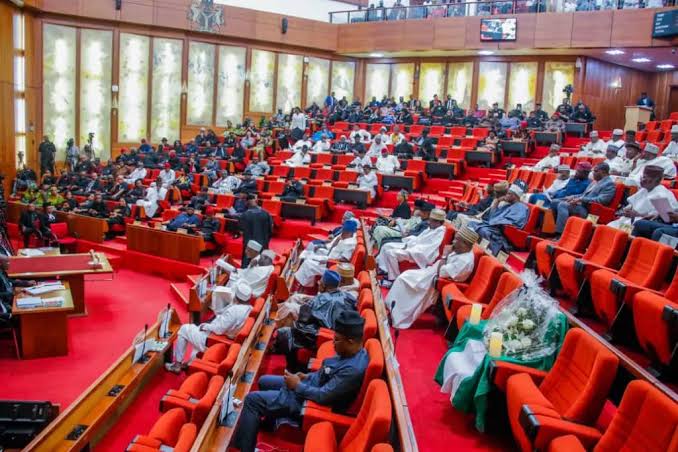
The execution of the capital component of the 2025 budget has been extended by the Senate from March 31 to June 30.
This came after a Bill to Amend the 2025 Appropriations Act was introduced, which would have extended the Act’s capital component from March 31 to June 30.
Senate Leader Opeyemi Bamidele (APC-Ekiti) introduced the measure in plenary on Tuesday.
While spearheading the discussion of the bill’s general principles, Bamidele claimed that the amendment’s justification was both convincing and practical.
He claimed that even while about thirty percent of the monies allotted to ministries, departments, and agencies (MDAs) had been released, the execution of capital projects under the 2025 Appropriations Act had not achieved an acceptable level.
“If this issue is not resolved immediately, it could worsen the already alarming instances of unfinished or partially completed projects throughout the nation,” Bamidele stated.
Only over 70% of the projects had been funded under the 2026 appropriations system, he said, adding that it was interesting to see that a sizable part of the projects had relevance.
He claimed that the president’s numerous important national economic and infrastructure projects would experience preventable discontinuity in the absence of the extension.
According to the legislator, the bill was created to guarantee continuity, improve budget performance, and encourage effective use of monies that have already been released.
It also aims to protect public resources from waste and enhance budgetary restraint.
Additionally, he stated, “by maintaining capital expenditure flows, conserving jobs, and supporting ongoing development efforts across key sectors of the economy, this extension will significantly contribute to economic reflation.”
According to the senator, it is crucial to provide MDAs the legal window they need to complete their initiatives in the best interests of the general public.
He urged the legislators to review the bill quickly and favorably.
While seconding the bill’s approval motion, Deputy Senate President Barau Jibrin (APC-Kano) stated that President Bola Tinubu was committed to accelerating and improving the nation’s infrastructure.
“It is in line with Mr. President’s “Renewed Hope Agenda” to bring prosperity to our country, and this cannot be accomplished without constructing the essential infrastructure required to realize this vision.
In this sense, it is crucial that time be allotted for the completion of initiatives that have already been started. If not, we will encounter the issue of unfinished initiatives, which is detrimental to our advancement.
“Everyone knows that if we don’t do this, it will cause problems for Mr. President’s desire to bring about the infrastructure development necessary to bring prosperity to our nation,” he stated.
Barau called on his colleagues to expedite the bill’s passage.
After a clause-by-clause review, the Senate subsequently approved the measure, delaying the implementation of the 2025 budget capital component to June 30, according to the News Agency of Nigeria (NAN).
Additionally, President Bola Tinubu’s request to raise the 2026 budget from the original N58.472 trillion plan to ₦68,323,309,818,667 trillion was accepted by the Senate during a special plenary on Tuesday.
The 2026 Appropriations Bill, which requests legislative authorization for a total expenditure of ₦68.323 trillion for the 2026 fiscal year, was also passed by the Red Chamber on its third and final reading.
On December 19, 2025, President Tinubu delivered the first ₦58.472 trillion budget to a joint session of the National Assembly.
With priority votes for defense and security (₦5.41 trillion), infrastructure (₦3.56 trillion), education (₦3.52 trillion), and health (₦2.48 trillion), the budget concentrated on strengthening macroeconomic stability, enhancing the business environment, fostering job-rich growth, and lowering poverty.
On Wednesday, however, President Tinubu forwarded a proposal to the Senate for an increase of N9 trillion. The senators promptly reviewed and accepted the request.
The Chairman of the Senate Committee on Appropriations, Senator Solomon Adeola, presented the report of the National Assembly Joint Committee on the 2026 Appropriations Bill during plenary. He informed the Chamber that President Tinubu had sent the Committee a communication suggesting changes to the budget while the Committee was working on the N58.472 trillion earlier proposed in December 2025.
“Mr. President sent a communication suggesting changes to the 2026 Budget during the Joint Committee on Appropriations’ review of the Bill.
In order to prevent the 2026 fiscal program from being disproportionately burdened by unresolved obligations from prior years, the suggested changes were designed to regularize outstanding legacy capital commitments carried over from past appropriation cycles.
Along with aligning the financing framework of the 2026 Budget with the revised expenditure profile in a way that maintains macro-fiscal stability, the proposals also aimed to accommodate a small number of strategic interventions in the areas of transportation, health, and institutional preparedness deemed essential to national development and governance continuity, he said.
He pointed out that ₦5.71 trillion in outstanding unpaid capital liabilities from the 2025 budget were included in the adjustment, stating that this was required since it was doubtful that these obligations would be fulfilled before the 2025 budget expired.
He claimed that the 2025 Appropriation (Repeal and Enactment) Act was the source of the outstanding commitments, pointing out that ₦2 trillion was added for national priority projects that were left out of the rollover to the 2026 budget.
A Federal Government equity commitment of ₦478.60 billion for the Presidential Legacy Light Rail Projects in Lagos, Kano, Kaduna, and Ogun States is another of the key national initiatives.
The interventions also include ₦8.96 billion for feasibility studies on the Maiduguri-Sokoto Superhighway and the Calabar-Maiduguri Corridor.
The Tinubu National Beltway Initiative includes these projects.
For priority health sector measures, an extra US$344.83 million, or around ₦482.76 billion, was suggested.
These interventions are linked to implementation pledges and current bilateral understandings.
Additionally, the Committee noted that an additional ₦98.50 billion was suggested for the Court of Appeal.
This is in favor of the 2027 General Election cycle’s institutional framework.
It is also suggested that the Supreme Court be given ₦36.7 billion. Additionally, this supports the General Election cycle of 2027.
It is suggested that the budget cap for the judiciary be reintroduced at ₦268.54 billion. This is to make room for the potential appointment of additional judges and Court of Appeal justices.
The funding sources include a $10/b increase in the oil benchmark, which generates ₦2.592 trillion, out of the total adjustments of ₦9.091 trillion.
The Chairman of the Committee claims that investor confidence has been rekindled by recent rate reduction efforts in the telecom sector. Over $2 billion in investment commitments and capital inflows have been documented.
He noted that the telecom industry is changing from a state of underinvestment and limited tax yield to one marked by resurgent growth.
Airtel Nigeria and MTN Nigeria are expected to contribute ₦874 billion in revenue.
In 2026, MTN Nigeria is projected to pay ₦724 billion in Corporate Income Tax (CIT). In 2026, Airtel Nigeria is anticipated to make a CIT contribution of ₦150 billion.
The anticipated increase in external borrowing is ₦6.163 trillion. This will help finance the modifications, he stated.
The changes are intended to strengthen macroeconomic stability and encourage growth that creates jobs. The 2026 budget has a high priority on infrastructure, health, education, and security.
The Senate accepted the changes after reviewing the Joint Committee’s report, expressing hope that they will boost economic growth and raise residents’ standards of life.
Atiku Abubakar, a former vice president and leader of the African Democratic Congress, has voiced serious concerns over reports that President Bola Ahmed Tinubu’s request for a new $6 billion foreign loan was approved by the Senate in a record amount of time—less than four hours after it was presented.
According to a statement released by Phrank Shaibu, Atiku’s Senior Special Assistant on Public Communication, the situation is not only concerning but also alarming.
He pointed out that a choice with such significant national ramifications, one that will put more strain on an already fragile economy and jeopardize the future of future generations, cannot be handled with such careless rush.
“What Nigerians have seen is a disturbing erosion of oversight responsibility, not legislative diligence,” he stated.
He emphasized that the National Assembly is a constitutional safeguard intended to question, examine, and defend the interests of the Nigerian people rather than acting as a simple rubber stamp.
Instead of acting as a constitutional safeguard, the Senate has devolved into a conveyor belt that processes petitions of significant national importance without conducting adequate research. Decisions on borrowing that will affect future generations cannot and should not be handled with such a casual hurry.
“Where was the discussion? The thorough analysis was missing. Atiku said, “Where was the accountability?
He cautioned that it raises severe concerns about due process and the legislature’s devotion to its constitutional obligation to approve a multibillion-dollar borrowing request in record time without visible examination.
Atiku cautioned that although these goals might seem standard on the surface, they reveal more serious structural flaws in the country’s financial management.
“It is not a strategy—it is a risky cycle—to turn to new borrowing in order to pay off current debts, fill budget gaps, and fulfill regular obligations. It shows a concerning lack of sustainable economic planning, clear prioritization, and fiscal restraint,” he stated.
He further grounded his worries in new fiscal indicators, pointing out that the World Bank revealed that Nigeria’s exposure to the International Development Association (IDA) had increased to $18.7 billion between January and February 2026, making it one of the world’s biggest recipients of concessional loans.
“Even as the Debt Management Office continues aggressive domestic borrowing through high-volume bond auctions, as evidenced by the March 2026 FGN Bond Offer Circular, the President is requesting an additional $6 billion external loan in March 2026 alone, largely to finance immediate government obligations and service existing debt,” he continued.
Atiku claims that this pattern indicates an unsustainable borrowing trajectory that puts the nation on a risky fiscal course.
The former vice president also questioned whether the move represents a conscious attempt to mortgage the nation’s future.
“Because that’s what it implies,” he said.
In addition to the growing debt it has already accrued in the first quarter of 2026, what does a government that seems to be getting ready for an election defeat in 2027 plan to do with an extra $6 billion in borrowed funds?
Atiku emphasized that prudence, not haste, should direct fiscal decisions at a time when Nigeria’s debt profile is still rising and debt servicing takes up a sizable amount of national revenue.
He stated, “Borrowing is not intrinsically bad, but reckless borrowing made possible by legislative complacency is dangerous.”
The quickness of the approval, he continued, points to a concerning feeling of desperation that undermines trust in the nation’s long-term economic trajectory.
“Nigeria cannot be used as a private enterprise at will. “We cannot sign away our country’s future in a matter of hours,” he said.
Atiku insisted that Nigerians should have openness, accountability, and responsible governance and urged the Senate to recall its constitutional function as a check on executive excesses rather as an extension of it.
“History will document this moment—and the decisions made,” he said in closing.