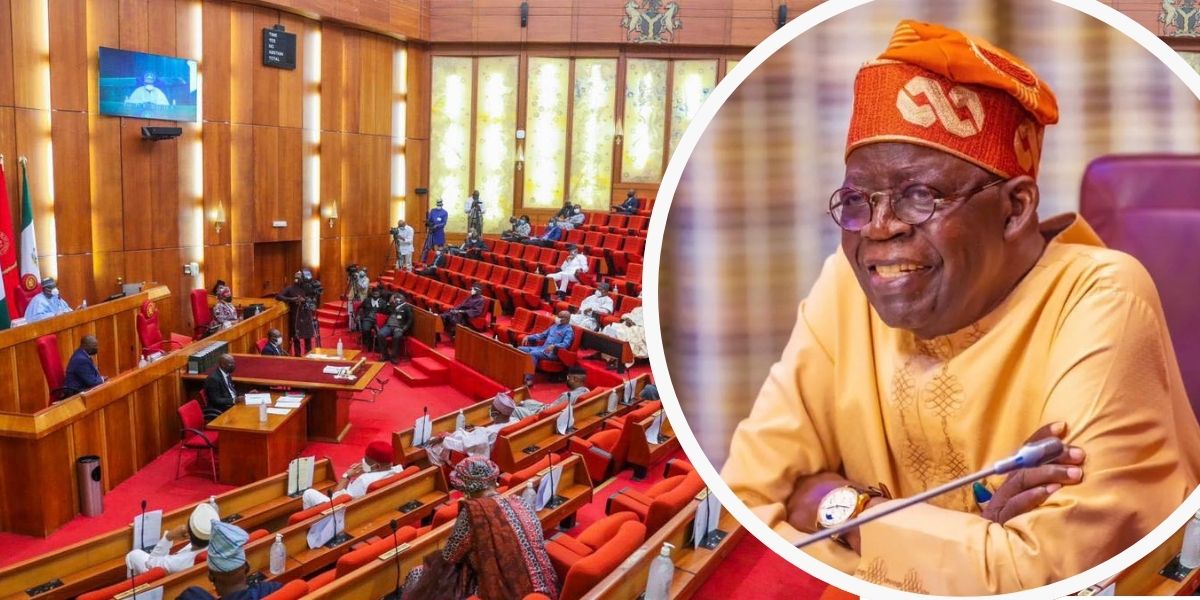
The Nigerian Senate criticized the Federal Government’s envelope budgeting system on Wednesday, stating that even though President Bola Tinubu declared a national emergency on security, the funding model is not prepared to handle the nation’s worsening security situation.
At the Office of the National Security Adviser’s (ONSA) 2026 budget defense session in Abuja, the upper house made this statement after members questioned officials about ongoing budgetary deficits, postponed releases, and unfinished capital projects.
Yahaya Abdullahi, the chairman of the Senate Committee on National Security and Intelligence, stated that despite Nigeria’s struggles with separatist tensions in the South-East, banditry and kidnappings in the North-West and North-Central, oil theft and piracy in the Niger Delta, and insurgency in the North-East, the current envelope budgeting framework has continuously failed to meet the operational demands of the country’s security and intelligence agencies.
The budget template, which establishes preset expenditure caps for ministries, departments, and agencies, has proven to be too strict for a sector that needs flexibility and quick reaction to changing threats, Abdullahi said.
Abdullahi stated, “The envelope budgeting system is insufficient to address the magnitude of security threats confronting the nation.” The seriousness of our finance system must be reflected in our determination to defeat insecurity. Under budgetary restrictions and with delayed disbursements, security agencies cannot function at their best.
His comments reveal a growing dissatisfaction among National Assembly legislators over what they say is a misalignment between fiscal reality and policy promises.
Despite the President’s repeated assurances to Nigerians that his administration is determined to restore security, senators contended that such promises need to be accompanied by timely and sufficient funding.
Abdullahi also bemoaned the fact that slow and insufficient funding releases, especially capital expenditures in the budgets for 2024 and 2025, had severely undermined security efforts nationwide.
Several initiatives aimed at improving logistics, operational mobility, surveillance infrastructure, and intelligence collection, he claimed, were either not carried out at all or were only half done.
He cautioned that if capital votes are not properly implemented, it will have repercussions for the entire security architecture, from personnel deployment and training to equipment acquisition.
Speaking at the meeting as well, Mohammed Sanusi, Permanent Secretary, Special Services, ONSA, echoed the committee’s worries, citing inconsistent overhead releases, envelope budgeting, and the failure to implement capital appropriations as the main performance barriers.
According to Sanusi, “the envelope budgeting framework has posed significant challenges to our operations.” “The inability to fully implement capital appropriations and irregular overhead releases have impacted our ability to support and coordinate security agencies effectively.”
In order to respond to sudden spikes in violence, new threats, and intelligence-driven operations that cannot be postponed by bureaucratic bottlenecks, Sanusi emphasized that security management needs a dynamic finance system.
Although ONSA coordinates many security and intelligence agencies, he informed lawmakers that the stability and adequacy of budget flows directly affect how successful the agency is.
Growing national security pressures are the backdrop for the Senate’s criticism. Recurrent attacks on rural communities, mass kidnappings for ransom, attacks on security formations and vital infrastructure, and ongoing threats from non-state actors have all occurred in Nigeria in recent years.
Even though defense and security receive huge annual budgetary allocations—often among the largest portions of the national budget—lawmakers and commentators have questioned whether the releases’ structure and spending patterns match actual realities.
Based on anticipated income and financial constraints, MDAs function within preset spending caps under the envelope budgeting approach.
Critics contend that the approach might hinder agencies that need flexibility, especially in emergency-driven sectors like security, even though its goal is to foster discipline and macroeconomic stability.
The senators in the session emphasized that extraordinary funding measures, not regular fiscal restraints, should be triggered when a national emergency on security is declared.
A mismatch between treasury resources and risks on the ground, they cautioned, might undermine public trust and give criminal networks more confidence.
However, the committee promised ONSA more robust legislative support to strengthen Nigeria’s security infrastructure.
“We are dedicated to offering the required legislative backing to guarantee the reinforcement of our security framework,” Abdullahi continued.
The guarantee suggests that funding mechanisms may be reviewed during the current budget debate for 2026, as parliamentarians have alluded to the necessity of reforms that would give security services more latitude in obtaining and allocating cash.
The committee examined sensitive parts of the budget request, such as classified expenditure lines and operational requirements, in a closed-door meeting following lengthy discussions in an open session.
The Senate’s review’s conclusion might have a significant impact on how Nigeria’s security institutions are funded in the upcoming fiscal year as lawmakers attempt to strike a balance between economic responsibility and the pressing need to bring peace and stability back to the entire nation.