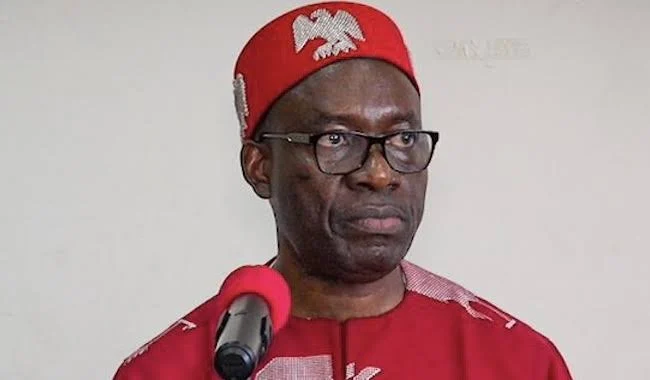
David-Chyddy Eleke examines the legitimacy of Anambra State Governor Prof. Chukwuma Soludo’s recent appeal for Ndigbo to appropriately reintegrate into the Nigerian project.
Despite receiving more than 90% of the total votes voted in the state’s governorship election on November 8, 2025, Anambra State Governor Chukwuma Soludo cannot claim to be particularly well-liked by the general public. That might be something that will be discussed later. Nevertheless, the professor of econometrics and former governor of Nigeria’s top bank is one governor whose open opinions cannot be wished away.
It doesn’t matter if Soludo’s words make you love or despise him; what matters is that, no matter how unpleasant or hurtful his opinions may be, you cannot ignore the truth they contain. Since taking office as governor in 2021, Soludo has frequently spoken unpopular opinions that, while not untrue or debatable, his detractors found to be quite repugnant.
His famous open letter, “History Beckons, I Shall not be Quiet,” is still one of the most well-known of these viewpoints. His opinions in the article were direct criticisms of Mr. Peter Obi, a former UNN classmate, his son’s godfather, and his predecessor, a Labour Party presidential candidate in the 2023 election.
The entire Igbo race in South East Nigeria was the objective of Soludo’s recent decision to reveal this fact on the 2026 Armed Forces Remembrance Day. The governor urged the Igbo people of the South East to stop marginalizing themselves, especially its young people, and encouraged them to accept their position as “co-owners” of the Nigerian project by joining the Nigerian Armed Forces.
Following a vibrant military procession and the symbolic placing of a wreath on the tomb of the “unknown soldier,” Soludo addressed the platform to deliver what he saw as home truth while considering the 56th anniversary of the Nigerian civil war’s conclusion. He called the civil war “needless” and stated that the idea of “no victor, no vanquished” must continue to serve as a national compass. However, what Soludo saw as more important was the South East’s residents’ desire to shed the toga of marginalization, which has remained a recurring topic of conversation.
He bemoaned the fact that, despite the fact that the war ended 56 years ago, Igbo people still have feelings of marginalization, to the extent that they refuse to be recruited into important institutions that may further their development and strengthen their voice in the Nigerian project.
For instance, the South East consistently reports low enrollment rates in vital industries like the military every year. The states in the South East declined to occupy the slots even after quotas were assigned. This has persisted, and it has been fed by harmful misinformation propagated by secessionist movements that want everyone to think that the system would always despise Igbo people. For instance, the Movement for the Actualization of the Sovereign State of Biafra (MASSOB), a separatist organization led by Ralph Uwazuruike, advocated for the Igbo people to avoid the 2006 national census, claiming it was useless for them.
Later, the group physically interfered with the exercise, even going so far as to attack census takers. Even the justifications that the census served as the foundation for allocating utilities and other benefits of democracy were insufficient to get them to change their minds.
Additionally, members of the Indigenous People of Biafra (IPOB), a later-day secessionist organization led by Nnamdi Kanu, who is currently incarcerated, has launched a propaganda campaign opposing military enlistment. The false allegation that Igbo officers in the police are targeted and sent to bandits and Boko Haram, which devastated the North East and West, respectively, in the hopes that they will be used as sacrificial lambs, was the initial cause of this.
After this failed, the group went on to declare war on their own brothers who were serving in the police, calling them “saboteurs.” There are numerous videos showing members of the Eastern Security Network (ESN), the militant wing of the IPOB, attacking police formations and even targeting Igbo officers for daring to register in the Nigeria Police, which they call to as “zoo police.” Some of these officers are killed, while others are abducted and forced to die slowly.
During the armed forces remembrance day, Soludo stated, “The Police is working hard, the army; you’re working hard, but Anambra people and the rest of the South East, this is the moment that we have to tell ourselves that the civil war has ended and the civil war ended 56 years ago,” in an attempt to dispel their misconceptions and provide home truth about how the Igbo can integrate themselves into the Nigerian project and reap the many benefits of doing so. Our young people from the South East, especially those from Anambra, have the lowest recruitment rates in the nation for the Army and even the police.
“I would like to take this opportunity to encourage our young people to join the Nigerian military.” Nigeria belongs to all of us, and we cannot be complete members of an organization while choosing to remain outside or not take part. We have been excluding ourselves in this particular region. In a few decades, we will turn around and cry that there are no officers of Igbo or Anambra descent because we refused to join the police and military. As equal proprietors of Project Nigeria, we must thus contribute equally.
Soludo is aware of the actions of a small group of criminals who pretend to be separatists and liberators in order to free the people from the “suffocating” hold of Nigerian authorities, who are thought to despise Igbo people. Soludo, who has consistently offered a carrot before a stick, seized another chance to urge criminals disguising themselves as freedom fighters to leave the bushes or face consequences for their actions.
In reference to them, Soludo stated: “I also want to call on our brothers and a few sisters who are in the forest, bushes, and so-called camps; some claim they are liberators, but these people are terrorists, criminals, and kidnappers.” Humans do not live in bushes or forests, therefore leave as you are not freeing anyone. Humans reside in homes. We have extended an olive branch to the few remaining terrorists, and we will assist them in becoming contributing members of society. The terror age is and must end. However, the line is formed in the sand if you choose to remain there, and I always remind our young people that no one has closed themselves off and lived off crime till old age. We take advantage of this chance to offer an olive branch once more.
As we commemorate today’s Armed Forces Day, we urge you to put down your weapons because the civil war is over. There is no alternative way to end the civil conflict, which affects not only the people in the South East but all of Nigeria. It’s time to construct Nigeria to fulfill its manifest destiny and become the world’s most advanced country in addition to its greatest population, according to Soludo.
Even though many people have criticized Soludo for what they called “loud mouthedness,” his message has resonated sufficiently in the minds of many. Soludo maintains that he made the correct statement after numerous conversations.
“History shows that groups that opt out of national processes often wake up a decade later to find themselves statistically “diminished” or under-represented in federal institutions, leading to a fresh cycle of disadvantage that is difficult to reverse,” wrote Mr. Christian Aburime, his press secretary, in defense of his principal. The aforementioned dynamics make it important that Ndigbo, particularly our brothers and sisters from Anambra State and the energetic, resilient youth of the Southeast, awaken! It’s time to stop watching from the sidelines. It is time to put a stop to the period of self-imposed exile from the core of Nigeria’s security architecture.
“Consider the heroes that the Southeast would lose if they chose not to enlist.” Future generals, strategists, and reformers may come from our bright, creative, and resilient young people. Thus, the Light of the Nation has always set an example for the young people of Anambra in particular. We have done well in both trade and education. Let us now rule as we serve our country. No other career option can compare to the discipline, abilities, and feeling of purpose that enlistment brings. Additionally, it is a doorway to power, status, and pensions. We have rebuilt from the devastation of war for the larger Southeast; now is the moment to reestablish our presence in every institution that unites Nigeria. Now is the time to say “never again” to marginalizing oneself.