
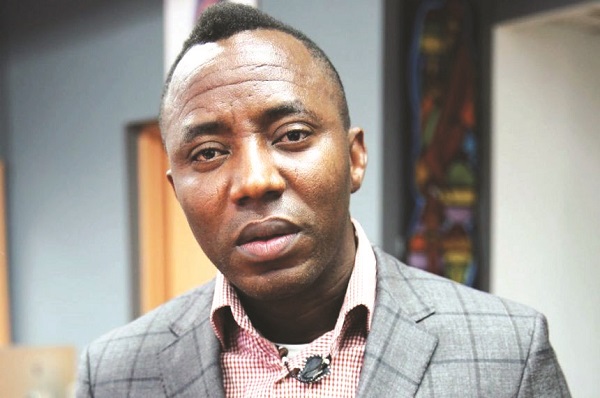
In the continuing trial of activist and publisher Omoyele Sowore for allegedly cyberstalking President Bola Tinubu, the Federal High Court in Abuja on Wednesday rejected materials submitted by the defense team.
According to reports, Sowore is facing two additional counts of cybercrime for a social media post on August 25, 2025, in which he called the President a “criminal” in response to Tinubu’s assertion during a visit to Brazil that corruption had been eradicated in Nigeria under his leadership.
Marshal Abubakar, Sowore’s attorney, underwent cross-examination by attempting to provide internet publications that allegedly contained disparaging remarks made by Tinubu against former Presidents Olusegun Obasanjo and Goodluck Jonathan in 2011.
According to the statements, Obasanjo was called “expired meat,” Jonathan was called “a drunkard and sinking fisherman,” and his administration was labeled as “corrupt and shameless.”
According to Abubakar, the records were crucial to show contradictions in Tinubu’s stance on corruption and public discourse as well as to bolster Sowore’s defense.
Justice Mohammed Umar, the trial judge, decided that the defense could not present the documents through the prosecution’s first witness, a Department of State Services (DSS) employee who had stated in court that he was not aware of their contents.
The judge decided that the items could not be entered into evidence since the witness neither acknowledged nor authored their knowledge.
Other documents outlining claims of alleged continued corruption in the nation, such as arrests and dismissals of public officials by the DSS and EFCC, were also dismissed by the court.
The DSS agent, the prosecution’s main witness, told the court he had no idea how Nigeria ranked on international corruption indices and was unable to verify whether people like Femi Fani-Kayode or Reno Omokri had publicly accused Tinubu of corruption or other illegal activity on social media.
Abubakar made an effort to provide proof of Nigeria’s ongoing battle with corruption, contending that Sowore’s appointment could not be considered fraudulent or illegal in light of the documented difficulties.
Citing the Evidence Act, the prosecutor rejects the evidence
The records were contested by prosecution attorney Akinlolu Kehinde (SAN), who claimed that they violated Section 84 of the Evidence Act, which governs the admissibility of electronic evidence, and were unrelated to the cyberstalking charges.
Kehinde requested the court to throw out the materials, arguing that the defense was trying to divert attention from the main points of the case.
Sowore’s defense was further restricted when Justice Umar maintained the objection and declared the documents inadmissible.
In order to continue the cross-examination, Abubakar requested an adjournment at the end of the session.
In order to give the case more time, Justice Umar postponed it until March 5, 2026.
Tap