Omoyele Sowore, a controversial activist and Sahara Reporters publisher, traveled to Aba, the commercial center of Eastern Nigeria, on March 17, 2026. He stated that his goal was to push for Nnamdi Kanu, a detained Biafran separatist leader, to be freed.
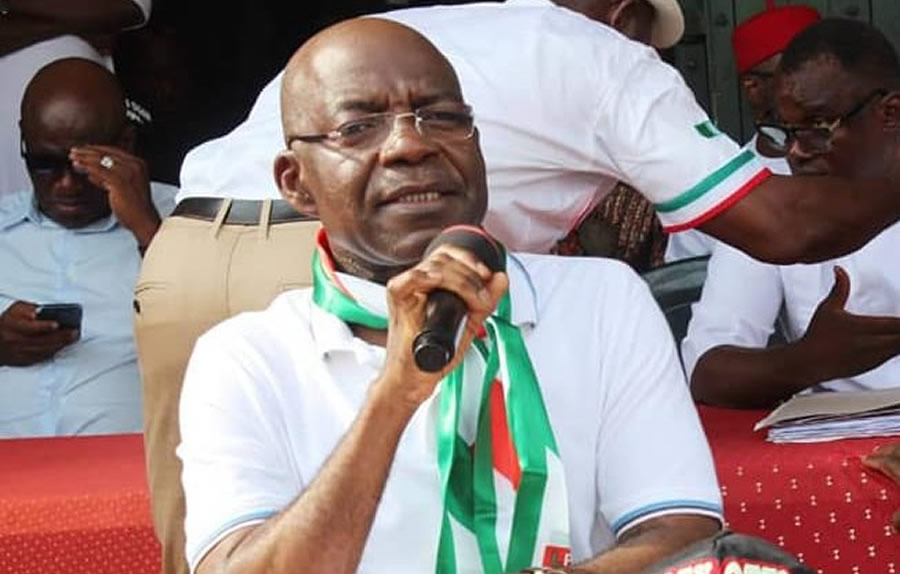
But events surrounding the visit—especially his comments made both during and after—indicate that the trip might have had a different purpose. It seems to be intended to undermine the increasing public acceptance and effectiveness of Abia State Governor Alex Otti rather than a targeted lobbying effort.
Since taking office on May 29, 2023, Governor Otti has presided over what many observers call a dramatic transformation of Abia State, turning it from one of Southern Nigeria’s least developed regions to one of the states with the quickest rate of improvement. This change has earned it the moniker “The Abia Miracle.”
Context is crucial for comprehending the issue surrounding Sowore’s visit. First, Nnamdi Kanu is still in federal detention, and the federal government—possibly with presidential intervention—has the last say over whether or not to free him. Any significant advocacy effort would logically target political power hubs like Abuja or Lagos rather than an Aba marketplace. This begs the obvious issue of what part Ariaria Market traders play in this kind of effort. In actuality, none.
Additionally, reports state that Sowore was at Ariaria for less than an hour. There isn’t much proof that he was in Abia before the current government took office. If he had, he would have been able to compare the state’s current change under Governor Otti with the extreme infrastructure deterioration that earlier characterized the state.
Sowore even took the road that led to Ariaria Market, which has clearly been improved. He admitted that the region is cleaner now than it was in the past, when it was rife with filth and neglect. The long-standing flooding problem known as “Ofe Obara,” which had severely damaged the Ariaria axis, has now been successfully resolved—something that earlier administrations were unable to accomplish.
Beyond Aba, its revitalization reflects a more general change in the state.
Abia has difficulties in many important areas prior to the current administration. Public services were generally ineffectual, roads were infamously bad, and infrastructure was in disrepair. Criminal elements even had authority over certain districts. The story has drastically evolved since then. Thanks in part to the Operation Crush security program, crime rates in Abia have been progressively dropping since May 2023, making it one of the safer states in Nigeria.
More than 400 roads have apparently been rebuilt in the last two years. These roads stand out for their solar-powered street lighting, adequate drainage systems, and longevity. Many have been finished in a short amount of time, frequently less than a year. The employment of direct labor—hiring local engineers and technicians instead of hiring outside contractors—is a notable aspect of these projects.
In public housing, a similar strategy has been used to renovate important government buildings such the Dr. Michael Okpara Auditorium, Commissioners’ Quarters, and the State Secretariat. Both urban and rural development initiatives have been expedited by the creation of the Greater Aba Development Authority and the Greater Ohafia Development Authority.
Education has also received a lot of attention. Governor Otti announced a state of emergency in the industry after taking office, which resulted in more funding—roughly 20 percent of the state budget, according to reports. Infrastructure development is continuing, and tertiary institutions have regained their lost accreditations. Even if such progress might not be immediately apparent during a quick visit, the system has been enhanced at the fundamental level by the hiring of 5,000 teachers through a merit-based approach.
With salary arrears settled and regular payments now guaranteed by the 28th of every month, workers’ welfare has improved, demonstrating a renewed dedication to governance.
The administration has hired more than 700 medical experts and made significant improvements at all levels of the healthcare system. “Project Ekwueme” has restored more than 200 health centers. Additionally, the state earned a $500,000 award in the 2025 Nigeria Governors’ Forum Primary Healthcare Leadership Challenge in the South East Zone. Furthermore, plans for a billion-dollar medical village have been finalized and construction has started on the site with the goal of reducing medical tourism from the area in partnership with foreign partners.
Beyond infrastructure, the administration’s strategy has been centered on governance changes. Merit-based hiring, budgetary restraint, open procurement procedures, and the efficient reorganization of Ministries, Departments, and Agencies are a few of these. A culture of service delivery and responsibility is progressively solidifying.
In light of this, Sowore’s comments seem to be mostly superficial, based more on ephemeral observations than a thorough comprehension of systemic adjustments. His comments are more spectacular than meaningful, akin to a “naked dance” in Aba, which lacks objective proof.
It is nevertheless true that Governor Otti has set the stage for Abia State to have a better organized and efficient government. The obvious changes, which are sometimes referred to as the creation of a “New Abia,” are just the start of what many predict will be a long-term development trajectory.
️