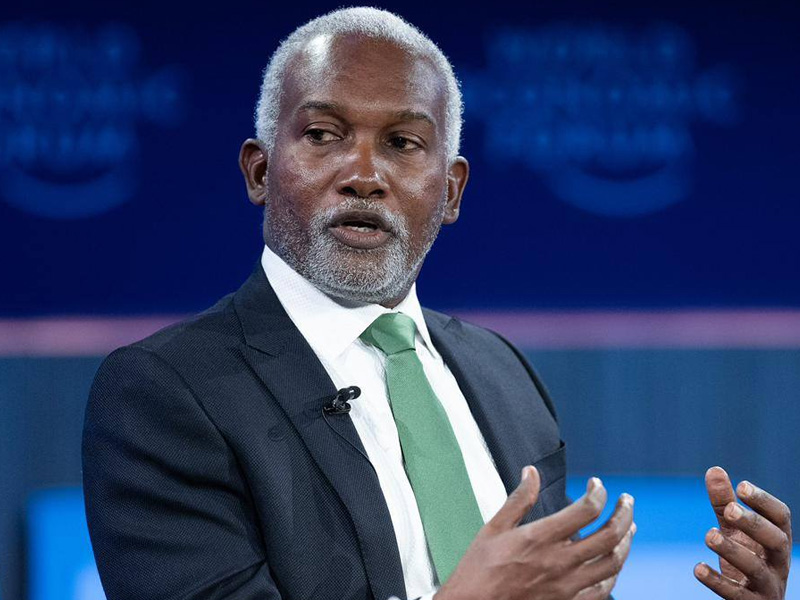
Yusuf Tuggar, the Minister of international Affairs, advised international investors Tuesday not to see Nigeria’s future through the lens of a few isolated security situations. According to Tuggar, these instances did not accurately represent the long-term investment fundamentals of Africa’s biggest economy.
Tuggar highlighted Nigeria’s security issues while speaking to CNN from the sidelines of the current World Economic Forum (WEF) in Davos, Switzerland. However, he emphasized that problems were localized and that the administration was aggressively addressing them.
According to him, the propensity to generalize instability throughout the nation has frequently resulted in inflated risk perceptions that have disguised potential in crucial industries. He called on the world to reconsider how it perceived Nigeria.
According to the minister, Nigerians are among the most diverse people on the continent. He emphasized the nation’s progressing macroeconomic changes and the Bola Tinubu administration’s continuous attempts to improve governance.
According to Tuggar, investors should have a more nuanced perspective of Nigeria, evaluating the nation based on its unique qualities rather than generalizations, even though no nation is immune to security problems.
“I think it would be nice to see (Nigeria) as a very diverse country that actually has not fared badly compared to countries that are more homogenous,” he said to CNN. Because despite certain fringe or even warring places, we have been coexisting peacefully in border areas that are currently cascading downward.
But in order to identify the appropriate remedies, it is crucial to define it for what it is. In addition to a number of other activities, we have forest guards. In actuality, our battle against Boko Haram was quite successful.
The minister refuted what he saw as the inaccurate framing of the African and Nigerian situations, stating that many of the assertions are exaggerated.
“Africa’s risk bias, where the issue of risk, geopolitical risk in particular, is overhyped when it comes to Africa, which doesn’t apply in other parts of the world,” he stated, referring to some of the discussions that are happening here.
Therefore, it is crucial that we examine the advancements made by the Tinubu administration in macroeconomic reforms, such as the reduction of corporate income tax, the reform of foreign exchange, and the tax reforms that facilitate investment in Nigeria.
“We have $43 billion in foreign reserves, so we can come to Davos and use our Nigerian cards—credit cards with no limits. The yield on our Treasury bills and sovereign bonds is between eight and ten percent. So let’s take a broad view of Nigeria. Let’s stop focusing on a few isolated occurrences and using them to characterize the entire nation.
“And it’s also important to note that sometimes when we dwell on some of these incidents, sorry, when we don’t frame the narrative correctly, we actually trigger some of these incidents, because that’s when some of the terrorists and bandits try to go for innocent civilians and use them as human shields because they know they’re going to be targeted,” he continued.
Tuggar acknowledged the impact of the recent coup in the Niger Republic and its detrimental effects on security in the Sahel, stressing that Nigeria is still willing to collaborate with other countries in order to provide equipment and training to address the country’s security issues.
“We were attempting to sort out the thousands that had surrendered,” he said. Prior to the coup in Niger, some were innocent victims trapped in combat zones. Because it permits the right of pursuit, Niger withdrew from the global joint task force that was functioning so effectively.
It makes it possible for Nigerian military to track down terrorists in Niger and vice versa. We are pleading with prospective investors to view us in the same light as they do other nations.
“You do not write off the entire country just because an incident occurred in a 923,000-square-kilometer nation.”
The minister declined to give a definitive answer when asked if the targets in Sokoto were targeted by the recent US-Nigeria airstrikes. He noted that people in charge of the military and security were best suited to respond to such inquiries.
“Enough to say that certain targets were hit, and as is the case with some of these strikes, sometimes you don’t get the right target,” Tuggar stated.
However, it highlights Nigeria’s and the US’s, as well as other nations’, readiness to learn more about the conflict in the area and cooperate to stop it.
“The West African region, as well as the Sahel and Lake Shad regions in particular, are among the fastest expanding regions in the globe since it is a global struggle. In the next 24 years, Nigeria’s population will reach 400 million. The continent with the greatest population will be Africa.
In order to prevent these wars from spreading to other continents and to prevent terrorism, extremism, and other criminal activities from flourishing in the Sahel, it is crucial that we put an end to them as soon as possible. Additionally, we’re doing a lot locally.
“Nigeria is bearing a lot of responsibilities,” Tuggar said. If you look at the job we’ve done in just one month—intervening in the Republic of Benin, where there was a coup attempt, sheltering an opposition leader following an election, and dealing with a coup in Guinea-Bissau—you’ll see how many duties we have, and we need your help.
“We require support in the form of equipment, training, and—above all—understanding and appropriate framing of the events occurring in our region and throughout the nation.”