
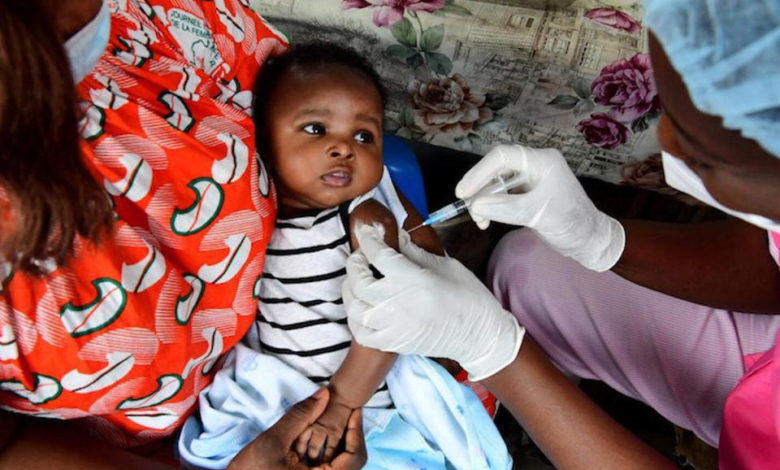
Perceived developmental regression in children after normal vaccines is causing parents to become increasingly frustrated and anxious. This raises challenging issues at the nexus of public health, parental experience, and scientific data.
Gift Oba addresses the parents’ concerns, the opinions of medical professionals, and the wider ramifications for vaccine confidence in Nigeria in this report.
For five-year-old Samson (no real name), when the world speaks in unison, it is a vast, reverberating stillness.
The tiny kid, who lives with his parents in the Obafemi-Owode Local Government Area of Ogun State, knows the words for “mama” and “dada,” but the phrases are stuck behind a wall of sound he cannot pull through.
Rather than requesting his favorite toy, he raises his palm, furrows his forehead, and turns his cry into his sole vocabulary.
A boy who constantly stares at the ceiling fan and rotates his body in a rhythmic 360-degree dance alongside its blades has taken the place of the child who once sung “Halleluyah” and engaged with the outside world.
For his mother, Mrs. Iraboh (not actual name) the bright recordings of his early years are terrible evidence of a “before” and a “after.” She maintained that her boy was well up until one significant event: receiving the Measles 2 immunization.
She described how her healthy youngster abruptly lost the capacity to repeat phrases and stopped responding to his name. “He was okay, until I collected the vaccine,” she said.
Her narrative offers a glimpse into a developing, intricate phenomenon where parental anxiety and developmental regression collide.
Mothers like Mrs. Irabo are conducting their own study, believing that heavy metals and vaccine records hold the secret to why their children’s voices vanished, even if medical science describes delayed speech as the result of hearing loss, heredity, or underlying illnesses like autism.
When a child’s speech and language development is slower than what is normally anticipated for their age, it is referred to as delayed speech. Numerous reasons, including hearing loss, developmental delays, environmental variables (such lack of stimulation), and genetic susceptibility, can cause this.
According to research, children with delayed speech may struggle to articulate words, comprehend language, or communicate properly. This can be brought on by a number of things, including a transitory lag, a hearing impairment, an underlying illness like autism, or an intellectual disability.
Before we had the measles 2 vaccination, my son was healthy. Mother
When her child was one year and three months old, the mother of two reported that she saw a regression in him following the vaccination, including his incapacity to converse like children of his age.
“Thursday, November 12, 2020, keeps flashing in my head. I was already 42 weeks pregnant and didn’t fall into labor. On getting to the hospital, I was induced and labored for 15 hours, before they carried out an emergency Cesarean Section,” she recalls.
“My child, however, was born healthily and well. Up until I had the measles 2 vaccine, he interacted with others and was OK like any other youngster. He began staring constantly, stopped talking, and was unable to repeat sentences. We would call his name, but he would not answer.
He would follow anything that was moving; for instance, he would focus on our ceiling fan and rotate 360 degrees in tandem with the blade. He refused to stop until I held him, even when he was on the verge of falling.
Before the vaccine went “wrong,” our correspondent saw in a brief video that the mother played that the young youngster made noises and said phrases like “mama” and “halleluyah.”
According to those recordings, he was OK and communicating with others, but after receiving the vaccine, he stopped speaking and was unable to even repeat sentences. Because the vaccine includes heavy metal, I was meant to detox him after collecting it, I discovered after doing some research,” she added.
Another mother, Lisa Benjamin, also known on TikTok as Lisa Motherhood & lifestyle, wrote about her daughter’s autism after getting the vaccination.
“What if these kids react differently to these vaccines, what if some children will be affected and others won’t?” she asked in the video.
“My daughter used to react to her name; she was fine and accomplished all of her milestones until she was a year old, at which point I began to notice some differences.”
When contacted, she reported that delayed speaking, tiptoeing, stimming, non-response to her name, and changes in social interaction with peers were among the early indicators observed.
The age of my child is three. Delayed speech, not answering her name, tiptoeing, stimming, and social interaction variances from peers were some of the early indicators I observed. As she got older, these symptoms became more apparent, she claimed.
On Lisa Benjamin’s TikTok post, a few parents related similar stories, attributing their child’s autism diagnosis to relapse following immunization.
“She ain’t lying, my child was verbal till his one-year vaccination and all of a sudden, he regressed and has been diagnosed with autism,” remarked OluwaMayokun Hamdallah.
“This happened to my son, he was already repeating words at 8 months there about saying goodbye and hello at 11 months before we collected measles 2 immunization,” wrote a user going by the handle @Oritoke. The issue started when he became ill, and we observed regression.
“After recovery he stopped answering to his name, wasn’t talking and started tilting his neck to one side. He was even tiptoeing, which he had not before done.
In a similar vein, @Ugonma said, “Hello mama.” My niece experienced the same thing; at seven months old, she abruptly stopped reacting to her name, but we were able to identify it in time. She was nonverbal and hyperactive at one year and six months of age. We had to get her a specialist tutor and perform a lot of heavy metal detoxifying.
“Basically what we did was half fill her bath tub with warm water,” Ugonma said in describing the detoxification procedure. Then add epsom salt and baking soda and put her in there for about 10mins (she had her toys so she was just playing).
We did that two or three times a week at night; it was one of the suggested activities. We’re not sure if it was helpful, but it was one of our actions.
Twins in Lagos pass away 24 hours after being vaccinated
Samuel Alozie, a 30-year-old father, said earlier this month that his twin twins, who were nine months old, died as a result of obtaining vaccinations at a basic healthcare facility in the Ajanybadi neighborhood of the Ojo local government in Lagos State.
Alozie, who goes as Promise Samuel on TikTok, claimed that on the morning of December 24, 2025, he took his twins, Testimony and Timothy, for their regular vaccinations. On the morning of Christmas Day, December 25, they passed away.
He claims that after the shots, his kids got extremely weak, and even though he gave them paracetamol as the nurse suggested, their fever kept rising till they passed away.
They were given phony, out-of-date, or unsuitable medications, he claimed.
Alozie stated, “The vaccination was administered in the morning on December 24. On the morning of December 25, they passed away. After the injection on the 24th, they were quite feeble, so I gave them paracetamol because the nurse advised me to do so if the fever persisted.
“I, and my wife, after we left the health centre, went home and gave the two of them paracetamol, which didn’t solve anything. After my wife gave them a cold water bath, they both passed away simultaneously on the 25th.
“The saddest aspect is that two of them were so weakened by the medicine that they were unable to play, talk, or eat like they used to.
In response, Ibrahim Mustafa, Permanent Secretary of the Lagos State Primary Health Care Board, stated that a post-mortem examination had been performed to ascertain the true reason of their death and that investigations were still underway.
Although Mustafa acknowledged that the children had received vaccinations, he maintained that there was no proof that this was the reason for their demise.
“We administer vaccinations frequently. Vaccinations have been administered since the beginning of time. Although the youngsters received vaccinations, we do not believe that the vaccine was the reason for their deaths.
“The only thing that can show what caused this thing is the post-mortem and toxicology tests were also being carried out following the allegations raised by the children’s father,” he added.
Mothers’ growing frustration
Mrs. Irabo revealed that raising a child with delayed speech can be emotionally taxing and necessitates patience to prevent irritation.
She claims that her son can express his demands in an intensive fashion, such as by screaming loudly or dancing while shaking his waist, when he wants to use the restroom.
The hardest thing, according to Mrs. Benjamin, is not being able to understand her daughter’s demands, which causes her to have meltdowns out of frustration because she is still unable to articulate herself.
“The hardest part has been not always being able to fully understand my daughter because she cannot yet express herself, which sometimes leads to meltdowns born out of frustration,” the mother stated.
“Managing societal misunderstanding and navigating the uncertainty, particularly not knowing how quickly progress will come, has been challenging.”
She described her coping mechanism as “continuously educating myself, advocating for my child, and celebrating small milestones.”
Mrs. Benjamin disclosed that she had also started being deliberate about her child’s meals, establishing straightforward routines that make her feel secure and in control, encouraging communication through plays and repetition, and paying careful attention to what upsets or calms her.
“It’s a hands-on process that calls for a lot of trial and error, patience, and consistency,” she continued.
Parents plead with the government to provide inexpensive services and supportive schools.
Some of the parents have lamented the expense and weariness of employing speech therapists for their kids, pleading with the government at all levels to take all necessary steps to provide a school atmosphere that is suitable for kids with special needs.
Additionally, they argued that policies that encourage inclusive education, therapy financing, and caregiver support would be extremely beneficial to families and urged the government and society to raise awareness, lessen stigma, and improve access to inexpensive early intervention treatments.
“Autism is not a one-size-fits-all disorder, nor is it a result of poor parenting.
“Children with autism are not less than others; they just experience and engage with the world differently. With compassion, understanding, patience, and the right kind of support, they can thrive.” According to Mrs. Benjamin, “empathy and inclusion make a significant difference.”
Expert: Vaccines protect children and do not harm them.
Dr. Adekunle Saheed Adediran, a consultant pediatrician and head of clinical services at the Federal Medical Center Abeokuta, has denied that vaccinations killed or seriously injured children.
He emphasized that children’s delayed speech or autism are not caused by the Measles, Mumps, and Rubella (MMR) vaccine, maintaining that immunization avoids death and impairments including blindness, deafness, speech difficulties, and paralysis, among other things.
Dr. Adediran said that the vaccination has helped reduce childhood morbidity and mortality, particularly in a developing country like Nigeria with a large number of children under five, a high incidence of infectious diseases, and poor medical facilities.
“I’ve had no reason to even remotely link these vaccines to delayed speech or autism in my practice of over three decades,” he stated.
Global immunization efforts have saved an estimated 154 million lives over the past 50 years, or six lives every minute of every year, according to a 2024 survey conducted by the World Health Organization (WHO) and published in The Lancet.
The measles vaccination was found to have the greatest effect on lowering infant mortality out of all the vaccines included in the study, accounting for 60% of the lives saved as a result of immunization.
According to Dr. Adediran, national health authorities continuously monitor the safety of vaccines after they are launched, ready to identify and address any issues. Before any vaccine is introduced, it must pass stringent testing through several phases of clinical trials to guarantee its efficacy and safety.
“The reasons behind a child’s potential developmental delay”
The consultant pediatrician made the point that a newborn’s growth is largely dependent on the availability of nutrient-dense calories, and that their physical and mental development will suffer if these calories are lacking.
He continued by saying that excessive screen time in infants and young children can be linked to delayed speech and language development. He emphasized that although there are many contributing factors, any child experiencing delayed milestones should see a pediatrician for a comprehensive evaluation, stressing that they are qualified to determine the cause.
“Proper nutrition no doubt promotes optimal growth and development in children: exclusive breastfeeding from birth till 6 months of age, introduction of adequate complementary feeding from 6 months and continued breastfeeding for 2 years and beyond.
“Delayed speech and language development may be linked to excessive screen use in newborns and young children. Toddler studies have proven this.
Children learn best when they engage with adults in real life, and passive screen time does not give this. He believed that young children’s screen time should be restricted and should be accompanied by an adult who actively engages the child by explaining and talking with them while encouraging positive engagement.
In the meantime, Dr. Adediran suggested that immunization education be incorporated into regular hospital health talks, particularly during prenatal care for pregnant women. He believed that this would give them the chance to ask questions, address concerns in a transparent manner, and urged the media to assist in disseminating accurate vaccine information in order to combat misinformation.