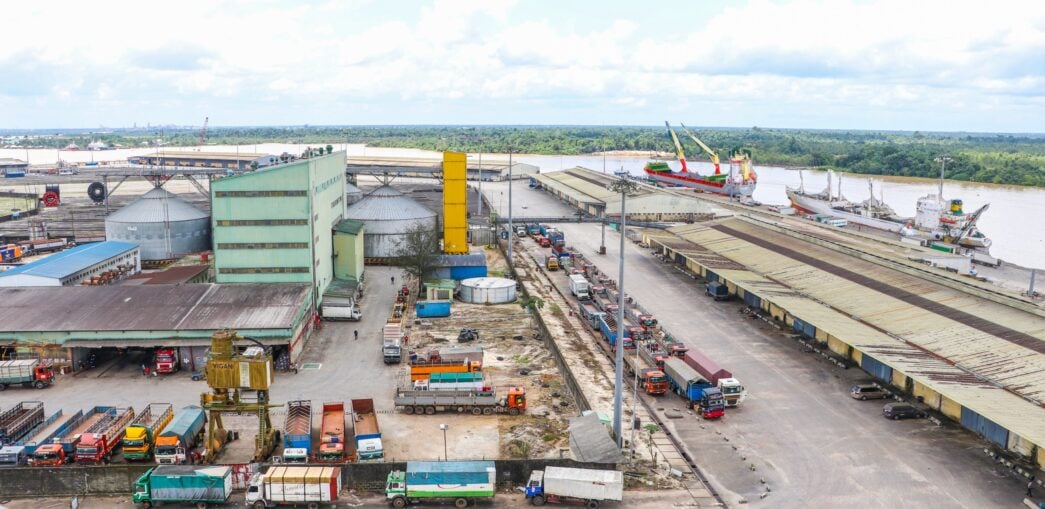
Stakeholders in the South-South have been urged by the Warri Chambers of Commerce, Industry, Mines and Agriculture (WACCIMA) to cease making concessions on matters that compromise the Delta ports’ ability to operate to their full potential.
It was Engr. who called. On Thursday, members of the Nigeria Union of Journalists (NUJ), Warri Correspondents’ Chapel, paid a courtesy visit to the Chambers’ secretariat in Effurun, Delta State, with Anthony Okoh, President of WACCIMA and the Delta Association of Chambers of Commerce (DACCIMA).
Okoh reaffirmed WACCIMA’s long-standing demand that the Nigerian Ports Authority (NPA) completely revitalize the Delta ports, emphasizing that the region’s employment and economic activity will be greatly impacted by their optimal performance.
“People in the South-South have a tendency to make concessions. It’s a matter of attitude. We need to shift our perspective and cease making concessions to the administration,” he stated.
He went on to say that the terrible status of the roads throughout the southern region was a result of the roads’ initial design, which was based on anticipated traffic levels, and he connected this to the poor state of port operations.
According to Okoh, “a chain reaction occurs when the pressure surpasses the estimated frequency and the roads give way.”
He suggested building an effective railway system to connect the Niger Delta states to other important commercial routes as a solution to the problem, claiming that this would improve business connectivity and lessen the load of heavy-duty trucks on the highways.
Additionally, Okoh bemoaned what he called the organized private sector’s fruitless attempts to consult with Sheriff Oborevwori, the governor of Delta State, on ways to maximize the state’s economic potential.
“The work we do here is voluntary. Our time and money are sacrificed. The organized private sector is not participating when our governor travels to Brazil or China for business meetings, he said.
He claims that in order to persuade the state government of the necessity of accepting the development proposals from the private sector, WACCIMA intends to invite its national leadership to speak with it.
We do not engage in conflict and are lawful. Although we have individuals who are capable of engaging in large-scale mechanized farming, we do not receive the necessary government support. Rather, other private sector entities provide us with support,” he continued.
According to Okoh, the government may help by serving as an insurance policy for the organized private sector.
He mentioned a plastic recycling project that had previously been proposed to the state government but had failed. He pointed out that although there were many good ideas that may improve the state’s economy, the difficulty lay in the government’s ability to put them into practice.
Earlier, Chairman of the NUJ Warri Correspondents’ Chapel, Comrade Okiemute Okpomor, who led the team, highlighted the need for closer collaboration between the media and WACCIMA to help drive economic growth in Delta State.