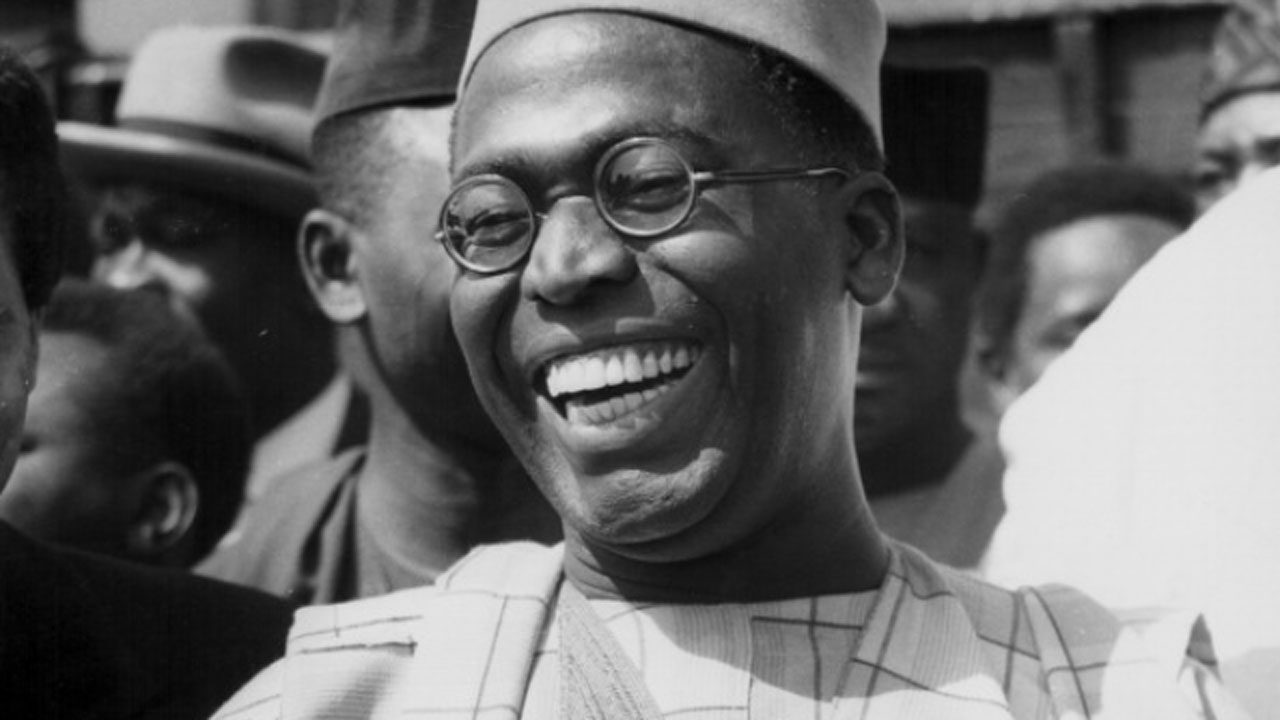
“Democracy, in my humble opinion, is the best kind of government and the fight against the arbitrary use of power by the rule of law.”Chief Awolowo Obafemi (1909–1987).
Unquestionably, a nation without a history will be condemned to a lack of a thorough knowledge of its sociocultural, political, and traditional values. A man named Olusegun Obasanjo, who was president of Nigeria until recently, eliminated history as a topic taught in schools for the vile purpose of trying to hide his shady political past.
Because of Obasanjo’s local and presidential incompetence, any Nigerian who is currently forty years of age or older might not, unless they work for it, have any historical awareness of the contributions our late political icon and sage, Chief Jeremiah Oyeniyi Obafemi Awolowo, made to our wonderful nation. Awolowo, who passed away on May 9, 1987, is still regarded as the unquestionable founder of progressive politics in Nigeria.
I apologize to the late Biafran warlord Dim Odumegwu Ojukwu, but Awolowo will always be remembered as the “best president Nigeria never had” because of his lasting contributions. Awolowo will also always be regarded as the most distinguished, knowledgeable, and powerful one-man political opposition this potentially magnificent nation has ever produced, as long as there is a Nigeria. Individually, Awolowo was just as powerful during his lifetime as his political groups, which spanned the first and second republics. His political group, the Action Group, AG, which was founded on March 21, 1951, was just as powerful as he was during the first republic. What’s more, the party was a rift in the fabric of the central government at the time and firmly embedded in the hearts of his people.
Awolowo was a powerful opposition leader at the time, and the ruling party would suffer politically if they ignored him. His detention during the first republic was a sign of the political era’s nunc dimittis. The Awolowo opposition phenomenon was so powerful at the time.
Take the second republic as an example. Awolowo ran under the Unity Party of Nigeria (UPN), a progressive party, but was defeated. Awolowo’s opposition to mal-governance was particularly powerful and effective until the fall of that republic and beyond, and his UPN had the greatest and most empirically supported political party manifesto and program in Nigerian history.
The Action Group party was founded by Awolowo, who was the Western Region’s premier in the 1950s, and is founded on his welfare-socialism political philosophy. No Nigerian, educated or not, can dispute Awolowo’s developmental and progressive influence, which has made his region one that other sections of the nation follow and envy, whether in the old western region, the present southwestern region, or the entire country. His party’s effective implementation of free health care, free education at all levels, full employment for all residents, and integrated rural development are policies that have been deemed too idealistic to achieve by the nation’s succeeding administrations.
The oppositional skills of Awolowo are prophetic, analytically intelligent, and selfless. He wrote a letter to National Party of Nigeria (NPN) President Shehu Shagari in 1981, warning that Nigeria would suffer “unspeakable disaster” unless a change in course was made. He noted that the “ship of state is fast approaching a huge rock.”
As they say, the disastrous results of his warning going unheeded are history. Even in modern-day Nigeria, no political party has been able to duplicate the Awolowo uniform cardinal program magic wand in the southwest region of the nation.
He established a Political Bureau led by Professor Samuel Cookey in August 1985, months after the autocratic Ibrahim Badamosi Babangida had taken control of the country in a military coup. Awolowo was among the prominent Nigerians invited by the Bureau, as was to be anticipated at the time. However, when no one else did, Awolowo, in his brave letter to Professor Cookey on February 28, 1986, recognized the Babangida abracadabra. With the words, “I do fervently and will continue to fervently pray that I may be proved wrong,” he spoke truth to terrible military might. We have started a pointless hunt, and something inside of me tells me that clearly. Ultimately, we would be really disillusioned when we picture the new order to be here. Asiwaju Bola Ahmed Tinubu, the current president of Nigeria, was one of the members of the National Democratic Coalition (NADECO) group that emerged from the horrific conclusion of that experience, which prevented Nigeria from holding its best elections ever. At the time, few Nigerians took him seriously.
An Awolowo’s political ideological consistency and altruism are unmatched by any opposition figure in modern-day Nigeria. Right now, we have avaricious political harlots posing as people’s advocates on both sides of the current political divide. They criticize for their own personal wealth rather than for the good of the group, and they hurl insults against the current administration and ruling leaders in an attempt to get financial or appointment chances.
A strong political opposition base was supplied by Awolowo. It is impossible to dispute his political intelligence, moral character, and unquestionable discipline, whether you love him or hate him. The administration of the day trembled when Awolowo spoke. He served as his era’s moral and political conscience, something Nigeria has yet to replicate. Awolowo offered alternative viewpoints free of pointless oppositional criticism in response to a shared national issue.
In contrast to Awolowo’s unselfish oppositional model, modern opposition squandered a great deal of time, effort, and money settling preventable internal party disputes and divisions, leaving little opportunity for any significant checks on the current administration.
There are numerous instances of power struggles and splits inside the nation’s current political parties that are harmful to the development of significant opposition. Due to their leaders’ insatiable desire for power and financial gain, the Peoples Democratic Party (PDP), the African Democratic Congress (ADC), the Labour Party (LP), and the New Nigerian People’s Party (NNPP) are currently in avoidable political binds.
These political parties’ leaders lack the political legitimacy and credentials necessary to persuade voters that they would be a good successor for the current administration.
In their excessive desire to control this nation, are Atiku Abubakar or Peter Obi the ones who have crossed political parties in violation of any recognized ideology? Perhaps Rabiu Kwankwaso or one of the other former politicians is running for president without any clear policy platform principles?
The Nigerian opposition is dispersed and lacks coherence. Without a cohesive or alternative vision for governance, they continue to harbor the illusion of taking control in this chaotic condition. Instead of the opposition’s current lackluster and disorganized front, where is the intended strategic direction?
Is it possible for the opposition to effectively hold the ruling party accountable? Ideological clarity is lacking in the current opposition. Their focus is not on fortifying their opposing base, but on facilitating easy alignment with the ruling party. With the political status quo failing to deliver a compelling message, it is no wonder that the opposition always finds it difficult to carve out a place in the electoral landscape.
Finding a “Awolowo” in today’s opposition is still ongoing, and finding answers to the nation’s ongoing security and economic problems is becoming increasingly difficult.