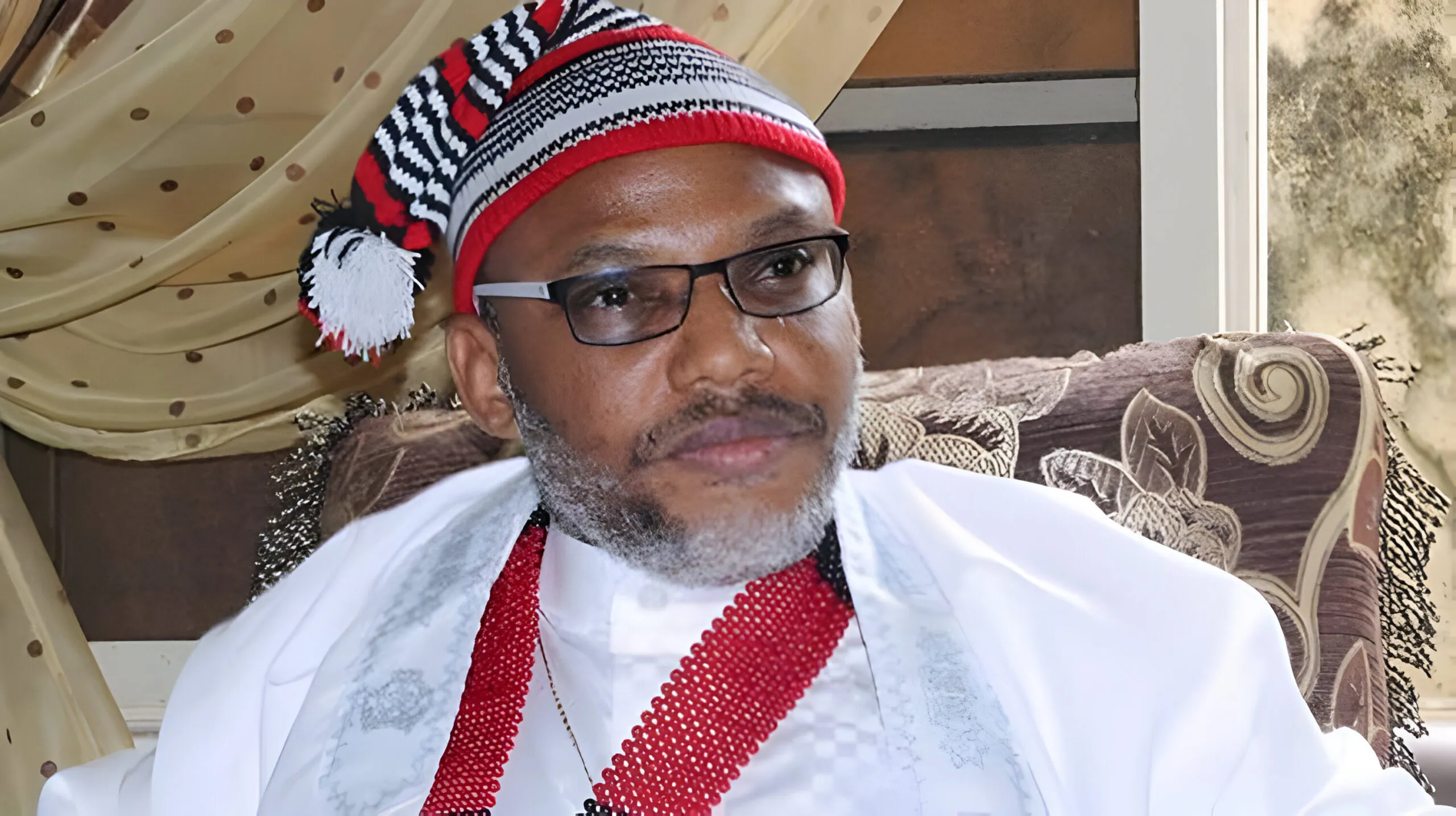
A group of pan-Igbo self-determination activists has denounced the UK government’s silence about the conviction and sentencing of Nnamdi Kanu, the leader of the Indigenous People of Biafra, or IPOB.
In a joint statement on Tuesday, the Rising Sun Foundation (RSF), American Veterans of Igbo Descent (AVID), and Ambassadors for Self-Determination (ASD) accused the UK government of failing to protect its citizens. Kanu’s passport is from Britain.
The Nigerian government accused the IPOB leader of terrorism, and on November 20, 2025, he was found guilty after a multi-year trial. The agitator was found guilty by the James Omotosho-presided Abuja Federal High Court and given a life sentence.
Kanu is presently incarcerated at the Nigeria Correctional Service’s Sokoto correctional facility.
The pan-Igbo activists chastised the UK government in a statement signed by Dr. Sylvester Onyia, AVID, Evans Nwankwo, ASD, and Maxwell Dede, RSF, for failing to act in Kanu’s case in the same way that it has been acting in comparable circumstances.
The statement, which was titled “Public briefing note on the UK government’s silence over the rendition, unlawful detention, and life imprisonment of British citizen, Mazi Nnamdi Kanu,” called the British government’s silence concerning and contradictory.
According to the statement, “Mazi Nnamdi Kanu, a British national, was sentenced to life in prison on November 20, 2025, by Nigeria’s Federal High Court (per Justice James Omotosho) under a repealed law, despite a binding Court of Appeal acquittal issued on October 13, 2022.”
The UK-Nigeria Extradition Treaty (2008), the European Convention on Extradition, the UN Convention Against Torture (Article 3), and Nigeria’s domestic laws, which prohibit trying a renditioned suspect, were all violated by Kanu’s illegal rendition from Kenya in June 2021.
The UK government has not released a statement since the November 20 sentencing, despite the seriousness of these offences and the fact that Kanu was kidnapped while holding a British passport and broadcasting freely from London, where IPOB is lawfully registered.
“This silence is unheard of, concerning, and at odds with Britain’s international human rights stance.”
Concerned over the UK government’s silence following Kanu’s life sentence, the statement pointed out that on November 11, 2025, the UK’s Foreign, Commonwealth & Development Office (FCDO) last spoke with Nigerian authorities, requesting “fair trial standards” and consular access.
“There has been no statement, no parliamentary briefing, no diplomatic protest, and no sanctioning of Nigerian officials since the life sentence,” it continued. The UK’s reaction to incidents involving significantly less serious infractions contrasts sharply with this quiet.
The UK’s lack of interest “reads as tacit endorsement of a sham process,” according to the activists.
They also denounced the UK government for not protecting a British national who had been kidnapped overseas. The statement claims that the UK has not responded to the “fabricated claims in Omotosho’s judgment, including false allegations that Kanu threatened UK/US missions,” demanded compliance with the 2022 appellate discharge, rejected trial under a repealed terrorism statute, or condemned the international kidnapping of its citizen.
According to the campaigners, “the implication is that the UK is failing its own citizens, violating its duty of diplomatic protection.”
The statement noted that the UK has historically been outspoken in cases involving detained activists like Alexei Navalny (Russia), Aung San Suu Kyi (Myanmar), Jimmy Lai (Hong Kong), and Julian Assange (Australia/US), and it further accused the UK government of applying rule of law standards selectively. However, the UK has choose to remain silent about Kanu, a British person who faces rendition, torture, unlawful detention, and conviction under a legislation that has been repealed. Britain’s reputation as a defender of due process and human rights is damaged by this selective approach.
The protestors also claimed that the UK government’s silence was proof of prejudice and animosity towards the Igbo people.
“We make it very clear that the UK’s silence is proof of ethnic animosity toward the Igbo.” In addition to Omotosho’s claims of threats against UK/US missions, the Igbo diaspora views the UK’s inability to safeguard Kanu as part of a pattern of calculated neglect that is evocative of Britain’s involvement in the Biafran War from 1967 to 1970.
According to the statement, “silence feeds mistrust and reinforces a belief that the UK prioritizes geopolitical convenience over justice.”
The pan-Igbo campaigners explained why the conviction is significant to the UK by pointing out that Kanu is a British citizen and that his broadcasts from London are protected by UK free speech laws (Human Rights Act 1998; Article 10 ECHR).
The statement stated that IPOB is lawfully registered in the UK with company number 09862831 and that “his political advocacy is peaceful, legal, and constitutionally protected in the UK.”
Human rights duties cannot be superseded by UK economic interests. Trade volumes of £6.5 billion a year with Nigeria do not relieve Britain of its obligation to defend a citizen who is being persecuted by the state. The reputation of the UK is in jeopardy. The statement went on, “Silence here undermines UK moral authority in future human rights cases.”
The Nigerian government’s refusal to abide by a legally binding Court of Appeal ruling, Kanu’s illegal rendition and purported trial under a repealed law, and claims of falsified evidence in the ruling were all major concerns that the activists demanded the UK publicly acknowledge.
Additionally, they requested that the UK urge that the Nigerian government adhere to the 2022 Court of Appeal ruling that cleared Kanu and offer the IPOB leader complete consular support, including access to medical care and oversight of the conditions of his confinement.
A parliamentary investigation into the UK government’s handling of Kanu’s rendition and continued detention, as well as a review of potential sanctions under the UK Global Human Rights Sanctions Regulations (Magnitsky model) against officials implicated in the rendition, torture, suppression of court rulings, and fabrication of evidence, are further demands.
“We disagree with the idea that this is an internal Nigerian issue. It becomes an international issue and a test of UK values when a British citizen is kidnapped overseas, tortured, tried under a statute that has been repealed, denied the benefit of a binding appellate acquittal, and found guilty based on false allegations.
It is quite concerning that the United Kingdom, the guardian of Magna Carta and the source of contemporary human rights law, has remained silent. It conveys the perilous idea that fair trial standards are flexible depending on the parties involved and that realpolitik can supersede the rights of its own citizens. We won’t let this injustice continue. To be silent is to comply.
The message went on, “The UK must act.”