

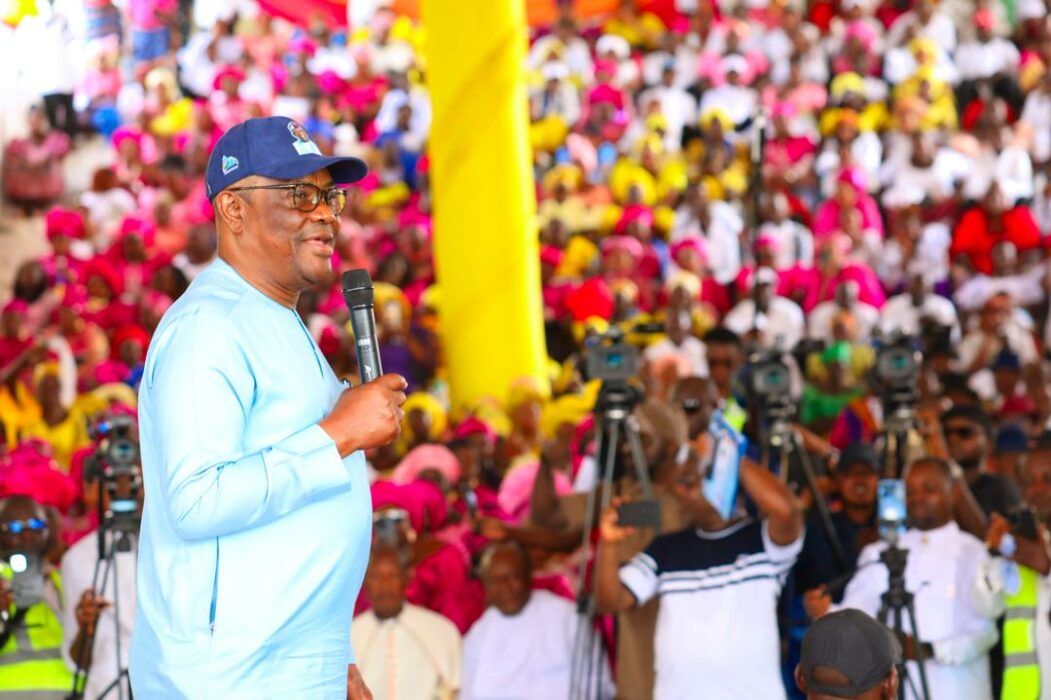
Minister of the Federal Capital Territory (FCT), Nyesom Wike, has declared that Nigeria must not be handed over to politicians he described as gamblers, insisting that President Bola Tinubu’s economic reforms are beginning to yield positive results and should be allowed to consolidate.
Wike reiterated that the removal of fuel subsidy by the Tinubu administration had increased financial allocations to state and local governments, creating opportunities for them to execute development projects and improve the living conditions of their people.
The minister stated this on Friday, during a Rainbow Coalition town hall meeting in Degema Local Government Area of Rivers State, where he urged residents to support continuity in governance rather than return the country to what he described as political uncertainty.
According to him, the economic policies introduced by Tinubu required time to stabilise and deliver their full benefits, warning against disrupting the process by handing power to politicians whose records, he alleged, raised questions about their commitment to national development.
“Don’t go and spoil it by bringing gamblers. Let us continue with this man we have seen now. Let him continue so that we know the economic policies he has laid will stabilise and we will reap from it, and more money will be coming,” Wike said.
He described the removal of fuel subsidy as a difficult but necessary decision, arguing that previous administrations had failed to address the problem despite recognising its negative impact on the country’s economy.
“The President came on May 29, 2023. Immediately he took the oath of office, having identified that this is a problem that has made Nigeria not to move forward, he said he was going to solve that problem.
Wike described fuel subsidy as a drain on national resources, arguing that its removal had made more funds available to the three tiers of government.
“Past leaders recognised the fuel subsidy as a sucker, a cancer. But they had no courage to end it once and for all.
“However, President Tinubu came, saw that subsidy must be removed, otherwise the country will die. He saw that already, the country was in a coma and he took that bold and courageous decision, which has brought the country out of coma,” he added.
The former Rivers State governor said the increased allocations to state and local governments were already translating into visible development, noting that local government chairmen now had greater financial capacity to provide infrastructure and other essential services.
Wike recalled that during his time as chairman of a local government council, allocations were often exhausted by recurrent expenditure, particularly the payment of primary school teachers’ salaries, leaving little or nothing for capital projects.
“In those days, when money was being allocated to you as a local government, assuming Degema got N700 million, it would be used to pay primary school teachers’ salaries, and what you would see remaining was zero. That means no one naira had come into Degema for development,” he said.
He also attributed the reduction in strikes in public universities to improved funding, saying the prolonged industrial disputes that disrupted academic calendars under previous administrations had become less frequent.
Wike, however, acknowledged that the reforms had come with economic difficulties for Nigerians but maintained that the foundation for recovery had been laid.
He recalled Atiku’s presidential bids in 1993, 2003, 2007, 2011, 2015, 2019 and 2023, noting that the former vice president was again seeking the presidency ahead of the 2027 election under the African Democratic Congress (ADC).
“Two days ago, Atiku was 80 years old. He started running for the presidency when he was 47. In 1993, he ran under the Social Democratic Party. In 2003, he came again. In 2007, the present President gave him a ticket in the Action Congress. In 2011, he came to the PDP. In 2015, he went to the APC. In 2019, he came to the PDP, and in 2023, we both ran. Now, in 2027, he is running again under the ADC,” Wike said.
He questioned the former vice president’s record in government, particularly his role in the privatisation of public enterprises during the administration of former President Olusegun Obasanjo.
Wike also criticised former Rivers State Governor Rotimi Amaechi, accusing him of abandoning major projects and mismanaging public resources during his tenure.
READ ALSO:
- 2027: ‘Don’t Vote For Me If You Won’t Vote Tinubu,’ Nwifuru Tells Voters
- 2027: I’m Done With Rivers, FCT, Give Me Imo, Kwara To Deliver, Wike Tells Tinubu
- Wike’s Demand To Lead Imo Tinubu Campaign Insult To Ndigbo — RHGN Deputy Leader
He specifically cited the proposed Karibi-Whyte Specialist Hospital, which he said was conceived as a 1,000-bed specialist facility but remained uncompleted despite an alleged expenditure of $39 million.
According to Wike, the amount was equivalent to about N53 billion at the exchange rate he referenced, while he questioned the fate of the project and the former Airport Hotel.
The FCT minister also faulted the previous administration’s mosquito-control programme, alleging that $10 million was spent on fumigation without achieving the promised results.
He challenged those responsible to explain the expenditure, particularly as residents continued to contend with mosquito bites and malaria.
Earlier, the Vicar of St Andrew’s Anglican Church, Bakana, Ven. Dr Isobeye Amabibi, commended Wike for what he described as his contributions to the development of Degema and other communities.
Amabibi specifically praised the provision of electricity to Bakana, saying residents were enjoying uninterrupted power supply, while also acknowledging ongoing infrastructure projects, including the landing jetty and road construction.
He appealed for the construction of internal roads to enable residents to access communities beyond the point where the existing road terminates.
The cleric also urged the incoming Rivers State administration to consider extending the road network to Tombia, Bukuma and Buguma to improve connectivity across the Kalabari communities.
Similarly, the Amanyanabo of Ancient Ke and Chairman of the Degema Local Government Area Council of Traditional Rulers, HRH Rt. Hon. Agolia Aboko Omoni, commended Wike for recognising traditional rulers and upgrading some traditional stools to second-class status during his tenure as governor.
Omoni, who spoke on behalf of traditional rulers in the area, said Wike’s decision to recognise the Amanyanabo of Ke, King Lawrence Odum of Bakana and the Amanyanabo of Bille had helped strengthen traditional institutions and promote peace in the communities.
He also applauded President Tinubu for the ongoing Lagos-Calabar Coastal Highway project, describing it as an important infrastructure initiative that would open up economic opportunities for coastal communities in Rivers State.
According to him, the highway would enhance connectivity across the coastal states and support the development of the blue economy.
The traditional ruler urged Wike to convey the appreciation of the Degema traditional institution to the President, while expressing optimism that the project would extend economic benefits to the area.
In his remarks, the Amanyanabo of Bakana, HRH King Lawrence O.O. Odum, also commended Wike for his contributions to the development of Rivers State, particularly his efforts to secure oil wells for the state during his tenure as governor.
Odum said the recovery of the Soku oil wells had contributed to improving the state’s revenue base, adding that traditional rulers and residents of Degema appreciated Wike’s political and developmental interventions.
He also pledged the support of the people of Degema for the political direction being pursued by Wike and his allies ahead of the 2027 elections.
Williams said the projects executed by his administration were aimed at improving infrastructure and delivering the dividends of democracy to residents.
The meeting was attended by political leaders, traditional rulers, community stakeholders and supporters of the Rainbow Coalition.

