

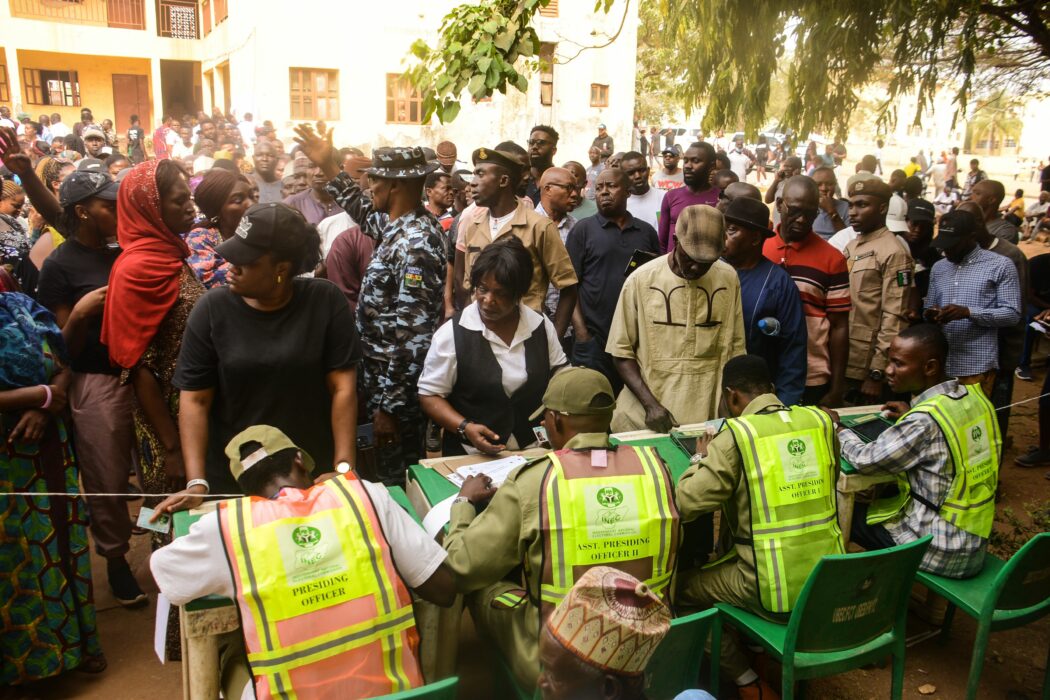
By ADEBAYO WAHEED, Ibadan; ABDULLAHI OLESIN, Ilorin; ALO ABIOLA, Ado-Ekiti; NONYE EKWENUGO, Kaduna; and ATTAH ANTHONY, Jalingo
While politicians jostle across the country to scramble for elective positions, the voting public is not amused by the track record of some elected politicians and is cautiously optimistic about another round of elections to bring in new or continuing government officials. Our correspondents sought the views of Nigerians on what would influence their choice of candidates in next year’s general elections.
While some voters are demanding an improved standard of living, others are calling for reductions in poverty, fuel, and food prices.
In Kaduna State, rising food prices, poverty, and unemployment may influence how voters make their choices in the 2027 general elections, as residents say the struggle to afford basic necessities has become increasingly difficult.
For many households, the rising cost of food has left little room for other expenses, including house rent, transportation, school fees, and savings.
A mother of six, Mrs. Josephine Audu, who spoke with our correspondent, said coping with the rising cost of living has been difficult, forcing her to think carefully before buying anything in the market.
“We are just surviving by the grace of God. You cannot even save. Even if you are earning N70,000 a month, it cannot take care of feeding alone, not to talk of paying house rent, transportation, and other expenses. So, it is just by the grace of God that we are surviving,” she said.
On vote-buying, Mrs. Audu said although hunger could make it difficult to reject money offered by politicians, she would not allow such inducements to determine her choice of candidate.
“There is hunger in the land, if I must be sincere. If they give me money, I will collect it and still vote for my choice,” she said.
A trader at the popular Central Market, Zainab Aliyu, said a 50kg bag of local rice now sells for between N60,000 and N70,000, while a bag of maize goes for between N30,000 and N40,000.
“One cannot say that things are cheap in Kaduna. Even in the bush market, things are expensive,” she said.
Aliyu said hunger would influence her voting decision in 2027, adding that she would accept money offered by any political party and vote for it.
“If they give me money, I will collect it and still vote for them because there is hunger,” she said.
A member of Waka Ambassador, Ambrose Edekobi, said poverty, inflation, and unemployment would be major issues in the 2027 elections.
He, however, expressed concern that vote-buying could undermine voters’ ability to make independent choices, saying some politicians offer as little as N2,000 or N3,000 to influence their decisions.
According to him, voters who accept such inducements risk enduring the consequences of their choices for another four years.
Edekobi said his group was sensitizing voters to make independent electoral choices, even when politicians offer them money.
A women’s leader, Aisha Ibrahim Medina, blamed the economic difficulties facing Nigerians on what she described as the government’s failure to do enough to improve living conditions.
She said the hardship is not limited to opposition supporters but also affects Nigerians across political divides.
“The hunger is not only affecting the opposition; it is affecting all Nigerians. It is everybody who is suffering; it is everybody who cannot afford a decent livelihood,” she said.
Medina said the economic situation could affect the ruling APC in the 2027 elections, arguing that the hardship could make it difficult for the party to retain power at the center.
She cited the experience of her cousin, a university graduate who is unemployed and struggling to make ends meet, as an example of the difficulties facing young Nigerians.
Similarly, a resident of Jalingo, Taraba State, Mr. Igbankwe Thomas, faulted claims of economic progress in Nigeria, saying rising inflation, unemployment, and hunger show that ordinary citizens are yet to feel the impact of government policies.
Mr. Thomas, who spoke on the prevailing economic situation, described the country’s economy as being in a state of stagflation, where rising inflation and unemployment occur simultaneously.
He warned that the trend could undermine economic growth and development and also affect how the people will vote next year.
He said the hardship had cut across households, including farming communities, where producers are struggling to earn enough from the sale of their agricultural produce to meet basic needs.
According to him, the depreciation of the Naira has weakened the purchasing power of farmers, making it increasingly difficult for them to afford essential commodities despite their efforts to produce food.
“Even for farmers who are producing, what they produce is not enough to take care of themselves because of the depreciation of the Naira.
“They take their farm produce to the market, sell them, but cannot buy enough with the money realized,” he said.
Mr. Thomas lamented that the situation has left virtually no household untouched by the economic crisis, insisting that government achievements should be measured by their impact on the living conditions of citizens rather than public claims and propaganda.
He also identified insecurity as another major challenge confronting the country, arguing that the protection of lives and property remains the fundamental responsibility of the government.
The Jalingo resident urged Nigerians to make the prevailing economic and security conditions major considerations when deciding the political future of elected leaders during elections.
He said voters should assess the performance of those in authority against their responsibilities and be prepared to either retain or replace them through the ballot.
“High cost of living, unemployment, insecurity, and hunger are enough to tell the people whether those in government are capable or not. When lives and property are not protected, it tells a lot,” he said.
Mr. Thomas maintained that the simultaneous rise in inflation and unemployment was a warning sign for the economy, adding that government interventions would only be meaningful when Nigerians experienced tangible improvements in their daily lives.
On their part, a cross-section of voters and public affairs analysts in Kwara State said the economic reforms of President Bola Tinubu’s administration, which have brought about extreme hunger into the country, would play a greater role in how Nigerians will vote during the coming general elections.
READ ALSO:
- INEC Under Fire Over Cleaned Voters’ Register Ahead Of 2027 Polls
- Shun Tribal Politics, Vote Tinubu In 2027, Tompolo Tells Anambra Voters
- 11.4m Nigerians Living With Diabetes, Most Unable To Afford Treatment – Association
A public affairs analyst, Mr. Tunde Salman, said issues of subsidy removal, Naira devaluation, and tax reforms have negatively impacted the lives of average Nigerians.
“The issue of extreme hunger occasioned by tax reforms, Naira devaluation, and subsidy removal will play greater roles in voters’ engagement in the 2027 general elections.
“As you may have seen, some opposition candidates have indicated their intentions to reverse or revisit the economic reforms of the present administration if voted into power in 2027.
“Insecurity and political issues such as the principle of power rotation are some of the factors that will also play important roles in the way Nigerians will vote in 2027,” Salman said.
On his part, the executive director of Kwara Must Change and PeacePro, Abdulrazaq Hamzat, said hunger, inflation, and unemployment will undoubtedly influence voters’ decisions in the 2027 general election.
He, however, added that economic hardship does not automatically produce political change, just as it does not automatically produce electoral compromise.
“Its ultimate effect will depend largely on how voters interpret their circumstances and the alternatives presented to them,” he said.
Hamzat noted that as the election approaches, money is increasingly dominating political conversations at the expense of ideas.
“Leading political players are flooding the political space with financial donations, food supplies, material distributions, and other forms of direct inducement. Government social investment programs have also expanded, with financial credits and other interventions reaching members of the public through different channels.
“Yet, despite the dominance of money-politics, alternative candidates and third-party political platforms have continued to draw attention to policy issues and substantive national questions.
“Indeed, some of the issues now attracting considerable attention in the campaigns, including fuel subsidy and its economic consequences, were prominently introduced into the national electoral conversation by alternative political voices, such as Accord presidential candidate, Dr. Gbenga Hashim before being adopted by major political contenders.
“This is significant. It suggests that although money may dominate campaign visibility, ideas can still shape political conversations and influence electoral choices. The ability of alternative candidates to sustain issues-based campaigns may therefore become an important factor in the 2027 election,” Hamzat added.
On his part, the national president of the Yoruba Youth Socio-Cultural Association (YYSA), Olalekan Hammed, declared that poverty and hunger are not decisive issues in the forthcoming general elections.
He said this was because poverty and hunger are global problems, not peculiar to Nigeria alone.
“Besides, this is not the first time people will lament hunger as an election approaches.
“There was an extreme outcry over poverty during the first term of former President Muhammadu Buhari, yet, he was voted in for a second term,” he said.
A political commentator, Ogunsola Adeoye, said, “In my view, from what one hears and sees around, all these are not going to be serious factors in the 2027 election.
“Agreed, there is hardship in the land, but the message of the ruling party that the hardship being faced is a precursor to the upcoming life abundance seems to be resonating.
“Again, the various ongoing infrastructure projects across the country are not easy to ignore when talking about the general hardship in the land.
“Then, despite the general hardship, the ruling All Progressives Congress (APC) has remained the party to beat in virtually all the elections held across the country since 2023.
“That’s an indication that all those factors have not really played any significant role in shaping how the people vote,” he added.
A resident of Ibadan, Mrs. Olufunke Adeyemi, admitted that things are costly amid hardship but people are still trying to survive.
In Ekiti State, a retired civil servant, Mrs. Adetola Ajayi, said she will give her vote to a politician with programs that will reduce hunger in the land, bring down skyrocketing prices of goods, services, and food items.
She said, “To be frank with you, some Nigerians are still struggling to have their three meals per day. People in this category need to be empowered; getting them jobs will give them sustainable sources of livelihood.
“Efforts must be made to reduce the price of food items and other goods so that they will be affordable to the common man. All of these will be put into consideration before voting for the party and candidates of my choice.”
For a businessman, Mr. Olugbenga Oni, he said those with good plans for the economic welfare of Nigerians will definitely have his vote.
Oni said, “The increasing prices of fuel and other petroleum products, the cooking gas, and even electricity tariffs are getting too much on the people. The high cost of living is biting hard. Economic policies of the government must be rejigged to ameliorate the suffering of the people.”
While commending the present administration for its bold step to remove fuel subsidy, he said continued efforts must be made to ensure that transport fares become affordable for Nigerians.
“More money is being made available to state governments to work with. The federal government should do more public accountability for Nigerians to benefit from more dividends of democracy,” he said.

