

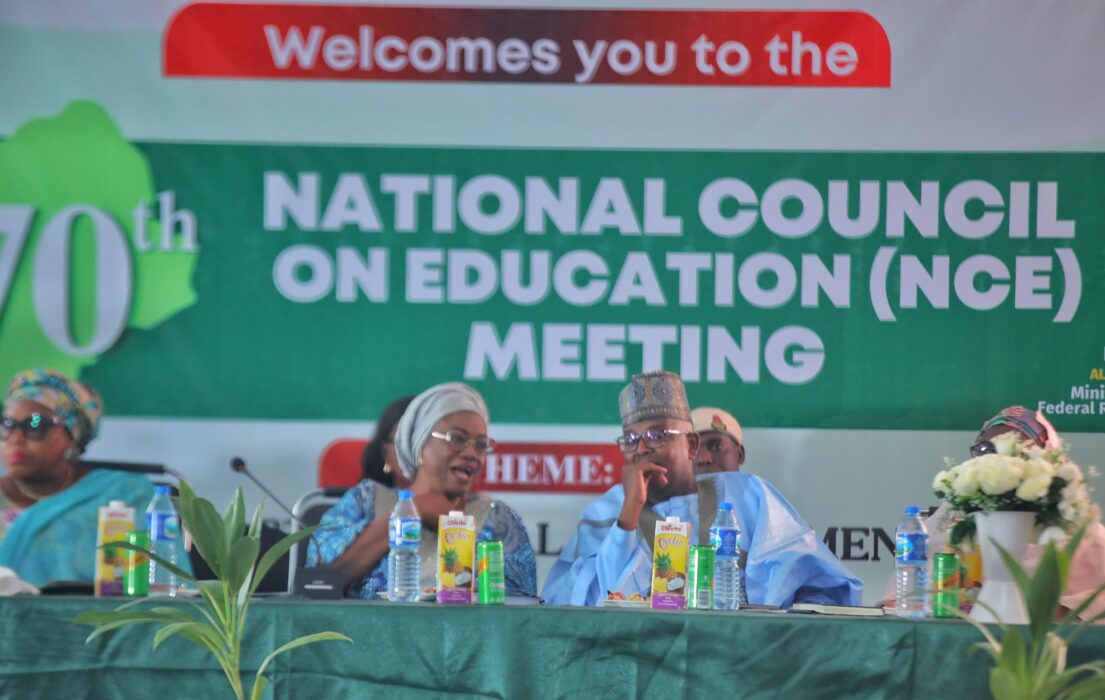
The federal government and the 36 state governments have renewed their commitment to tackling teacher shortages, improving education infrastructure and reducing the number of out-of-school children across the country.
The director overseeing the office of the Permanent Secretary, Dr ( Mrs) Folake Olatunji David who represented the Minister of Education Dr Tunji Alausa, stated this on Monday during the official session of the 70th National Council on Education (NCE), held in Maiduguri , Borno State capital to deliberate on major policy issues affecting Nigeria’s education sector.
The NCE, the highest policy-making body on education in the country, brought together Permanent Secretaries from the Federal and state Ministries of Education, the FCT Secretariat, heads of education agencies and other key stakeholders.
The meeting focused on recommendations from the Joint Consultative Committee on Education, particularly those relating to the theme of the 2026 council: infrastructure and teacher development.
The permanent secretary said the recommendations before the council were drawn from extensive consultations involving states and stakeholders in the education sector.
She added that the council would scrutinise the recommendations before they are presented for approval as national education policies.
According to her, improving education infrastructure without investing in teachers would not produce the desired learning outcomes.
“We cannot have just infrastructure without having corresponding development of the teachers’ ability to manage the classrooms and turn out students that have high learning outcomes,” she said.
She said teacher development must address both the quality and quantity of teachers, stressing that governments at all levels must ensure that schools have adequate numbers of competent teachers.
On the growing challenge of out-of-school children, the Permanent Secretary said the federal government and state governments were working to ensure that children were enrolled, retained in school and provided with quality learning.
She said it was no longer enough to merely get children into classrooms, adding that the focus must also be on ensuring that they actually learn.
“It is not just sufficient to have them in school. We are also constructing infrastructure all over the country, and a lot of interventions are being put in place to ensure that we have a conducive learning and teaching environment,” she said.
The permanent secretary further said teachers would be continuously trained and equipped with relevant competencies, particularly as the education system increasingly embraces digital technology.
She also commended the present administration for its interventions in the education sector, saying efforts were being made to recruit teachers in the right numbers, improve their skills and strengthen teaching and learning nationwide.
On insecurity and its impact on schools, particularly the abduction of pupils in Mussa and Lassa communities in Borno State, the Permanent Secretary described the safety of pupils, teachers and school administrators as a priority of government.
She said security was a national issue requiring concerted efforts by the federal and state governments.
“The issue of security is a national issue, not just for the education sector. The federal government and the state governments are putting a lot of measures to address these issues,” she said.
Borno State Commissioner of Education, Innovation, Science and Technology, Engr Lawan Abba Wakilbe who represented Borno State Governor, Professor Babagana Umara Zulum, said the State Government has reduced the number of out-of-school children in the state from about 2.2 million in 2019 to less than 700,000, following sustained investment in education infrastructure and efforts to return displaced children to school.
Wakilbe said the theme of the meeting which focused on infrastructure development and teacher improvement was particularly relevant to Borno, which had invested heavily in rebuilding schools and restoring education disrupted by years of insurgency.
According to him, the council also provides an opportunity for education officials from across the country to exchange ideas and share experiences on improving the sector.
“It will be a very great experience for us to exchange ideas with our counterparts from all over the country. A lot of lessons will be learned and there will be a lot of takeaways at the end of the meeting,” he said.
Assessing Borno’s performance in the education sector under Governor Babagana Umara Zulum, he said the state had made significant progress in bringing children back into classrooms.
He said, “In 2019, we started with 2.2 million children out of school. We now have less than 700,000.
“We inherited 765,000 children in school. Today we have 1.8 million. I think that is a big credit.”
Wakilbe said Borno, which recorded the highest number of out-of-school children in Nigeria in 2021, had dropped to sixth position when the figures were released in 2024.
He expressed optimism that the state would record further improvement when the Federal Ministry of Education releases its next figures in December.
“By the time the Federal Ministry of Education rolls out the figures in December, you will find out that we are going to move right to the very bottom,” he said.

