

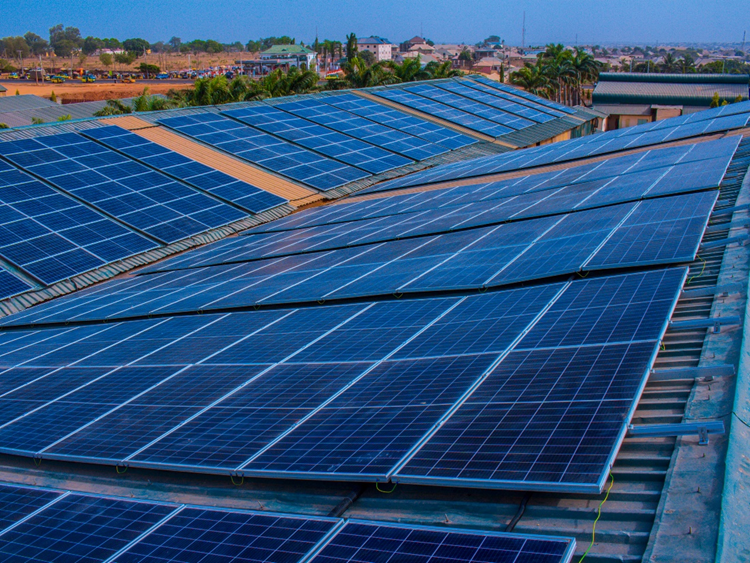
Solar power generation has grown substantially in recent years to about 20% of Nigeria’s electricity supply and could reach 50% by 2029 if current deployment and private-sector partnerships continue, the Rural Electrification Agency (REA) said.
This was disclosed by REA managing director, Abba Abubakar Aliyu, on Thursday at the just concluded 25th Nigerian Oil and Gas (NOG) Energy Week in Abuja.
Speaking at an energy panel called, “Re-Engineering Africa’s Power Market – Driving Reliable Energy Systems
Aliyu said Solar’s share of national generation has grown quickly and that continued momentum would see it approaching half of the country’s power mix in the next two to three years.
Aliyu said the growth was driven by increasing deployment and greater collaboration with private investors.
“Solar currently makes up 20 per cent of the nation’s total generation capacity and at the rate of deployment we are seeing it is approaching 50 per cent,” he said.
Read Also: Muslim-Muslim Ticket: APC Leaders Back Tinubu-Shettima Alliance Ahead Of Nomination
The REA boss told delegates that Nigeria was moving from being a major consumer of clean-energy equipment to a regional provider of renewable technology.
Manufacturers in the Lagos-Sagamu industrial corridor were building capacity to meet demand across West Africa, he said.
Aliyu said solar photovoltaic (PV) panels made in Lagos were already being exported to neighbouring countries.
A pipeline of some 3.7 gigawatts of PV manufacturing capacity was being developed to support further expansion, he added.
“If you go to the Lagos – Sagamu axis, you will see manufacturing companies coming up,” he said.
While they acknowledged the rapid growth in solar deployment and local manufacturing, REA and industry representatives warned that conventional gas-fired thermal plants will still be needed to stabilise Nigeria’s grid.
Another panellist, Vincent Ozoude, managing director and chief executive officer of Transafam Power Limited, said the intermittency of renewables and the need to stabilise supply for a growing population required gas.
He warned that without sufficient gas-fired capacity, the benefits of renewables investments could be undone. “Gas fired thermal plants are the quick fix to stabilising the baseline of the grid, given the swings in renewables,” he said. If you don’t have the gas-fired plants there today, no matter how much renewable investment we are doing, we are going backwards.
Panelists called for a dual-track investment strategy to keep expanding solar generation and domestic manufacturing, but also maintain and upgrade gas-fired plants.
They called for the federal government and private investors to harmonize policies and financing to back both tracks.
Also, speakers recommended investment in grid infrastructure to get the new generation to consumers. They called for the deployment of digitalised smart-grid systems for real-time dispatch of power, and for the building of more high-voltage transmission lines to ensure that newly generated electricity does not remain stranded.
The panelists said that linking increased solar capacity, continued gas support and better transmission and digital controls would be needed to convert increased generation into a dependable supply for millions of households across Nigeria.

