

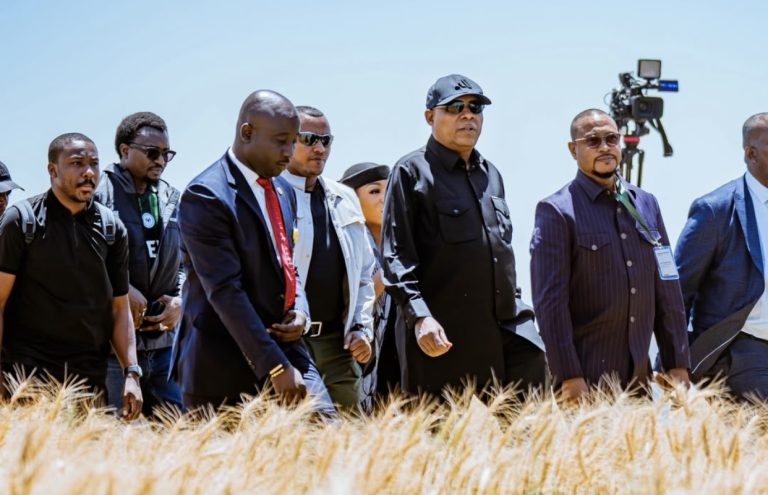
Nigeria is seeking to leverage Ethiopia’s agricultural transformation to achieve food sovereignty and strengthen food security across Africa, Vice President Kashim Shettima has said.
VP Shettima made this known in Addis Ababa, Ethiopia, while interacting with journalists as part of his three-day visit to the East African country.
Speaking during a tour of farms and agricultural facilities in Oromia, Ethiopia, as part of the Ethiopia–Nigeria Leadership Exchange, Vice President Shettima stated that the goal was to secure Africa’s place as the food basket of the world.
He cited Ethiopia’s Oromia model as the benchmark for Africa’s agricultural rebirth, emphasising that the strategic agribusiness hub provides a blueprint for farming communities both on and off the continent.
He said; “By resolving critical supply chain gaps and logistical bottlenecks, the country aims to de-risk agribusiness, attract significant investment, and ensure long-term food and nutrition security.”
The Vice President noted that Ethiopia had transformed its wheat production, flipping the script from importing $1 billion in wheat annually to achieving full self-sufficiency.
He commended the massive economic turnaround, saying the nation now generates enough surpluses to export to neighbouring countries like Djibouti and Kenya.
He also noted Ethiopia’s progress in rice production, observing that the country had become largely self-sufficient in the commodity.
VP Shettima said Nigeria planned to leverage Ethiopia’s experience in advancing large-scale, mechanised and modernised agricultural production.
“We intend to embrace improved seeds, mechanisation, and climate-smart agriculture,” he said.
The Vice President, however, warned that food security was fundamental to national sovereignty, stressing that countries depending heavily on external food sources could compromise their sovereignty.
“Food dependency compromises our sovereignty. Without independence in food production, a nation remains incomplete in its sovereignty,” he stated.
Pacesetters
VP Shettima declared that, through closer cooperation in modern agriculture and large-scale food production, Nigeria and Ethiopia had the potential to sustain the African continent.
He expressed Nigeria’s determination to achieve food sovereignty by adopting mechanisation, climate-smart agriculture, high-yield seeds and modern farming practices.
VP Shettima expressed optimism that cooperation between Nigeria and Ethiopia could significantly boost Africa’s food security, describing the East African nation’s agricultural transformation as an exemplary model.
“I am overwhelmed with joy that the real economic renaissance of Africa is in the offing. Ethiopia has become the pathfinder, the front runner in us reclaiming our pride and our continent. We are mightily proud of them.
“Africa must learn to feed itself. Ethiopia is doing it and Nigeria is on course to do the same. Ethiopia is a success story worthy of emulation,” he maintained.
Tree Planting
The Vice President also announced plans for Nigeria to embark on a massive tree-planting campaign starting next rainy season, with a target of planting 20 billion trees.
He stated that the initiative would draw lessons from Ethiopia’s Green Legacy Initiative, which combines environmental restoration with economic and livelihood benefits.
“We will embark on a massive tree-planting campaign in the next rainy season. It requires a lot of planning, energy and drive, which Ethiopia was able to galvanise its population into doing. We intend to plant 20 billion trees,” he hinted.
He said the programme would support environmental restoration while creating employment opportunities, adding that Nigeria sought to replicate aspects of Ethiopia’s experience.
VP Shettima also said the combined population and economic potential of Nigeria and Ethiopia could have a wider impact on the continent.
“With a population of 100 million people, and a combined population with Nigeria of over 400 million, Ethiopia’s success will reverberate across the length and breadth of East and Southern Africa,” he said.
President of the Oromia Regional State, Shimelis Abdisa, outlined the region’s agricultural achievements and the contribution of farming to Ethiopia’s economy.
Read Also: Gov Idris’ aide threatens to bar Malami from Kebbi over alleged billboard vandalism
Abdisa said more than 200 varieties of crops were being cultivated across Ethiopia, while the country had expanded its exports of agricultural products, including bananas, avocados and coffee.
He noted that wheat production alone generated more than $3.1 billion annually for the country, adding that Ethiopian wheat was competitive in the international market.
The Oromia President announced collaboration with the Dangote conglomerate to produce fertiliser for regional farmers.
He noted that the region’s large-scale poultry production had grown significantly beyond its initial two-million-bird capacity, with plans for further expansion.
During the tour, Vice President Shettima visited wheat, banana and papaya farms in the region, where he examined Ethiopia’s agricultural production systems and ongoing efforts to expand food production.

