

By CHIBUZO UKAIBE and JAMES KWEN, Abuja
Nigeria is heading towards another consequential presidential election, with the January 16, 2027 poll expected to test the popularity of President Bola Ahmed Tinubu’s administration and the ability of opposition politicians to offer a credible alternative.
With approximately 60 days to the election, the political atmosphere is increasingly charged. Economic pressures, persistent insecurity, unemployment, food affordability and public confidence in government are among the issues likely to dominate the campaigns.
The Independent National Electoral Commission (INEC) has published its list of 18 presidential candidates representing different political parties.
Among the prominent contenders, based on their previous electoral performances, party structures and national visibility, are incumbent President Tinubu of the All Progressives Congress (APC), former Vice President Atiku Abubakar of the African Democratic Congress (ADC), and former Anambra State Governor Peter Obi of the Nigeria Democratic Congress (NDC).
However, the contest extends beyond these three figures. It is also unfolding against the backdrop of a changing opposition landscape, with political realignments, coalition negotiations and legal disputes adding to the uncertainty.
The Contenders: Their Strengths and Weaknesses
Bola Tinubu (APC)
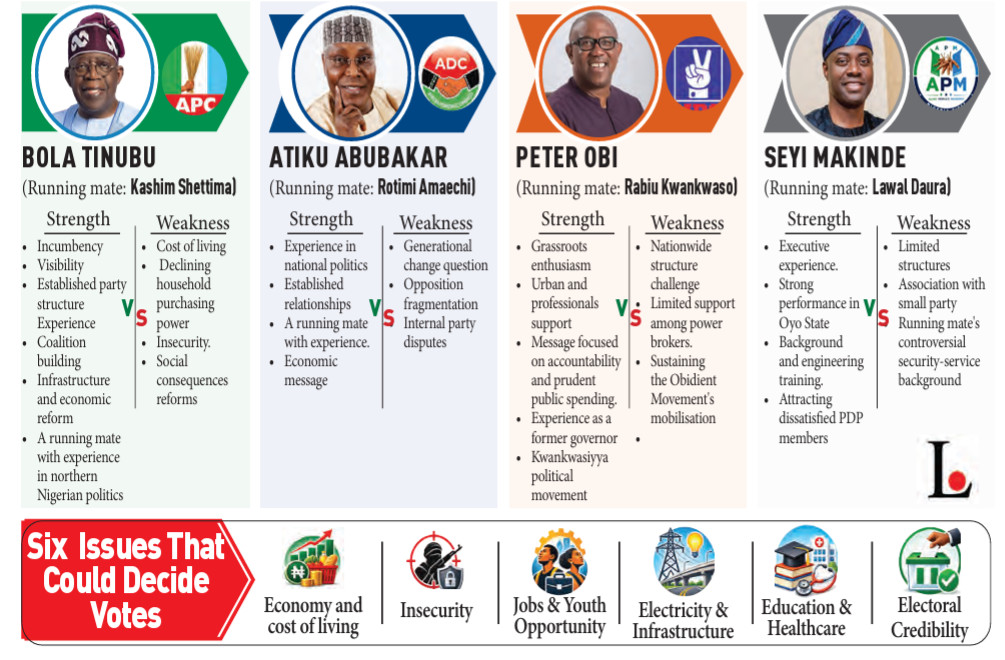
The incumbent president is seeking a second term, with former Borno State governor and senator, Kashim Shettima, as his running mate.
Tinubu enters the race with the advantages of incumbency, an established political organisation and experience in managing the federal government.
His administration has defended its economic reforms, particularly the removal of the petrol subsidy and foreign exchange liberalisation, arguing that they were necessary to address structural weaknesses and improve government revenue.
The APC also boasts an extensive nationwide political structure, strengthened by defections and alliances across several states.
Strengths:
Incumbency and nationwide visibility.
An established political structure across the country.
Experience in political organisation and coalition-building.
Ability to campaign on ongoing infrastructure and economic reforms.
A running mate with considerable experience in northern Nigerian politics.
Weaknesses:
Public dissatisfaction over the cost of living and declining household purchasing power.
Persistent insecurity, including banditry, terrorism and kidnappings.
Criticism of the pace and social consequences of economic reforms.
The challenge of convincing voters that the promised benefits of the reforms are reaching ordinary households.
The central question for Tinubu is whether Nigerians consider the sacrifices associated with his economic policies worthwhile enough to grant him another term.
Atiku Abubakar (ADC)
The former vice president has former Rivers State governor Rotimi Amaechi as his running mate.
Atiku brings decades of political experience to the contest. Having served as vice president between 1999 and 2007 and contested several presidential elections, he has established political networks across the country.
His campaign focuses on economic restructuring, production, job creation, institutional reforms and social protection.
His choice of Amaechi also brings additional executive experience and political organisational capacity to the ticket.
Strengths:
Extensive experience in national politics and government.
Established political relationships across the six geopolitical zones.
Familiarity with presidential campaigns and national issues.
A running mate with executive and ministerial experience.
An economic agenda centred on production, industrialisation and institutional reforms.
Weaknesses:
His repeated presidential bids raise questions about generational change in Nigerian politics.
Opposition fragmentation could undermine his electoral prospects.
Amaechi’s political influence in Rivers State faces challenges from competing interests.
Legal challenge
The party has announced plans to appeal the judgment, making the legal battle a potentially decisive factor in determining its participation in the election.
The development has introduced considerable uncertainty into Atiku’s campaign at a critical stage of the electoral process.
Peter Obi (NDC)
The former Anambra State governor and 2023 Labour Party presidential candidate has former Kano State Governor Rabiu Musa Kwankwaso as his running mate.
Obi remains a significant figure in the opposition following his strong performance in the 2023 presidential election. His appeal is particularly visible among young Nigerians, professionals, urban voters and supporters of the Obidient Movement.
His campaign is built around accountability, fiscal discipline, production, investment, education, healthcare and improved governance.
His partnership with Kwankwaso offers an opportunity to combine his support base with the latter’s political network in Kano and other parts of northern Nigeria.
Strengths:
Strong grassroots enthusiasm among sections of the youth population.
Significant recognition among urban voters and professionals.
A political message centred on accountability and prudent public spending.
Experience as a former governor.
Kwankwaso’s established Kwankwasiyya movement and northern political connections.
Weaknesses:
The challenge of translating popular support into a strong nationwide political structure.
Limited support among some established political power brokers.
The need to expand beyond his traditional South-East support base.
Questions about sustaining the Obidient Movement’s mobilisation and converting enthusiasm into votes.
Kwankwaso’s influence in Kano has faced challenges from defections and changing political alliances.
The Obi-Kwankwaso partnership represents a significant political realignment. However, whether it can translate regional support into a cohesive nationwide campaign remains a major question.
Seyi Makinde (APM)
The Oyo State governor, who is serving his second term, has former Director-General of the Department of State Services, Lawal Daura, as his running mate.
Although this is his first presidential contest, Makinde enjoys the backing of experienced politicians from the PDP, a former ruling party at the centre.
Strengths:
Demonstrable executive experience.
Strong political base in Oyo State and considerable influence in the Southwest.
Business background and engineering training.
Potential to present himself as a pragmatic administrator rather than a career politician.
Ability to attract dissatisfied PDP and opposition politicians.
Weaknesses:
Limited political structures outside the Southwest.
His departure from the PDP and move to the APM could complicate coalition-building.
Association with a relatively small party presents a major electoral disadvantage.
His running mate’s controversial security-service background could attract criticism.
Assessment: Makinde has demonstrable executive capacity, but his biggest challenge is translating state-level popularity into nationwide electoral strength.
Adewole Adebayo (SDP)
Adebayo is making a second attempt at the presidency, with veteran politician Dr Usman Bugage as his running mate.
He has demonstrated political tenacity and intellectual confidence in his campaigns, appealing to some progressive-minded voters.
Strengths:
Articulate, intellectually confident and comfortable discussing national issues.
Legal, business and international experience.
A clear ideological and policy-oriented political identity.
Experience contesting the 2023 presidential election, giving him some national recognition.
Potential appeal among educated voters seeking an alternative to the established political class.
Weaknesses:
Limited grassroots electoral machinery.
No record of winning a major executive or legislative election.
Modest performance in the 2023 presidential election.
Needs stronger political alliances and wider recognition beyond elite and media circles.
Assessment: Adebayo is a credible candidate in terms of ideas and communication, but needs a much stronger political organisation to become electorally competitive.
Omoyele Sowore (AAC)
Sowore is the founder of the African Action Congress (AAC), established in 2018. Having contested the presidency in 2019 and 2023, he brings campaign experience to the race.
His radical politics and activism have earned him considerable recognition among politically conscious young Nigerians.
Strengths:
READ ALSO:
- 19 Kidnap Victims Regain Freedom After 22 Days In Zamfara
- 2027: APC, Opposition Clash Over Tinubu/Shettima’s Chances in Borno
- INEC Under Fire Over Cleaned Voters’ Register Ahead Of 2027 Polls
Strong name recognition, particularly among politically conscious young Nigerians.
Established reputation as an anti-corruption and anti-establishment activist.
Strong media presence and communication skills.
Consistent political messaging and an identifiable ideological position.
Ability to mobilise sections of the youth population frustrated with conventional politics.
Weaknesses:
His radical political image could make it difficult to attract conservative voters and established political interests.
Has struggled to translate activism into substantial votes in previous presidential elections.
Limited access to the financial and grassroots networks available to major parties.
Needs to demonstrate broader coalition-building and governing capacity.
Assessment: Sowore remains a powerful opposition voice and could influence the political debate. However, activism and presidential electability are two different things.
Gbenga Olawepo-Hashim (Accord)
An experienced politician and businessman, Olawepo-Hashim is also an established political mobiliser. Having contested the presidency in 2019, he is no stranger to the race.
His experience in party politics and political negotiations gives him a network that could prove useful in the contest.
Strengths:
Extensive political experience dating back to the pro-democracy movement.
Business and international exposure.
Familiarity with political negotiations and party organisation.
Potential appeal to moderate opposition politicians and business interests.
Experience working across different political platforms.
Weaknesses:
Relatively low national name recognition among ordinary voters.
Has not built a substantial nationwide electoral constituency.
Accord lacks the political machinery of the major parties.
His candidacy has faced internal party disputes and litigation.
Assessment: Olawepo-Hashim could be more influential behind the scenes than his public profile suggests. His greatest opportunity may lie in becoming a consensus candidate or coalition negotiator.
Donald Duke (PRP)
The former Cross River State governor is also not new to presidential politics. Regarded as a bridge between the elite and middle class, Duke brings administrative experience and an established public profile to the contest.
Strengths:
Experience as a two-term governor.
Strong communication skills, international exposure and a sophisticated public image.
His tenure in Cross River State was associated with tourism development and Carnival Calabar.
Potential appeal among middle-class voters seeking a polished alternative.
Experience in national presidential politics.
Weaknesses:
Has been away from the centre of Nigerian politics for a considerable period.
His 2019 presidential performance was weak.
Tinapa’s disappointing commercial performance remains a potential vulnerability.
PRP has limited nationwide electoral infrastructure.
Needs to reconnect with younger voters.
Assessment: Duke has considerable public appeal, but must overcome the perception that he represents an older political generation without a sufficiently powerful electoral machine.
Sandy Onor (PDP)
An academic and politician, Onor is the presidential candidate of Nigeria’s former ruling party at the centre.
Strengths:
A professor and accomplished academic.
Experience in local government administration, state government and the Senate.
Strong understanding of legislative processes and public administration.
Potential appeal among intellectuals and voters interested in institutional reforms.
The PDP’s historical grassroots network offers a wider platform than some smaller parties.
Weaknesses:
Limited national name recognition.
Lost the 2023 Cross River governorship election.
His political strength is concentrated in Cross River and parts of the South-South.
The PDP’s internal divisions are a serious handicap.
His emergence from the Wike-aligned PDP faction raises questions about the party’s national legitimacy and unity.
Assessment: Onor is intellectually capable and politically experienced, but his national electoral prospects remain constrained unless the PDP resolves its internal crisis.
Other contenders
Other candidates in the race include Rufai Adekunle Omo-Aje of the Action Alliance; Aliyu Abbas-Bin of the Action Democratic Party; Kabiru Yusuf of the Allied Peoples Party; and Sunday Adenuga of the Boot Party.
Issues Likely to Determine the Election
Beyond personalities and party affiliations, the 2027 presidential election will largely revolve around issues that directly affect the daily lives of Nigerians.
These include:
Economy and cost of living: The impact of economic reforms on household incomes, food prices and purchasing power.
Insecurity: Persistent terrorism, banditry, kidnapping and other security challenges.
Employment and opportunities for young people: Unemployment, job creation and economic opportunities for the growing youth population.
Electricity and infrastructure: Reliable power supply, transportation and other essential infrastructure.
Education and healthcare: Access, affordability and the quality of public services.
Credibility of the electoral process: INEC’s preparedness, electoral transparency and public confidence in the outcome.
There are also ongoing efforts to unite opposition parties behind a single candidate. Whether the proposed coalition will materialise and, if it does, whether it will have sufficient electoral strength to unseat the ruling party remain to be seen.
We Are Confident of Victory – APC
The All Progressives Congress (APC) Presidential Campaign Council says it is approaching the 2027 general election with confidence, citing the achievements of President Bola Ahmed Tinubu’s administration, its nationwide political structures and growing public engagement with its programmes and policies.
Alake said that since assuming office in May 2023, Tinubu had undertaken bold economic reforms and initiated development programmes aimed at addressing longstanding structural challenges, strengthening the economy and creating opportunities for sustainable growth.
“The APC remains committed to demonstrating how these reforms are translating into tangible benefits for Nigerians,” he said.
He dismissed attempts to portray isolated incidents of destruction of campaign materials as evidence of widespread rejection of the APC.
“Nigeria remains a politically diverse region, and the actions of a few individuals cannot reasonably be presented as reflecting the views of millions of citizens,” he said.
On Saturday’s presidential rally in Jos, Plateau State, Alake described the event as a major political outing, with thousands of enthusiastic APC supporters attending to welcome the president.
“The APC rejects attempts to misrepresent the rally through unverified allegations that the President was booed by the crowd. Such claims must be supported by credible evidence and assessed against the full context of events, rather than selective footage or politically motivated interpretations.
“The party maintains that the substantial turnout in Jos demonstrated the strength of its mobilisation in the North-Central region, while recognising that attendance at a political rally should not be confused with an electoral verdict.
“As the elections draw closer, the APC will continue to engage Nigerians across all regions, communicate its achievements and plans, and promote peaceful, issue-based political competition.
“The party remains confident in its capacity to earn the trust of Nigerians, recognising that the ultimate decision rests with them,” he added.
We’re Prepared, Strong To Defeat APC In 2027 – NDC
Sixty days to the January 16, 2027 election, the Nigeria Democratic Congress (NDC) says it is prepared and strong enough to defeat the ruling APC.
He said the violence allegedly perpetrated against the NDC had strengthened its resolve to rescue Nigeria from the APC, which he accused of steering the country towards perdition.
“We are happy with our performance despite all the barricades erected on our path by the ruling APC. We have covered more states than any other political party. We have done more town Hall meetings than anyone,” he said.
On whether an opposition coalition was necessary and could still work ahead of the election, Director said the party remained open to the idea but was confident of winning independently.
“We don’t discount anything, as we believe that a United opposition can easily defeat the APC. However, we in the NDC are prepared and strong enough to defeat the APC. We shall defeat them.
“If anything, the violence perpetrated against us has strengthened our resolve on the need to rescue Nigeria from the hands of the APC that has steered the country on the path to perdition,” he said.
We Will Wrestle Power From Ruling Party – APM
The All Progressives Movement (APM) says its presidential candidate will emerge as the consensus opposition candidate and defeat the ruling APC.
“We are hopeful towards winning the election as the consensus candidate for the opposition. Very, very essential, from the recent interview with APM presidential candidate, Engr Seyi Makinde, we are in talks with the main opposition parties, particularly ADC and NDC. No doubt we will wrestle power from the APC as they are already jittery,” he said.

