

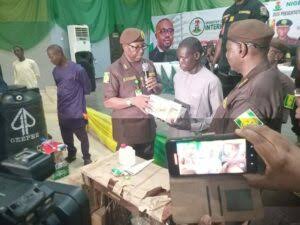
The Nigerian Correctional Service (NCoS) has warned 33 former inmates not to sell or misuse the vocational equipment provided to help them rebuild their lives, start businesses and become financially independent after incarceration.
The Controller-General of the NCoS, Sylvester Ndidi Nwakuche, gave the warning during the 2026 presentation of aftercare materials to former inmates in Abuja, where beneficiaries received vocational starter packs to support their reintegration into society.
Nwakuche described the initiative as more than a distribution of vocational equipment, saying it represented a deliberate investment in human dignity, economic empowerment, public safety and the successful reintegration of former inmates.
Addressing the beneficiaries, he said their past mistakes should not determine their future, stressing that every individual, regardless of past circumstances, deserved an opportunity to rise, rebuild and make meaningful contributions to society.
He said: “Today, we gather not merely to distribute vocational starter packs, but to celebrate hope, restore confidence and open new doors of opportunity for almost 31 ex-offenders embarking on a new chapter of their lives.”
“Today is a reminder that a person’s past should not become a determinant for their future, that a mistake need not define a lifetime, and that every individual, regardless of past circumstances, deserves an opportunity to rise, rebuild and make a meaningful contribution to society,” he said.
He explained that the responsibility of the Correctional Service extended beyond keeping offenders away from society to preparing them for successful return to their communities.
According to him, discharged inmates frequently encounter stigma, unemployment, economic hardship and rejection, challenges which, if not adequately addressed, could undermine rehabilitation efforts and increase the risk of reoffending.
He said the aftercare programme was designed to bridge the gap between the vocational and behavioural lessons acquired behind correctional walls and the opportunities available in the wider society.
The starter packs covered various vocational trades, including laundry, barbing, tailoring, fashion design, hairdressing, carpentry, masonry, welding and metal fabrication.
Nwakuche said the beneficiaries had acquired relevant skills during their incarceration and were now being provided with the basic equipment needed to translate their knowledge into productive economic ventures.
“These starter packs represent much more than tools of trade. They are instruments of empowerment. They are symbols of renewed confidence and seeds of economic independence. They represent our belief that today’s offenders can become tomorrow’s entrepreneurs,” he said.
He maintained that empowering discharged inmates was also an investment in public safety, noting that every successfully reintegrated individual, established business and sustained honest livelihood represented another step towards reducing reoffending and building safer communities.
The NCoS boss therefore urged the beneficiaries to deploy the equipment responsibly, embrace discipline and integrity, resist negative influences and remain committed to legitimate businesses.
“The past may be part of your story, but it must never become the title of your future.
READ ALSO:
- 33 Ex-Offenders Accept Aftercare Starter Packs, Say We’ll Use Tools To Overcome Stigma, Rebuild Our Lives
- Ondo Poly Conversion: Educationist Warns Against Abandoning Technical Education
- UKVI Warns Visa Applicants Against 4 Fraud Warning Signs
“Don’t sell these tools; use these tools with diligence, discipline and integrity. Let your skills become your strength, your determination become your driving force, and your success become your testimony,” he charged.
He further challenged governments, private organisations, religious institutions, community leaders, families and individuals to support the reintegration of former inmates by dismantling social stigma and creating opportunities for them to thrive.
Nwakuche commended officers and personnel of the Correctional Service, particularly the relevant directorates responsible for health and welfare, for sustaining the rehabilitation and aftercare initiatives.
He also acknowledged the support of the Minister of Interior, Dr Olubunmi Tunji-Ojo, describing him as a strong pillar in the Service’s efforts to reform inmates and reintegrate them into society.
He called on more organisations and well-meaning Nigerians to invest in aftercare programmes, emphasising that giving former inmates a second chance was also giving society another opportunity to become better.
One of the programme’s beneficiaries, Hajiya Mariam Omeyaza Suleiman, a former inmate of the Suleja Correctional Centre who regained her freedom in November 2025, has turned her rehabilitation experience into an entrepreneurial venture, using her skills to support other former inmates.
In her appreciation message, she said the Correctional Service had provided her with the platform to transform her life from incarceration to entrepreneurship, philanthropy and the empowerment of fellow former inmates.
She said that barely a year after leaving the facility, she had established herself in shoe-making, bag production and public relations, turning the vocational skills she acquired during incarceration into sources of livelihood and opportunities for herself and others.
She said her transformation was particularly evident at the ongoing World Public Relations Forum in Abuja, where she was showcasing crafts and products she and others had learnt to produce while in the correctional facility.
According to her, she mobilised fellow ex-offenders who regained their freedom around the same period, established a business outfit where they collectively produce and market handcrafted products, and created a platform through which they could earn a living and empower themselves.
The initiative, she explained, was informed by her determination not to allow the circumstances of her past to limit her future or prevent other former inmates from rebuilding their lives.
“I didn’t allow the shadows of yesterday to determine my today. My skill became my strength, and I vowed to remain committed to the path of true citizenship.
“Today, I support families, touch lives and further reform inmates. I was involved in reforming fellow inmates while I was at the Suleja facility, and I have continued that commitment even after regaining my freedom.
“God is using me to give other fellow inmates a second chance to become productive and law-abiding citizens,” she said.

