

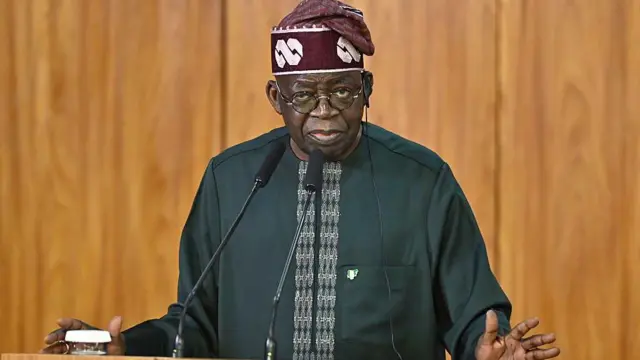
President Bola Tinubu has recalled how the death of former military ruler, General Sani Abacha, in June 1998 prompted him to return to Nigeria from exile, saying he was determined to join the struggle for genuine democracy rather than remain abroad.
Tinubu said the pro-democracy movement was a defining moment in his political journey, recalling that activists paid a heavy price for the restoration of democratic governance. Some lost their lives, others suffered permanent injuries, while many lost their livelihoods and were separated from their families.
The President spoke on Tuesday at the Presidential Villa, Abuja, during the presentation of a new book by veteran journalist and Chairman of The Nation Editorial Board, Sam Omatseye, titled From AD to APC: The Evolution of Nigerian Political Parties and the Exploits of One Man (1998–2015).
He said the struggle against military rule tested the courage and convictions of those involved, but they remained committed to the fight for democracy despite the dangers.
Tinubu, who described Omatseye’s book as a masterpiece, said he had read every page of the publication and experienced much of the political history documented by the author.
He commended the journalist for spending about three years researching the book, conducting interviews and seeking clarification on events and decisions that shaped Nigeria’s political evolution.
According to the President, Omatseye was persistent in asking difficult questions and ensuring that the account reflected historical facts, whether favourable or otherwise.
“A book is not only research and interviews; it is faithfulness to the spirit of that research, and one must not forge the facts, distort them, or leave them out. Whether they flatter or they wound, he must understand contexts and caveats, and above all, he must give them perspective,” Tinubu said.
He described Omatseye as a journalist who combined the eye of a reporter, the patience of a historian and the heart of a poet.
The President recalled meeting Omatseye in Abuja during the June 12 struggle, when the journalist was Managing Editor of the Abuja Bureau of Concord Newspapers.
He said Omatseye interviewed him several times during the period when the Abacha regime clamped down on pro-democracy activists and media organisations.
Tinubu noted that Omatseye later travelled to the United States on a journalism fellowship, around the same period some activists went into exile to continue the struggle.
“Two men scattered by the same storm, each carrying Nigeria in his heart,” he said, recalling their experiences during the period.
Describing the struggle as a defining moment in the country’s political history, Tinubu said those involved refused to abandon the fight despite the personal risks.
“It was a terrible time for all of us in the pro-democracy struggle. It tried our souls. It tested our mettle. But we did not flag. We kept hoisting the flag of our country and the flag of the progressive conscience,” he said.
He added that the struggle came at an enormous human cost.
“Some died along the way. Some were wounded for life. Some lost their livelihoods. Many of us were torn from our loved ones, while our wives, our children and our relatives lived in constant danger,” he stated.
Tinubu said Nigerians owed an enduring debt of gratitude to those who sacrificed their lives, resources and personal comfort to secure the return to democratic governance.
He described the pro-democracy movement as a struggle for future generations and a contest between justice and injustice, insisting that there could be no genuine democracy without the sovereignty of the people.
The President also warned against taking democracy for granted, describing it as an institution that required continuous protection and nurturing.
“Democracy is not an island to be locked away in a drawer. It is a garden we must tend every day, so that it does not merely survive, but grows by leaps and bounds,” he said.
He further recalled that some former military leaders continued to approach political governance with the mentality of military rule after the restoration of civilian administration.
Tinubu said he was determined not to remain in exile following Abacha’s death because he wanted to participate directly in the struggle for genuine democracy.
“I knew this, and I resolved that I would not stay behind when Abacha died. I came home to join the fight for true democracy,” he said.
He subsequently joined the Alliance for Democracy (AD), which sponsored his election as Lagos State governor in 1999.
“The rest, today I say, is history. I’ve enjoyed every bit of success and disappointment,” he added.
Osoba recounts Tinubu’s political manoeuvres
Former Ogun State Governor and chairman of the occasion, Chief Olusegun Osoba, also narrated how Tinubu helped preserve the progressive political movement after the Alliance for Democracy suffered major setbacks in the 2003 general election.
READ ALSO:
- Tinubu Risked Life To Return To Nigeria After Abacha’s Death – Omatseye
- Tinubu Seeks Senate Approval Of Revised 2025 Laws Of Federation
- How Tinubu Secretly Formed 2 Parties After 2003 Election Defeat – Osoba
Osoba disclosed that Tinubu secretly facilitated the formation of two political parties to prevent the destruction of the progressive movement following the defeat that left him as the only governor elected on the AD platform.
He said the move was designed to counter what he described as efforts by the powers that be to destroy the opposition and establish a one-party state.
According to Osoba, Tinubu arranged for the registration of two political parties through Senator Adefuye and Opadokun without the knowledge of the administration of former President Olusegun Obasanjo or the security agencies.
He said the parties completed their registration processes before former Lagos Governor, Bisi Akande, was brought in to preside over their unveiling.
Osoba also recalled Tinubu’s role in mobilising prominent Nigerians to oppose Obasanjo’s third-term agenda, naming former Head of State, General Muhammadu Buhari, and former Inspectors-General of Police Gambo Jimeta and MD Yusuf among those involved.
He further narrated how Tinubu led efforts to bring Buhari into the progressive fold ahead of the 2007 elections, although the arrangement eventually collapsed when Buhari returned to the All Nigeria Peoples Party (ANPP).
Osoba said the group subsequently adopted former Vice-President Atiku Abubakar as its presidential candidate.
He also recalled how Tinubu facilitated negotiations with former anti-corruption chief Nuhu Ribadu, who was then in exile in Maryland, United States, to contest the 2011 presidential election on the platform of the Action Congress of Nigeria (ACN).
The former governor said the political alliances and negotiations eventually culminated in the formation of the All Progressives Congress (APC) ahead of the 2015 general election.
He attributed the party’s eventual victory partly to Tinubu’s decision to support Buhari as its presidential candidate.
“If a man like Buhari must have a second term at that time, what is wrong and what is new that we now say President Tinubu should have a second term?” he asked.
Imo State Governor and Chairman of the Progressive Governors Forum, Hope Uzodimma, reaffirmed the commitment of the forum’s 31 members to Tinubu, saying they would remain with the President despite blackmail and propaganda.
He said the governors would demonstrate their support through activities in their respective states ahead of the 2027 general election.
The Imo governor also urged scholars to document more aspects of Tinubu’s political journey, arguing that one book could not adequately capture his political engagements and contributions.
Kaduna State Governor, Uba Sani, described the APC as a product of years of democratic struggle and political collaboration, urging Nigerians to preserve its history for generations yet unborn.
Sani, who recalled his own participation in the pro-democracy struggle, said he witnessed the difficult period when Nigerians were detained and intimidated because of their political beliefs.
He stressed that the restoration of democracy was a collective achievement and should not be attributed to one individual.
The governor also commended Tinubu’s administration for approving two universities for Kaduna State and facilitating major infrastructure projects, including one valued at $165 million.
He said the projects, alongside road construction and other critical facilities, demonstrated the Federal Government’s commitment to development and would help address infrastructure gaps in the state.
Governors, NASS, ministers pledge N510m for book
In a major show of support for the publication, the 31 governors under the Progressive Governors Forum pledged N310 million towards the book presentation.
Senate President Godswill Akpabio announced a N100 million contribution on behalf of the National Assembly, while Minister of Information and National Orientation, Mohammed Idris, and Minister of the Federal Capital Territory, Nyesom Wike, pledged N50 million each.
The contributions brought the total announced pledges to N510 million.
Omatseye, an award-winning journalist, author, poet and playwright, is Chairman of the Editorial Board of The Nation newspaper, where his weekly column, In Touch, has run for two decades.
His latest publication traces Nigeria’s political evolution from the return to civilian rule in 1999 to the collapse of the Peoples Democratic Party’s 16-year hold on federal power in 2015.
It examines the political alliances, negotiations, strategic decisions and personalities that shaped the emergence of the APC and its eventual victory in the 2015 presidential election.
Omatseye is also the author of Beating All Odds: Diaries and Essays on How Bola Tinubu Became President, published in 2024.

