

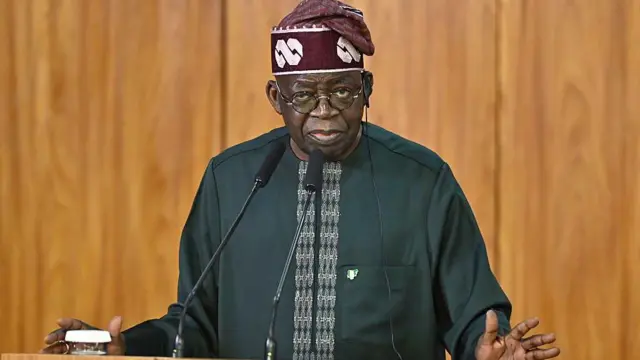
President Bola Tinubu risked his life and political future when he returned to Nigeria shortly after the death of former military ruler, General Sani Abacha, in 1998, despite warnings from fellow pro-democracy activists who preferred to wait and assess the political situation.
Veteran journalist and author, Sam Omatseye, disclosed this in his new book, From AD to APC: The Evolution of Nigerian Political Parties and the Exploits of One Man (1998–2015).
Omatseye’s Book On Tinubu For Launch Tuesday
The account is contained in Chapter 11, pages 185–187, of the book, an excerpt of which was included in the programme of events for its public presentation on Tuesday at the State House Conference Centre, Abuja.
According to Omatseye, Tinubu, who was then in exile, insisted on returning to Nigeria during an emergency meeting of the National Democratic Coalition (NADECO) Abroad in London following Abacha’s sudden death in June 1998.
The meeting was attended by prominent pro-democracy figures, including former Minister of Foreign Affairs, Professor Bolaji Akinyemi; retired General Alani Akinrinade; and Prince Iludoyin.
Although Abacha’s successor, General Abdulsalami Abubakar, had indicated a willingness to engage civil society organisations, members of the group remained suspicious of the military government and were reluctant to return immediately.
Omatseye wrote that most of the exiles preferred to monitor developments before making a decision, given their previous experiences with military rule.
“Most did not want to return just yet. They still wanted to watch the direction of affairs. There was a sense in which caution made sense.
“The military from the times of Babangida had laid ambush against the political society,” the author stated.
However, Tinubu, whom Omatseye described as the face of NADECO Abroad, argued that delaying their return would allow those who supported military rule to take control of the emerging political space.
According to the book, Tinubu warned that the exiles risked wasting the sacrifices they had made in the struggle for democracy if they remained abroad.
“If they delayed and stayed back, they would surrender the country to the apologists of the military.
“They were the members of the five leprous fingers, and they could execute a pirouette and style themselves as democrats.
READ ALSO:
- Nigeria’s Economy Grew Over 4% In 2026 – Tinubu
- Tinubu, Defence Minister to Join 8,000 Engineers to Strategise on Ending Insecurity in Nigeria
- 2027: Tinubu Has Won Christians’ Confidence With Courageous Leadership, 2023 Sentiments Gone – Wike
“It would turn the work of all of them, who had lost lives and resources, into a waste. He did not want that,” the excerpt read.
Omatseye added that Tinubu tried to persuade his colleagues to take the risk of returning home, arguing that Abacha’s death marked the end of an era.
“Tinubu tried to persuade them to take the plunge, and that the death of Abacha meant the decapitation of an era,” he wrote.
Despite his arguments, the other exiles remained hesitant, suggesting that they should first visit Nigeria to assess the situation before committing to a permanent return.
The book, however, revealed that Tinubu had a personal reason for wanting to return home.
Addressing his colleagues, he reportedly said he wanted to see his mother again, using humour to soften his argument and disarm those who opposed an immediate return.
“So, in order to provide an excuse, he brought in a sense of domestic humour to disarm his fellows. He burst out in Yoruba, ‘Mo fe lo ri maami.’ (I want to see my mother.) They were amused but they had no counterpoint to his cheerful alibi,” Omatseye wrote.
Abacha seized power from the Ernest Shonekan-led Interim National Government in November 1993, months after the annulment of the June 12, 1993 presidential election won by Chief MKO Abiola.
Abacha died on June 8, 1998, while Abiola, who remained in detention following the annulment of the election, died on July 7, 1998.
Following Abacha’s death, Abdulsalami initiated a transition programme that culminated in the promulgation of the 1999 Constitution and the restoration of civilian rule on May 29, 1999.
Tinubu, a former senator who contested the 1992 senatorial election on the platform of the Social Democratic Party, returned to Nigeria and contested the Lagos governorship election under the Alliance for Democracy in 1999.
He won the election and served as governor of Lagos State from 1999 to 2007 before eventually becoming President in 2023.
Omatseye is Chairman of the Editorial Board of The Nation newspaper, where his weekly column, In Touch, has run for two decades. He is an award-winning journalist, author, poet and playwright.

