

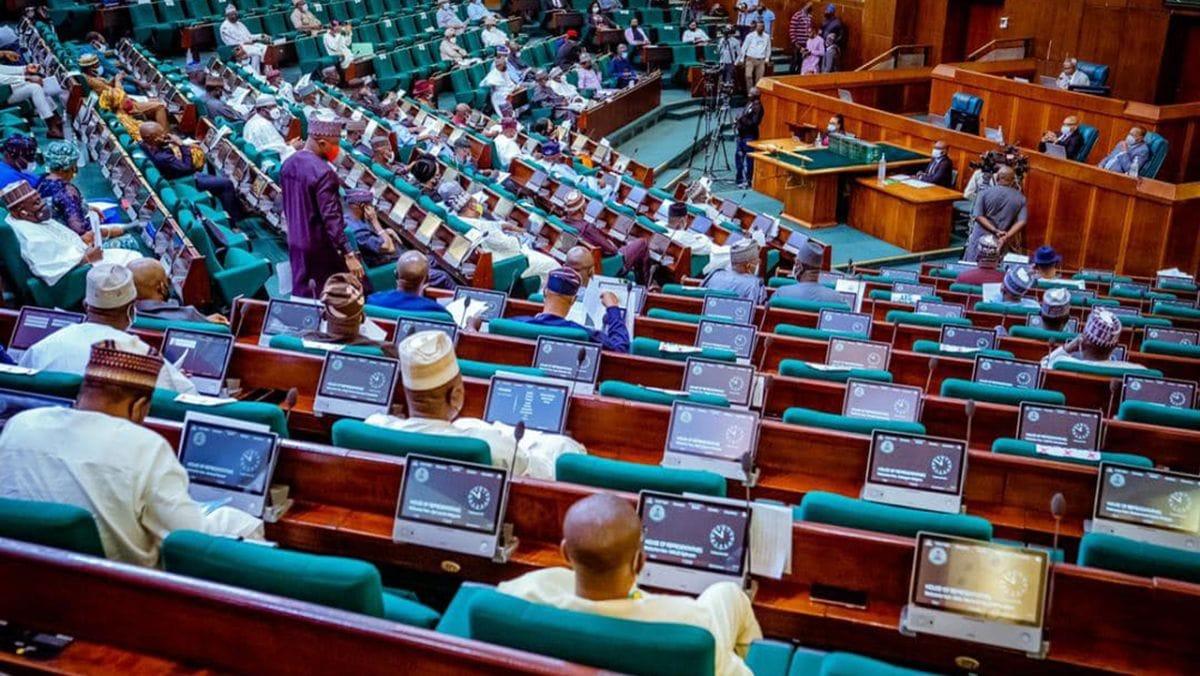
A recent change to the Electoral Act 2026 that stipulates a fine of ₦10 million or two years in prison for anyone who belong to multiple political parties has sparked heated discussion throughout Nigeria’s political arena.
The contentious idea, which was approved by the House of Representatives, has reportedly caused division among members and prompted harsh condemnation from analysts and opposition figures who caution that it could jeopardize constitutional rights and damage the legitimacy of the general elections in 2027.
Just one month has passed since President Bola Tinubu signed the Electoral Act 2026 into law.
The House scaled first and second readings, committee stage, and third reading in a single legislative process before considering and passing the new amendment during plenary.
In Section 77 of the Act, which addresses political party membership, the bill adds three additional clauses.
The plan, which is being supported by House Leader Julius Ihonvbere, aims to make dual party membership illegal and punish violators severely.
According to reports, anyone discovered to be a member of multiple political parties concurrently faces harsh penalties under the law.
The measure said, “A person shall not be registered as a member of more than one political party at the same time.”
Additionally, it states that dual membership “shall be void and the person shall cease to be recognized as a valid member of any political party pending regularization.”
“A person who knowingly registers or maintains membership in more than one political party at the same time commits an offence and is liable on conviction to a fine of ₦10 million or imprisonment for a term of two years or both,” the legislation further criminalizes the act.
Disagreement Among Lawmakers
Members of the House were instantly divided over the proposal; some supported it, while others voiced constitutional and legal objections.
Jonathan Gaza, the chairman of the House Committee on Solid Minerals, backed the amendment, claiming that it would be dishonest and dishonest for someone to be a member of two political parties at the same time.
Abubakar Fulata, the chairman of the House Committee on University Education, cautioned that the plan might be in conflict with the freedom of association guaranteed by Section 40 of the 1999 Constitution (as amended).
“Section 40 of the Federal Republic of Nigeria’s Constitution, as amended, which guarantees the freedom of association at any time, appears to be violated by this proposed amendment,” he stated.
“I believe we should suggest that you be restricted to just one party rather than being denied membership in two. It is against his rights to be prevented from freely associating with all political parties.
Deputy Speaker Benjamin Kalu, who presided over the meeting, insisted that dual party membership amounts to “fraudulent misrepresentation” while defending the bill’s objective.
Instead of enrolling on several platforms, he argued that people should support political parties that accord with their ideological views.
Political analysts claim that the modification raises new questions about whether the federal government, led by the All Progressives Congress (APC), is prepared to guarantee fair competition before the 2027 elections, according to Daily Post.
They caution that any perceived restriction could have the opposite impact, arguing that a fair and competitive political atmosphere is still a necessary requirement for free, fair, and credible elections.
The proposal is rejected by the opposition.
The amendment has been sharply denounced by opposition voices, especially those of the Social Democratic Party (SDP).
Adewole Adebayo, the party’s head and 2023 presidential contender, called the bill an assault on democratic liberties and unconstitutional.
“Punishing someone for joining a political party is unconstitutional. He stated, “You cannot pass legislation that prevents someone from joining three political parties if they so choose.”
While electoral regulations mandate that candidates be sponsored by a single political party during elections, Adebayo contended that membership in several political associations is not prohibited.
The SDP leader went on to charge lawmakers of promoting partisan agendas over democratic ideals.
“They are enacting laws for a single individual. “What they are doing is legislative lynching,” he claimed, claiming that the action is intended to protect the APC and President Tinubu’s administration from internal unrest.
Experts Connect Bill to Defection Fear
Maarcellus Onah, a public affairs expert and lawyer, connected the modification to the ruling party’s mounting worries about potential defections.
He maintained that political realignments might be brought on by deteriorating economic conditions, instability, and a decline in public trust in government.
Therefore, he stated, “the proposed legislation is intended to prevent politicians within the ruling party from abandoning it if political conditions worsen.”
Onah also attacked the National Assembly, claiming that it had not fulfilled its constitutional obligation to hold the executive branch responsible.
He declared, “The National Assembly is the enabler of many of the problems we complain about. Instead of rising to that important constitutional role, they simply chose to approve whatever that is sent to them.”
He further claimed that a few lawmakers who supported the plan had previously changed political parties.
The All Progressives Congress (APC), which presently controls more than 30 states and has a majority in both chambers of the National Assembly, has dominated the debate, raising concerns about the necessity of the change.
In response, Adebayo contended that popular support is not always reflected in political dominance.
“The people are not happy with you just because you captured the governors,” he declared.
“The people will have the last word.”

