

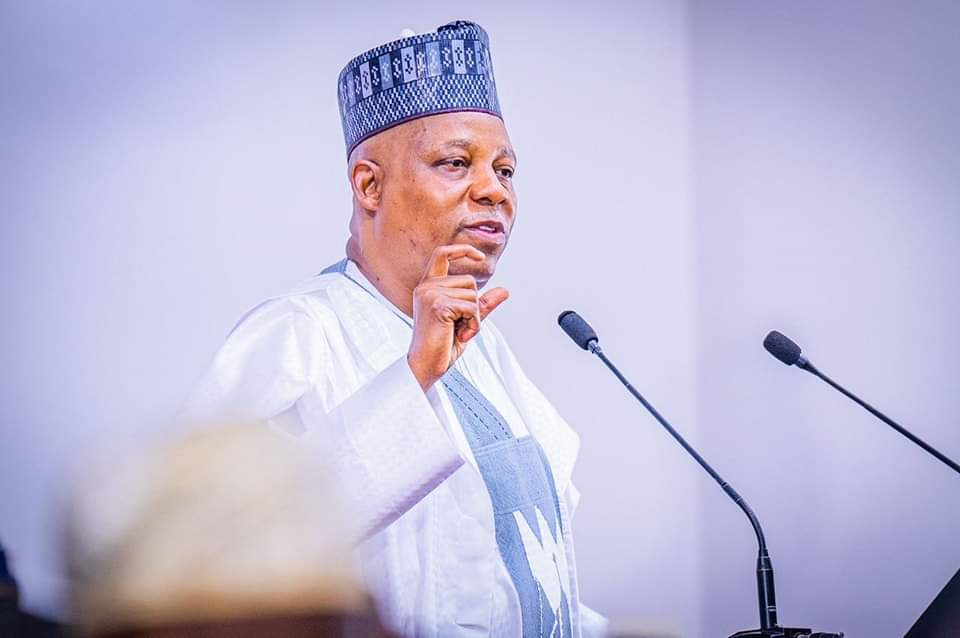
Vice President Kashim Shettima said that President Bola Tinubu’s decision to remove fuel subsidy during his inauguration at the Eagle Square, Abuja on May 29, 2023 was a bold decision he took and not in his official inauguration speech.
It was reported that the removal of fuel subsidy had led to significant changes in petrol prices and the wider cost of living.
But Shettima said Nigeria was now on the right path, insisting that the economic reforms introduced by President Tinubu were beginning to yield positive results.
Kashim Shettima, the Vice Presidential candidate of the APC, made this known at the Nasarawa Economic Summit 2026 where he was the special guest of honour.
He said the administration of President Bola Tinubu had taken hard but necessary steps to stabilize the economy, restore investors’ confidence and correct fundamental distortions that had weakened the country’s financial standing.
Some of the decisions taken by the Presidency were inevitable, the Vice President said, especially given the poor state of the country’s reserves when the administration came into office.
According to Shettima, the removal of fuel subsidy was one of the major reforms carried out by the administration, adding that the decision was necessary as the country could no longer sustain the subsidy regime.
“Some economic decisions taken by the Presidency were almost unavoidable because even our national reserves were paltry and not even enough to import fuel for one month,” he said.
He never ran to town, however, with the story of bankruptcy, for he knew what effect it would have on the economy.
“He made the brave decision. The abolition of the fuel subsidy was not included in his formal speech. He held it close to his heart. “Either he took it there, or he might never take it again.”
The Vice President said the administration’s reforms had begun to build confidence in the Nigerian economy, adding that investors were now reacting positively to the government’s direction.
He said that the country’s gross external reserves had shown signs of recovery while the capital market had also recorded strong gains.
And now, our gross external reserves, that was above $46 billion in 2025, have been recovering.” Shettima said,
“Confidence is coming back to the marketplace. Those who invested in the capital market one year ago are worth three times their investments.
“I know the stock market… what was the price of Zenith, GT banks last year… ₦40-₦50. The stock prices are now N130. That shows that the economy is working and booming. Investors are starting to view Nigeria as a country that is ready to put itself right.
“A country that can make hard choices in hard times. “Capital goes where it is credible, stable and in a direction.”
He said the reforms had sent a strong signal to investors that Nigeria was ready to take corrective steps, even when such decisions were politically difficult.
Tinubu tells investors Nigeria has attained FX stability
Shettima’s comment came after President Tinubu told foreign investors in Paris, France, that Nigeria had achieved stability in the foreign exchange market after the removal of fuel subsidy.
In a statement by his Special Assistant on Social Media, Dada Olusegun, Tinubu told the investors that the removal of subsidy has freed the country from a major economic burden.
“We removed subsidy that was a burden to the whole country and since then we have attained FX stability,” the President was quoted as saying.
Bayo Onanuga, Special Adviser to the President on Information and Strategy, in a separate statement, said Tinubu’s economic reform programme was designed to remove distortions, stabilise macroeconomic indicators and create the foundation for inclusive growth.
Onanuga said the administration had made transparency, fiscal discipline and fast implementation of tough reforms a priority.
The Minister of Finance and Coordinating Minister of the Economy, Taiwo Oyedele was reported to have also ruled out the return of fuel subsidy despite public complaints over the rising cost of living.
Oyedele said subsidy payments created distortions in the economy and maintained that petrol prices would not be controlled by the government.
The market has the capacity to regulate itself without government interference, he said, and the Presidency believes so.
The removal of fuel subsidy has been one of the most controversial policies of the Tinubu administration, with government officials insisting that the decision was necessary to stabilise public finances, while many Nigerians continue to complain about its impact on transport, food prices and household spending.

