

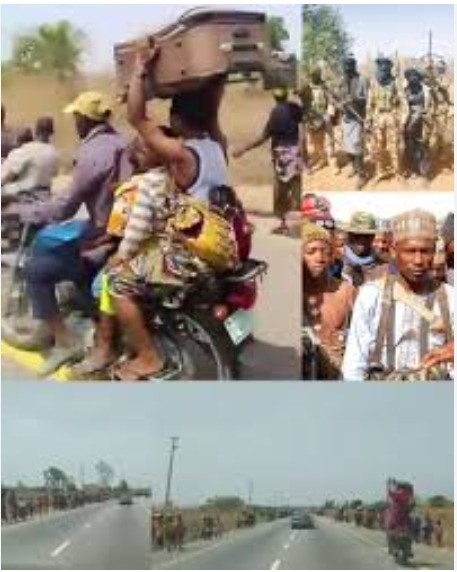
What started as a monstrous terrorist attack on communities in Odeni Gida Ward of Udege Development Area, Nasarawa Local Government Area of Nasarawa State has now morphed into something far more disturbing – the alleged occupation of deserted communities by the same terrorists alleged to have displaced the people.
But survivors say their pain hasn’t ended months after coordinated attacks killed more than 80 people across several communities.
Homes were torched, food stores looted, farms abandoned and properties worth hundreds of millions destroyed.
Beyond the bloodshed and displacement, many residents now fear a concerted effort to reframe what happened, to bury the truth beneath the softer language of “communal clash.”
From the beginning of the violence, many residents and community voices refused to accept attempts to characterize the attacks as routine communal unrest. They said that there was a coordinated armed invasion by alleged heavily armed Fulani attackers who stormed into several communities simultaneously.
However, some government and security officials continued to repeatedly use the “communal clash” narrative, which many residents affected by the violence feel did not reflect the scale and nature of the killings.
For many survivors, it was not only semantics, but also what that classification could eventually mean accountability, justice, compensation, and even ownership of ancestral lands.
Another bitter pill to swallow was the report of a recent visit to the affected areas by the Special Assistant on Community Engagement to President Bola Tinubu, Dr. Abiodun Essiet.
Some of the attacked communities remain largely deserted, with displaced villagers not having fully returned home because of fear and insecurity.
Residents say some of the same people named as perpetrators in the attacks now openly graze cattle in those deserted communities, unchallenged.
Many locals believe the development has fed suspicions that the attacks may have been more than simple reprisals.
“The very communities they displaced are now in the grip of the attackers.
“That tells you this was never just a fight. “It was a conquest,” bewailed a resident.
Online videos and photographs appear to bear out the scale of the displacement, showing villagers, including women and children, running with loads balanced on their heads as they fled for safety in neighboring settlements.
The continued isolated reports of attack and intimidation, especially on the farmlands, coupled with the perception that the issue is slowly dropping from the public’s consciousness, has further added to residents’ frustration.
Some in the community say local leaders are sabotaging the justice push by participating in reconciliation meetings that critics say too quickly framed the crisis as behind them while victims still are displaced.
At one point, relief materials intended for the affected persons were reportedly shared in a manner that some residents perceived as equating the victims with the alleged attackers, a move that critics say reinforced the “communal clash” narrative they had consistently opposed.
While meetings have since taken place between affected communities and Fulani leaders, residents say little has been heard about whether agreements reached during those engagements were ever implemented or respected.
Meanwhile, reports of new attacks on farmers and insecurity in surrounding areas have continued quietly, even as public conversations about the tragedy slowly dwindled.
One of the most vocal critics of the official narrative is Yahaya Kana Ismaila, who says the attacks bear the hallmarks of organised armed violence, not communal conflict.
The affected Eloyi communities have no ethnic ties or territorial identity with the armed men alleged to have carried out the attacks, a major factor that, he argues, weakens claims that the violence was communal in nature.
He said the attackers came in large numbers and with sophisticated weapons, attacked multiple settlements simultaneously, burned homes and forced residents to flee.
The argument over terminology has since become central to the crisis itself. Though authorities and some stakeholders persist in describing the violence as communal unrest, many residents feel such descriptions run the risk of minimising the gravity of what happened.
Reacting, a public affairs commentator, Kana, described the Udege killings as a grim reminder of the rising insecurity in the state. He warned that the continued absence of arrests and accountability could further deepen fear and hopelessness among the residents.
He said that despite reports that more than 70 people lost their lives in the attacks, no suspect had been arrested at the time of his reaction, a development that he said raises serious concerns about justice and protection for vulnerable communities.
The destruction of homes, farm produce, motorcycles and livelihoods built over several years was regrettable, he said, adding that many families affected may never fully recover from the losses inflicted on them.
He further argued that the crisis had created a situation where many rural residents now feel abandoned and helpless, more so in the wake of recurring attacks linked to disputes over kidnapping, grazing and destruction of farmlands.
“The reality is harsh that many innocent people have been traumatised, displaced and uncertain about their future.
“Whole communities have been destroyed, and those who survive are expected to return and rebuild their lives amid fear and insecurity,” he said.
He cautioned that unless there is decisive action by security agencies and government authorities, the perception that armed groups can attack communities without consequences may continue to embolden criminal elements across the state.
As fear spreads in affected communities, residents continue to make desperate appeals for urgent intervention from the Nasarawa State and Federal Governments.
Reacting to renewed tension in parts of Odeni Gida Ward, Abdulwahid Angala Odeni, described the situation as devastating.
“My people are broken and homeless. Radical hoodlums Fulani herdsmen are invading my heritage. Odeni Gida Ward, Udege Development Area, Nasarawa Local Government Area, Nasarawa State.
“We call on the Government of Nasarawa State to come to our aid.
Another resident, Suleiman Otto Wakili, also urged federal authorities to intervene.
“Fulani herdsmen attacked Sabon Gida Angwa Ogiri in Odeni Gida Ward of Nasarawa State. Please, the Federal Government should do something about our situation,” he said.
Trust in local authorities seems to be rapidly waning for many displaced residents.
There are increasing questions over the response of Nasarawa State Government, security agencies and emergency institutions.
There has also been a specific concern expressed about the lack of large-scale humanitarian support, despite early promises that aid would be provided to support displaced persons and to promote safe return to affected communities.
Now, many victims feel the only option left is to take their case directly to the Presidency and call for federal intervention, before more communities are lost forever to fear, displacement and silence.
As displaced families continue to wander between uncertainty and survival, one painful question keeps echoing through Odeni Gida:
So if the people cannot safely go home, who really owns the land now?

