

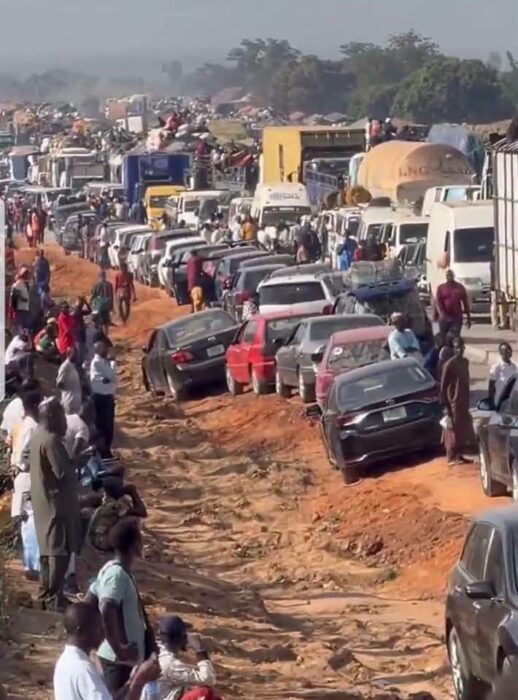
The Federal Road Safety Corps (FRSC) has cleared the Gidan Busa Bridge along the Kaduna-Abuja Expressway following the removal of the last of three crashed articulated trucks responsible for the gridlock that left motorists stranded for two days.
The Kaduna Sector Commander of FRSC, Andrew Longkam disclosed this in an update on Tuesday, saying the final truck was removed after its load was transferred to another vehicle.
The Corps said the bridge was now free of obstruction, although the heavy backlog of vehicles could take a few hours to clear and restore normal traffic flow.
The development followed a prolonged traffic congestion along the Gidan Busa-Katari axis on Monday, November 9, which reportedly left some travellers spending up to eight hours on the highway.
The sector commander said its tow truck was deployed to Gidan Busa Bridge to facilitate the removal of the remaining truck, while personnel of the FRSC, Army and Police were on ground to manage traffic and maintain order.
Longkam appealed to motorists to remain patient, avoid lane hopping and strictly comply with the directives of law enforcement personnel.
The recurring gridlock, however, has raised concerns about the vulnerability of the strategic highway, which links the Federal Capital Territory with Kaduna and other parts of northern Nigeria.
The Abuja-Kaduna-Zaria-Kano highway reconstruction dates back to December 2017, when the Federal Government awarded the original contract, with construction commencing in 2018.
The project subsequently experienced delays and restructuring, with another phase of rehabilitation formally flagged off in October 2024.
Beyond the ongoing road works and diversions, the FRSC has identified motorists’ impatience and disregard for traffic regulations as major factors worsening congestion along the route.
The staff officer, Public Education Department, FRSC Kaduna State Command, Garba Usman, said motorists often create multiple lanes instead of following traffic instructions, thereby blocking themselves and other road users.
READ ALSO:
- Air Peace Offloads Passenger Over Threat to Set Abuja-Bound Aircraft Ablaze
- Tinubu Arrives in Kaduna for APC Campaign Flag-Off
- Abuja One-Chance Robbery: FCT Police Chief Reveals How Officer’s Wife Was Victimised
“Instead of people to hold on for the other traffic to move, people will start taking left, right and centre.
“Nobody wants to follow the traffic law enforcement agencies that are there to control them.
“By the time everybody takes his own way, they end up blocking themselves,” he said.
Usman explained that the ongoing construction and diversions had reduced the available space for traffic movement, making patience and compliance with traffic rules essential.
Meanwhile, some travellers who experienced the Monday gridlock recounted their ordeals, describing the journey as exhausting.
One of the affected travellers, Reuben Buhari, said he spent eight hours travelling to Abuja, expressing concern that tanker and trailer drivers could be forced to spend the night on the highway.
“We spent eight hours before reaching Abuja, and we were lucky to be in a small car,” Buhari said.
He urged Nigerians to learn to obey traffic regulations even when enforcement officers were not watching, stressing that impatience and disorder among road users would continue to worsen traffic congestion.
Another traveller, Grace Boniface, recalled an earlier experience when she left Kaduna at 1pm but arrived in Abuja around 2am, reaching her home at 3am.
Similarly, Isaiah Uba Makoshi said a journey that ordinarily took between 30 and 40 minutes once lasted eight hours because of other road users’ impatience.
The latest incident has renewed calls for improved traffic management, strict enforcement of lane discipline and accelerated completion of the highway rehabilitation to prevent recurring gridlock and reduce the hardship faced by commuters.

